The body of convicted war criminal Ratko Mladić has been returned to Serbia from The Hague, where he died while serving a life sentence for genocide, war crimes and crimes against humanity.
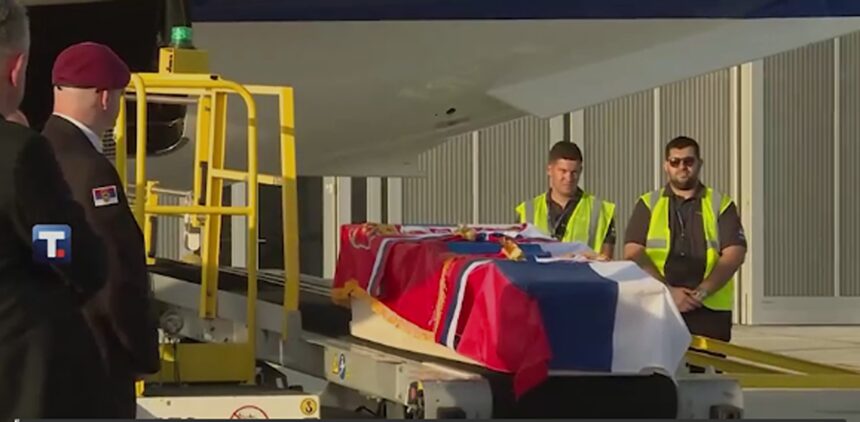
A Serbian government aircraft carrying Mladić’s remains landed at Belgrade’s Nikola Tesla Airport on Thursday afternoon. The coffin was received by members of the Serbian Army and carried from the aircraft by six uniformed soldiers, before being transported to the Military Medical Academy for an autopsy requested by his family.
The coffin was draped in the flags of Serbia and Republika Srpska, adding a highly symbolic military and nationalist dimension to the return of a man convicted by the UN tribunal for some of the worst atrocities committed during the 1992–1995 Bosnian War.
On board the government aircraft were Mladić’s son, Darko Mladić, his granddaughter Anastasija, Serbian Justice Minister Nenad Vujić and two of Mladić’s former wartime comrades.
Mladić died on August 27 at the age of 84 while in the custody of the International Residual Mechanism for Criminal Tribunals in The Hague. He was serving a life sentence after being convicted of genocide in Srebrenica, crimes against humanity and war crimes, with his conviction upheld on appeal.
His return has reignited controversy over Serbia’s treatment of a convicted war criminal.
Serbian authorities had previously announced plans for Mladić to receive state and military honors, prompting strong criticism from European officials and human-rights advocates. The European Union has warned that glorifying convicted war criminals is incompatible with European values and Serbia’s aspirations for EU membership.
The images from Belgrade are already raising difficult questions: how can a country seeking European Union membership present a man convicted of genocide with military symbolism and public honors?
The issue goes far beyond one funeral. It touches directly on Serbia’s unresolved relationship with its wartime past, accountability for the crimes of the 1990s, and its stated commitment to a European future.
The body is now at the Military Medical Academy, while preparations continue for the funeral. Current reports indicate that a commemoration is planned for Saturday, followed by the funeral and burial in Belgrade on Monday.
For the victims and survivors of Srebrenica and the siege of Sarajevo, however, Mladić’s legacy is not one of military glory—it is one of genocide, mass atrocities and devastation.
And the sight of Serbian soldiers carrying his coffin is certain to intensify the debate over whether Serbia is confronting that legacy—or continuing to glorify it.