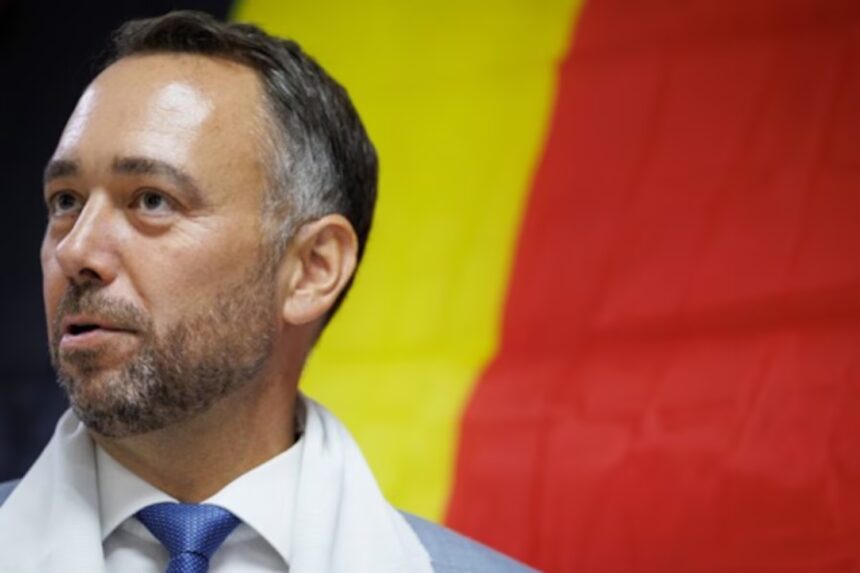
Belgium’s Foreign Minister Maxime Prévot has delivered a blunt message to Serbia over the honours surrounding the funeral of Ratko Mladić: turning a convicted war criminal into an object of honour is shameful and deeply disrespectful to his victims.
Prévot did not mince his words.
Ratko Mladić, the former commander of the Bosnian Serb army, was convicted of genocide, crimes against humanity and war crimes by the UN tribunal for the former Yugoslavia. He became one of the most notorious figures of the Bosnian war, particularly because of his role in the Srebrenica genocide.
“The Butcher of Bosnia” represents some of the darkest atrocities in European history, Prévot said, specifically highlighting Srebrenica.
For Belgium, the issue is not simply how a family chooses to mourn a deceased relative.
It is what a state chooses to honour.
Prévot condemned the treatment of Mladić in the strongest possible terms, calling the honours surrounding his funeral “shameful and disrespectful” to the victims and their families. He also said he had personally conveyed the message to his Serbian counterpart responsible for European affairs.
But Prévot’s warning goes beyond the funeral itself.
He directly connected Serbia’s treatment of Mladić with the country’s European ambitions.
According to the Belgian minister, honouring a man convicted of genocide moves Serbia further away from the EU’s fundamental principles: respect for human dignity, human rights and the fight against impunity.
That makes Mladić’s funeral more than a domestic Serbian affair.
It has become a test of what Serbia is prepared to accept — and what the European Union is prepared to tolerate from a country seeking membership.
The warning comes as European officials are increasingly scrutinising Belgrade’s handling of Mladić’s return.
European Enlargement Commissioner Marta Kos has described the return of Mladić’s remains and what follows as a “very important test” for Serbia’s European path. Ireland’s Minister for European Affairs Thomas Byrne has also said that a state funeral or participation by senior Serbian government officials in commemorating Mladić would be unacceptable.
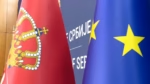
Meanwhile, Mladić’s coffin returned to Serbia aboard a government aircraft, wrapped in the Serbian flag and carried by Serbian soldiers — imagery that has further intensified criticism across Europe.
The contradiction is difficult to ignore.
Serbia says it wants to move toward the European Union.
Yet the return of a man convicted of genocide has been accompanied by symbols of state recognition and public honour.
And European officials are now making clear that these two directions do not easily coexist.
You cannot build a European future by glorifying the darkest chapters of Europe’s past.
For the victims and their families, Mladić is not a symbol of national pride.
He is the man whose forces were responsible for some of the worst atrocities of the Bosnian war — atrocities that an international tribunal found sufficient to convict him of genocide, war crimes and crimes against humanity.
Prévot’s message therefore carries a much broader significance.
Remembering the dead is one thing. Honouring a convicted genocidaire is another.
And Belgium is making clear where it stands.
For Serbia, the question is no longer simply how Ratko Mladić will be buried.
It is whether Belgrade will continue looking backward or finally confront the crimes for which Mladić was convicted and demonstrate that its European ambitions are matched by European values.
The victims deserve dignity. Justice demands accountability. And Europe should not be asked to look away while convicted war criminals are turned into heroes.