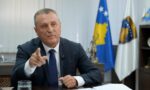
Four years after Kosovo formally applied for European Union membership, its chief EU negotiator Jeton Zulfaj arrived in Dublin with a blunt question for the European Union:
Why is Kosovo still waiting?
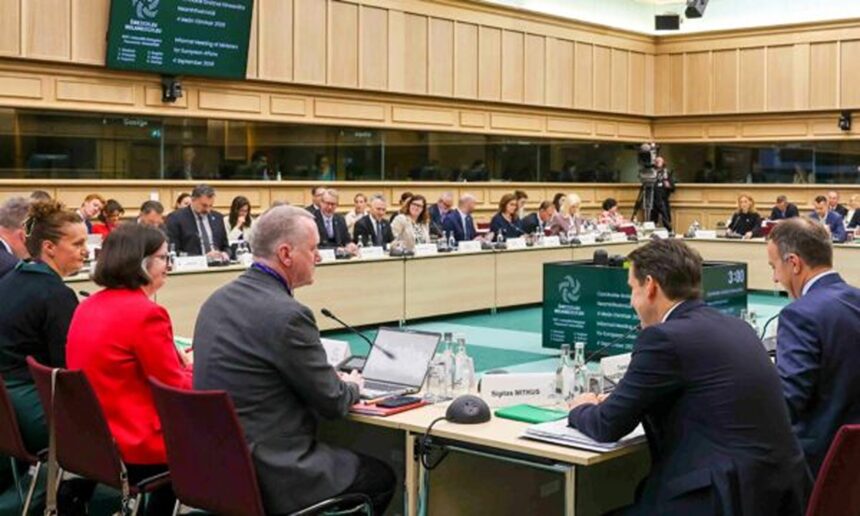
Speaking at the informal meeting of EU ministers for European affairs in Dublin, Zulfaj said Kosovo has a clear priority: advancing its candidate status and opening accession negotiations. He argued that Kosovo has done its part by advancing democratic reforms, strengthening the rule of law and aligning itself fully with the EU’s Common Foreign and Security Policy.
But, according to Zulfaj, the problem is no longer simply what Kosovo must do.
It is whether the EU is prepared to do its part.
“Almost four years have passed since we submitted our application. During all this time, we have not heard anyone in this room call for our application to move forward,” Zulfaj said.
His frustration was unmistakable.
Kosovo has repeatedly been told that it must convince EU member states that it deserves to advance. Zulfaj questioned whether that responsibility should not also belong to the European institutions themselves.
If enlargement is genuinely a merit-based process, why is Kosovo being left waiting without even moving to the next formal step?
Kosovo submitted its application for EU membership on 15 December 2022. It still does not have candidate status.
For Zulfaj, this is not simply a question of diplomatic impatience.
He argues that enlargement itself serves the strategic interests of the European Union. The accession process pushes aspiring countries toward stronger institutions, democratic standards, rule of law and alignment with European foreign and security policy.
And Kosovo, he stressed, is already moving in that direction.
Just days before the Dublin meeting, Zulfaj highlighted Kosovo’s alignment with the EU’s latest Council decisions and foreign-policy declarations, including sanctions against Russia over its war against Ukraine.
His argument was therefore straightforward:
Kosovo is doing its homework. The EU must do its part.
Zulfaj also challenged the idea that Kosovo’s European future should remain hostage to political hesitation inside the Union.
The European Union, he argued, was created as a peace project — one that should not allow hostile actors to gain ground on the continent simply because the Union cannot reach consensus on enlargement.
And then came Ratko Mladić
Zulfaj’s intervention became even more pointed when he referred to the Serbian minister sitting in the same room.
Serbia, he noted, is represented at the European table while the Serbian government has just received the remains of Ratko Mladić with military honours.
Mladić was convicted of genocide, crimes against humanity and war crimes and sentenced to life imprisonment by the International Criminal Tribunal for the former Yugoslavia.
Zulfaj argued that the contrast should not be ignored.
On one side, Kosovo — a country that says it has fully aligned itself with the EU’s foreign and security policy and is demanding movement based on merit.
On the other, Serbia — an EU candidate whose government has been at the centre of controversy over the treatment of a convicted genocidaire.
“For me, this is wrong,” Zulfaj said. “And it will be a stain on our conscience if we say nothing.”
The comparison exposes a difficult question for Brussels.
What does “merit-based enlargement” actually mean if political considerations can keep Kosovo frozen while Serbia continues advancing despite controversies surrounding its approach to war-crimes accountability?
Zulfaj’s message was ultimately directed not only at Serbia, but at the EU itself.
Kosovo does not want a shortcut. It does not want special treatment. It wants the accession process to begin moving according to the same principle Brussels repeatedly promotes: reforms, results and merit.
The EU has long described enlargement as a transformative instrument. Kosovo is now asking the Union to apply that principle in practice.
Because after almost four years of waiting, the question is no longer simply whether Kosovo is ready to move forward.
The question is whether the EU is ready to let it.