U.S. special envoys Steve Witkoff and Jared Kushner are expected to travel to Moscow and Kyiv in the coming days as the Trump administration steps up efforts to broker an end to Russia’s war in Ukraine, while a Russian drone strike has hit the headquarters of Ukraine’s Security Service in central Kyiv.
Ukrainian President Volodymyr Zelenskyy said the American representatives would travel first to Moscow on September 5 and then to Kyiv on September 6. U.S. officials have not immediately confirmed the exact itinerary, but an American official previously told Radio Free Europe that Witkoff and Kushner would visit both capitals.
The Kremlin has also not formally confirmed the visit, although Russian media quoted Kremlin spokesman Dmitry Peskov as saying the two envoys could arrive in Moscow on September 5.
Zelenskyy urged Moscow and Kyiv to halt airstrikes for the duration of the diplomatic meetings, saying Ukraine was prepared to refrain from conducting aerial attacks to ensure the safe movement of the negotiators.
“From our side, there will be no airstrikes, and Russia must also refrain from carrying out air attacks during the time necessary for these negotiations,” Zelenskyy said.
Russian strike hits SBU headquarters
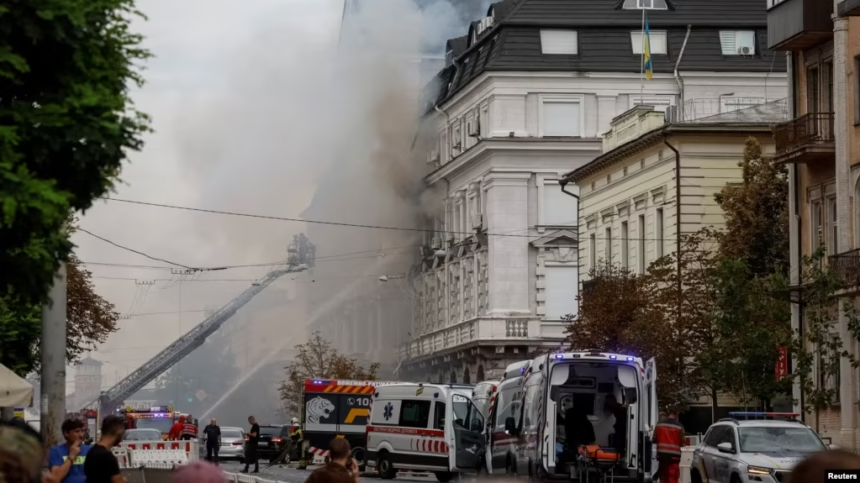
The diplomatic push comes shortly after a Russian drone struck the central headquarters of Ukraine’s Security Service, or SBU, in Kyiv.
Zelenskyy said the drone was directed at the office of acting SBU chief Oleksandr Poklad, although Poklad was not inside the office when the attack occurred.
Kyiv Mayor Vitali Klitschko said several people were injured after a fire broke out at a non-residential building in the Shevchenkivskyi district, where the SBU headquarters are located.
Zelenskyy said he ordered Poklad to prepare an “adequate, visible” response to the attack and, if possible, to mirror the Russian strike.
The SBU has played a central role in Ukraine’s long-range campaign against Russian targets, including strikes against oil infrastructure and vessels linked to Russia’s so-called shadow fleet.
Poklad has headed the agency in an acting capacity since July and has pushed for expanded long-range operations inside Russia, while also overseeing efforts to identify suspected Russian agents within Ukraine’s security services.
Analysts warn of further escalation
The attack has raised concerns among Western security experts that Russia is intensifying its aerial campaign against Kyiv at a particularly sensitive diplomatic moment.
Heather A. Conley, a senior fellow at the American Enterprise Institute and former U.S. State Department official, described the strike as a clear escalation following several days of heavy Russian bombardment.
Tressa Guenov, a former senior Pentagon and State Department official, said the strike demonstrated Moscow’s willingness to target increasingly sensitive Ukrainian institutions despite the uncertain diplomatic situation.
She also argued that the attack highlighted Ukraine’s continuing need for additional air-defense interceptors from Western allies.
The strike follows a separate confrontation between Ukraine’s two main security agencies. On September 2, personnel from the SBU and the Main Directorate of Intelligence, known as HUR, exchanged fire on the streets of Kyiv.
Zelenskyy subsequently dismissed deputy officials from both agencies and said they must be held accountable, describing the incident as “shameful.”
U.S. diplomatic push
The planned visits by Witkoff and Kushner represent a new phase in Washington’s efforts to bring Russia and Ukraine toward an agreement.
CIA Director John Ratcliffe also traveled to Moscow on August 25, where he met with senior Russian intelligence and security officials. The CIA did not disclose details of the discussions, while the Kremlin said Ratcliffe did not meet President Vladimir Putin.
According to reports, Ratcliffe warned Russian officials against attacking or testing NATO’s resolve, particularly regarding the Baltic states of Estonia, Latvia and Lithuania.
The latest diplomatic initiative comes as Washington faces uncertainty over how much additional pressure it is prepared to place on Moscow, including the possible expansion of sanctions and further support for Ukraine’s air-defense capabilities.
For Kyiv, the timing presents a stark contradiction: American negotiators are preparing to engage directly with Russian officials, while Russian drones are striking one of Ukraine’s most sensitive security institutions.
Zelenskyy’s call for a temporary halt to air attacks suggests Kyiv wants to create space for diplomacy. But his simultaneous order for a possible reciprocal strike against Russia underscores how little the military confrontation has eased despite renewed diplomatic activity.