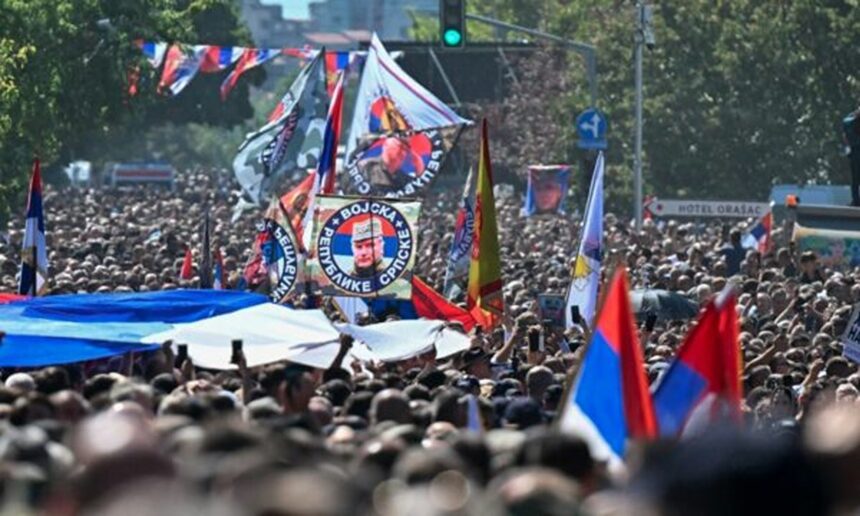
Yesterday, Belgrade hosted the funeral of Ratko Mladić, a convicted war criminal sentenced to life imprisonment for genocide and war crimes in Bosnia and Herzegovina.
And the guest list was revealing.
Senior Serbian officials, representatives of the Republika Srpska leadership, Serbian Orthodox Church figures, war veterans and far-right groups all gathered to accompany Mladić to his final resting place.
The religious ceremony was led by Serbian Orthodox Patriarch Porfirije. Among those present was also Russia’s ambassador to Serbia, Aleksandar Bocan-Harčenko.
Danilo Vučić, the son of Serbian President Aleksandar Vučić, was also there. The president had previously said he would not attend because of a scheduled meeting with the president of Uzbekistan.
Six Serbian government ministers at the funeral
According to photographs and footage published from the funeral, six Serbian government ministers attended — roughly one-fifth of the cabinet.
They included Justice Minister Nenad Vujić, Defense Minister Bratislav Gašić, Labor Minister Milica Đurđević-Stamenkovski, Culture Minister Nikola Selaković and Minister for Public Investment Darko Glišić. Minister without portfolio Nenad Popović was also present.
Aleksandar Vulin, a former Serbian government minister and member of the Republika Srpska Senate, also attended.
So did Miloš Jovanović, an MP and leader of the New Democratic Party of Serbia (Novi DSS).
Republika Srpska leadership travels to Belgrade
A significant part of the political leadership of Republika Srpska also made the trip to Belgrade.
Among those present were Željka Cvijanović, member of the Presidency of Bosnia and Herzegovina; SNSD leader Milorad Dodik; Republika Srpska President Siniša Karan; its Prime Minister Savo Minić; and Banja Luka Mayor Draško Stanivuković.
Representatives of pro-Serbian parties from Montenegro also attended, including figures from Milan Knežević’s Democratic People’s Party and Vladislav Dajković’s Slobodna Crna Gora.
Patriarch Porfirije: Mladić’s name will remain in memory
The religious ceremony was led by Patriarch Porfirije, accompanied by other bishops.
Mladić’s coffin was covered with the flags of Serbia and Republika Srpska.
During the ceremony, Porfirije said that the name of the man convicted by the Hague Tribunal would remain present in the memory and prayers of a large part of the Serbian and Orthodox population.
Also present was Veselin Šljivančanin, who was convicted by the Hague Tribunal and served 10 years in prison for crimes committed at Ovčara in Croatia.
From the ‘Red Berets’ to the ‘Night Wolves’
War veterans from the Army of Republika Srpska and various veterans’ organizations from Serbia also played a visible role at the ceremony.
Among those present were members of special police units, the “Heroes of Košare” association and veterans of the Red Berets.
And outside the church, members of the Russian motorcycle club Night Wolves were also spotted.
The group is under European Union and U.S. sanctions because of its close ties to Vladimir Putin and its support for Russia’s invasion of Ukraine.
Far-right figures were also present, including Miša Vacić, leader of Srpska Desnica, and Goran Davidović Firer, leader of the banned neo-Nazi organization Nacionalni Stroj.
What was Ratko Mladić convicted of?
Ratko Mladić was sentenced to life imprisonment by the Hague Tribunal for genocide in Srebrenica, persecution and forcible displacement of civilians, terrorizing civilians during the siege of Sarajevo, and taking UN peacekeepers hostage.
In 2021, he was found guilty on 10 of the 11 counts against him for war crimes and crimes against humanity.
The Hague Tribunal found Mladić responsible for the genocide of around 8,000 Bosniak men and boys in Srebrenica in 1995.
Yet decades later, the man convicted for those crimes was not surrounded only by mourners.
He was surrounded by ministers, politicians, religious leaders, veterans, far-right extremists and Russia-linked groups.
That is what makes this funeral so revealing.
Because when a convicted genocidaire becomes the center of such a gathering — and senior officials are willing to stand in the crowd — the question is no longer simply how Serbia remembers its past.
The question is what kind of past Serbia is still willing to glorify.