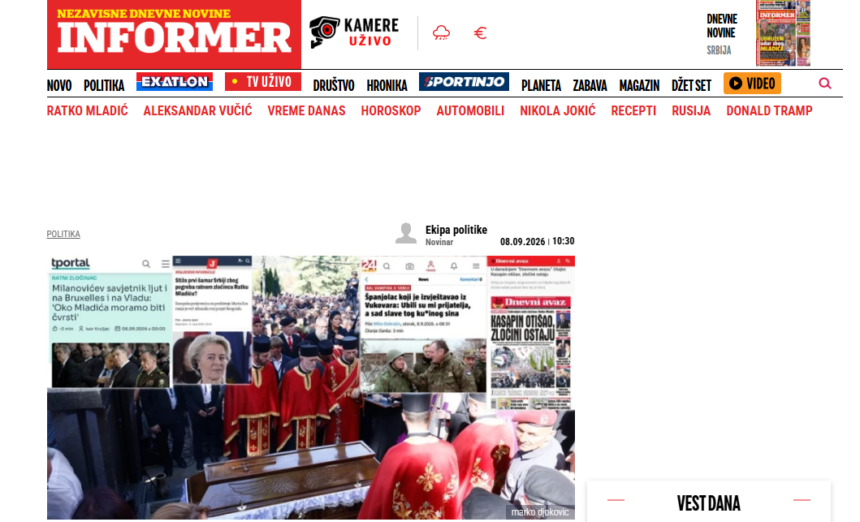
Serbian pro-government tabloid Informer has portrayed growing criticism of Ratko Mladić’s funeral as part of what it described as a coordinated regional campaign against Serbia, accusing media and political figures in Croatia, Bosnia and Herzegovina, Montenegro and Kosovo of seeking to pressure the European Union into punishing Belgrade.
In an article published after Mladić’s burial in Belgrade, Informer described the criticism as a “synchronized regional machine” and accused what it called “Serbophobes” of launching a new campaign against Serbia.
The tabloid particularly criticized Croatian Prime Minister Andrej Plenković, former Croatian Prime Minister Jadranka Kosor, and media outlets in Croatia over their reactions to the funeral and calls for a stronger response from Brussels.
Informer also targeted criticism coming from Bosnia and Herzegovina, Montenegro and Kosovo, accusing media outlets in Sarajevo, Podgorica and Prishtina of repeating what it characterized as an “anti-Serbian” narrative.
The article argued that critics were deliberately ignoring what Informer described as key facts, including that Mladić’s funeral was a private family ceremony and that Serbian President Aleksandar Vučić did not attend.
The tabloid also emphasized that the European Commission had already issued its own assessment of the funeral, while accusing regional critics of attempting to create a false image of Serbia as being “on the wrong side of history” in order to pressure Brussels into taking action against Belgrade.
Informer further claimed that criticism of the funeral was part of a broader pattern in which Serbia is allegedly subjected to political pressure and demands for concessions whenever disputes arise over its regional policies.
The article then shifted its focus to Croatia and Bosnia and Herzegovina, accusing their political representatives of hypocrisy by pointing to their treatment of figures associated with crimes against Serbs during the wars of the 1990s.
It specifically rejected calls for European Commission President Ursula von der Leyen to avoid visiting Belgrade or for the EU to impose consequences on Serbia, describing such proposals as an attempt to turn a private funeral into a political instrument.
The tabloid concluded by portraying the criticism as evidence of a new regional alignment against Serbia and questioned whether Brussels would accept what it called the “dictate” of Serbia’s regional critics.
The article reflects a broader narrative in Serbian pro-government media that presents international and regional criticism of Belgrade through the framework of external pressure on Serbia, while emphasizing Serbia’s sovereignty and portraying criticism over the commemoration of convicted war criminals as politically motivated.
The debate comes after Mladić, who was convicted by the International Criminal Tribunal for the former Yugoslavia of genocide, crimes against humanity and war crimes, was buried in Belgrade with the participation of Serbian officials, political figures and supporters. His funeral has triggered renewed criticism from EU officials and politicians across the region over the public glorification of a convicted war criminal.