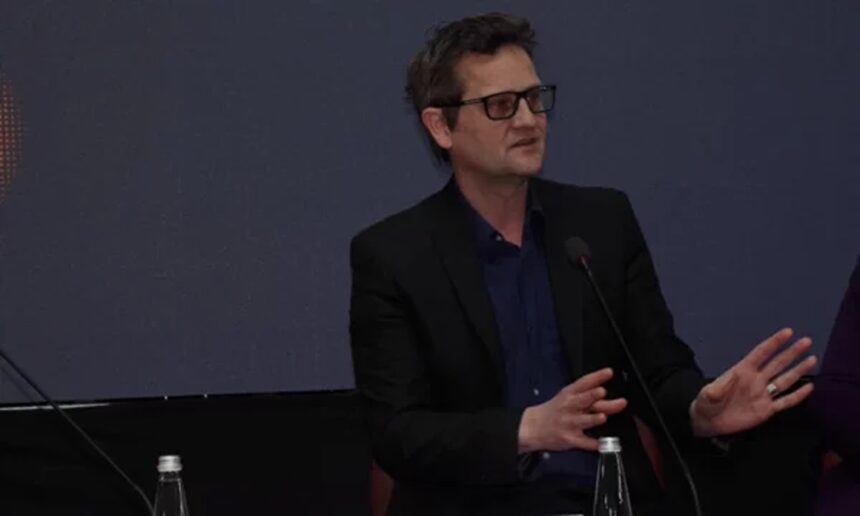
Aidan Hehir, Professor of International Relations at the University of Westminster, has sharply criticized the Kosovo Specialist Chambers and the way, in his view, former leaders of the Kosovo Liberation Army (KLA) are being treated in The Hague.
Speaking to KTV’s “Interaktiv,” Hehir said Hashim Thaçi cannot be portrayed as an ordinary KLA member, pointing to the senior position he held within the organization and his subsequent roles as prime minister, foreign minister and president of Kosovo.
“You know, Hashim Thaçi was not simply a low-ranking soldier in the KLA. He held a very senior position in the organization. He later became prime minister, foreign minister and president of Kosovo. Whether you like it or not, he is closely connected to Kosovo’s identity,” Hehir said.
Hehir argued that the four former KLA leaders on trial have significant reputations in Kosovo and are regarded by many as figures associated with the country’s liberation during the 1998–1999 war.
He compared Kosovo’s experience with Ireland’s history, saying that Irish people would not have accepted their own fighters being judged by foreigners for their participation in a struggle against oppression.
He also referred to the history of other countries, including the United States, which was founded following an armed rebellion against British rule.
“Many countries around the world were created by rebel figures who fought heroically against oppression and who did not always do so in the most moral or cleanest way,” Hehir said.
Hehir described it as a “deep shame” that Serbian intelligence material has been used in proceedings against former KLA leaders. He characterized the Specialist Chambers as a foreign court that, in his view, was imposed on Kosovo.
“But for a foreign court — and that is what this court represents, a foreign court imposed on Kosovo — to convict them and to use Serbian intelligence material during the trials of these figures, that is a deep shame,” he said.
Hehir also argued that the court was established to satisfy Serbia, a claim he linked to what he described as the international community’s broader approach toward Belgrade.
He said he supports the principle of justice being served, but questioned whether the Specialist Chambers was the appropriate mechanism.
“I completely agree that justice should be served, but not through this court,” Hehir said.
Hehir further criticized what he sees as the disproportionate international focus on alleged crimes committed by KLA members, arguing that greater attention should be paid to crimes committed by Serbian forces during the Kosovo war.
He pointed to killings, rape, torture, destruction of homes, schools and mosques, as well as the continued issue of missing persons.
“The fact that we are sitting here today and that tomorrow we will be talking about what the KLA did — when we should be talking about all the rapes, all the people who are still missing, all the torture, killings and destruction of mosques, schools and homes that Serbia committed in 1998 and 1999 — is concerning,” Hehir said.
According to Hehir, the fate of those missing from the Kosovo war should have been placed at the center of negotiations between Kosovo and Serbia.
He argued that the location of missing persons’ remains should have been treated as a red line in negotiations and criticized what he described as excessive tolerance toward Serbia by the European Union and other international actors.
Hehir also discussed the potential consequences in Kosovo if the former KLA leaders were convicted. He referred to research he conducted in 2016–2017, saying he had expressed concern that convictions could contribute to instability.
He stressed, however, that any anger should not be directed toward Kosovo’s Serb community or religious sites.
Any attacks against Serbs, vandalism of monasteries or similar acts, he warned, could be used by Belgrade as further arguments for its claims of ethnic cleansing in Kosovo.
His message was therefore also a call for restraint: whatever the outcome of the proceedings, he urged those who may feel anger to direct it toward political and legal channels rather than violence.
For Hehir, the central issue extends beyond the fate of four individuals. It concerns how Kosovo’s liberation is remembered, how wartime crimes are addressed, and whether justice is applied within the broader historical context of the 1998–1999 war.