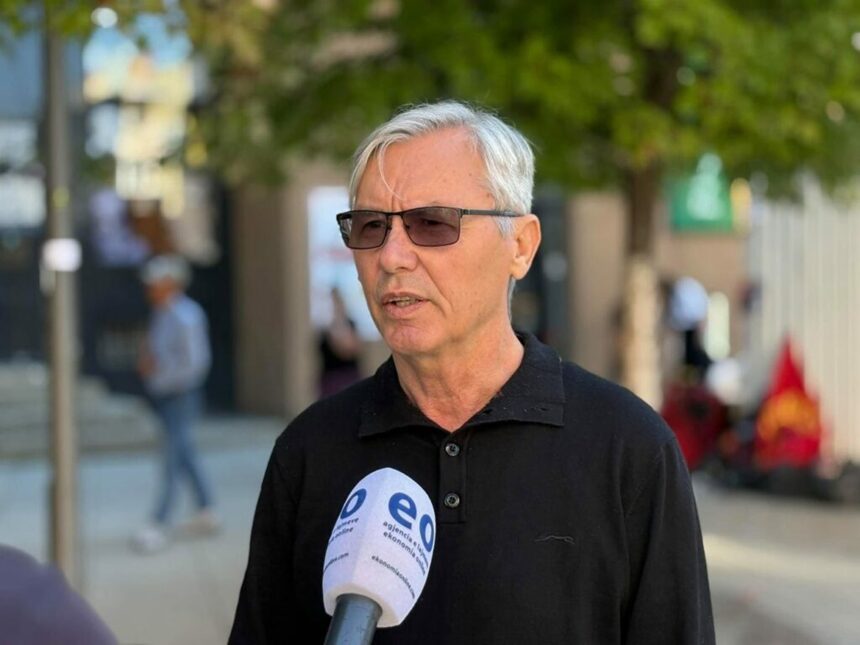
Security analyst Hysen Gecaj has warned that attempts to destabilize Kosovo could follow the verdict of the Specialist Chambers in The Hague, saying that Serbia and other states that are not friendly toward Kosovo could exploit the situation and public emotions to create instability.
Gecaj said such a reaction from Serbia was expected regardless of the outcome of the judicial process, while emphasizing that Kosovo’s security institutions have developed professional capacities to manage situations of this kind.
“The complexity of security itself requires that events be anticipated well before they happen. For Kosovo, this should not have been a surprise, because we know that Serbia is constantly looking for ways to plunge Kosovo into the kind of turmoil it would like to see. Therefore, knowing that there would be a verdict, it was also clear that there would be an attempt by Serbia—not only Serbia, because Russia and other powers that are not friendly toward Kosovo are also involved—to destabilize Kosovo.
Regardless of the final outcome of the court, it was known that Serbia had already considered various options and ways to respond. Whether they were convicted, acquitted, or received very light sentences, all of these scenarios had been taken into account in advance and they were prepared to react accordingly,” he said.
Gecaj also expressed criticism of the way the Specialist Chambers were established, saying he hopes the appeals process will produce a different outcome for the four defendants convicted at first instance.
“It is quite clear that, although this court is political because it was established through a political decision, this initially made us question whether the court’s final decisions could also be political. When we say this, we mean that the professionalism of the judges, prosecutors and all the staff dealing with this matter may not be entirely impartial and objective.
I hope that the appeals process will bring an improvement in favor of the four defendants convicted at first instance. However, this is not the right solution, and it was a mistake, as I have said from the beginning, to establish this court on the basis of political decisions,” he said.
He compared the suffering of the people of Kosovo during the war with the allegations of crimes addressed in the proceedings in The Hague.
“To compare a war of liberation with a war conducted by the other side, which committed crimes—not only here in Kosovo, because if it had happened only in Kosovo perhaps public opinion could have been misled more easily—we know very well how many crimes Serbia committed in Croatia, how many crimes it committed in Bosnia and Herzegovina, and how many crimes it subsequently committed in Kosovo.
Now we are talking about around 300 people who allegedly suffered killings and mistreatment during the war in Kosovo. Unfortunately, even poor treatment is mentioned, including inadequate facilities and a lack of comfort. But I am surprised that this court does not understand that this was a wartime situation, when even KLA soldiers did not have sufficient space to sleep and did not have adequate food,” Gecaj said.
According to him, the comparison between the cases addressed in The Hague and the victims of the war in Kosovo raises questions about the fairness of the process.
“To compare 300 people who were persecuted and mistreated, along with several killings whose circumstances and identities remain unclear, with the suffering of the people—1,047 children were killed, 1,047 children. Is that figure not staggering? Three hundred people compared with 1,047 children killed? Make that comparison. Where is the justice in this? What kind of justice are we talking about?
The number of years in prison given to these four individuals is now being compared with the sentences handed down to Serbian politicians and generals. It is absurd. Those who committed crimes through a sophisticated mechanism such as the Yugoslav Army and later the Serbian Army had a structure, a hierarchy, extensive logistics and political support behind them, as well as international support. We are talking about Russia and many other states allied with Serbia, which supported it not only militarily and economically, but also by sending various criminal groups to fight against this defenseless population.
I deliberately say ‘the people’ rather than the Kosovo Liberation Army, because the army emerged from this people, from ordinary citizens who endured the entire war and sacrifice. In fact, the Kosovo Liberation Army is the people, nothing more. They were inexperienced people, poorly equipped and without prior military knowledge, who were simply forced to defend themselves,” he said.
Speaking about the security situation surrounding the protests, Gecaj said Kosovo’s security institutions have developed professional capacities, but warned that the main risk lies in the possibility of citizens being manipulated.
“Fortunately, over the more than 20 years during which the Kosovo Intelligence Agency, Kosovo Police and Kosovo Security Force have been preparing, our security institutions have reached a satisfactory professional level and are quite well prepared.
However, we must bear one thing in mind: specific circumstances, such as this case involving the court, are particularly difficult to manage because the other side—the enemy—exploits citizens’ emotions. Many young men and women, unaware of the enemy’s tactics, fall into traps that have been prepared in advance.
They focus on particular individuals, identifying during protests which groups can be manipulated more easily for their purposes. Unfortunately, this number is not small. Not only here, but everywhere in the world, certain groups can be manipulated. Then a crowd that is already frustrated and dissatisfied with what has happened can sometimes blindly follow those whom it should not follow,” he said.
Gecaj called on protest organizers, war veterans and the “Freedom Has a Name” group to take a leading role in organizing the demonstrations in order to prevent actions that could harm institutions or citizens.
“What should be done in our case? Someone should take responsibility for this activity. Whether political institutions—I would prefer them not to—or, at the very least, the war veterans and their leadership, together with the ‘Freedom Has a Name’ group, should lead these demonstrations, provide clear guidance, and help the people understand that these are the only groups whose instructions should be followed.
This would reduce the possibility of the enemy exploiting our young men and women to the detriment of the Republic of Kosovo, because these are precisely the moments that provide the greatest opportunities. In addition to the damage caused by the sentencing of these four prominent figures, this moment could also be exploited to cause further harm to Kosovo,” he said.
Gecaj warned that political tensions and delays in consolidating institutions could create opportunities for external interference.
“The destruction of our institutions, damage to our public facilities, and threats against our political and public figures must be avoided at all costs because we do not need such things.
There is plenty of dissatisfaction, including my own, with our leadership, government and institutions in general, because we have seen that for years we have been unable to consolidate our governmental institutions.
This always creates space and opportunities for foreign intelligence agencies to identify these gaps, intervene in the Republic of Kosovo and destabilize it, as they are doing. Political delays in resolving problems can also be part of, and may serve as a focus for, hostile agendas against Kosovo,” he said.