Kosovo Prime Minister Albin Kurti has accused Serbia of failing to hand over cadastral documentation to Kosovo, despite an agreement signed in 2011 and financial support provided by the European Union to facilitate the process.
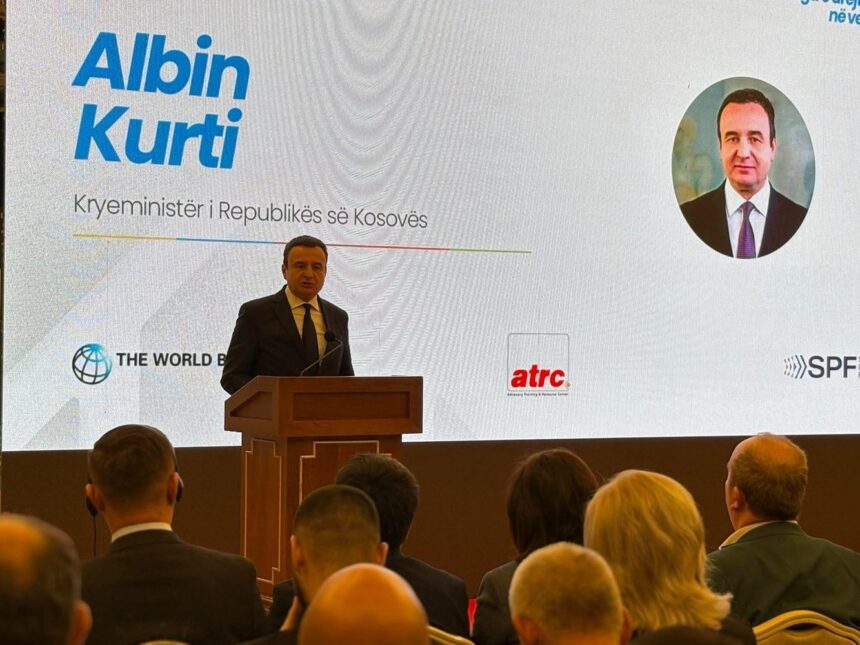
Kurti made the remarks at the closing event of the PIAKOS project, organized by the Advocacy and Training Resource Center (ATRC) and the World Bank. He also highlighted reforms in property registration, efforts to protect public assets and government programs supporting vulnerable families.
Speaking about property rights and cooperation between public institutions and civil society, Kurti said property documentation was essential to legal certainty, family welfare and dignity.
“Documentation guarantees legal certainty, which is a prerequisite for the security of a house or apartment, as well as for a family’s well-being and dignity,” Kurti said, adding that secure housing should be recognized as a human right.
He praised cooperation between the government and ATRC through the PIAKOS project, which provided direct assistance to citizens in 16 municipalities across Kosovo. Women were among the main beneficiaries, particularly in resolving property documentation and inheritance procedures.
Kurti said joint property registration by spouses had increased significantly over the past decade. According to figures he presented, around 100 properties were registered in the names of both spouses in 2016, compared with approximately 31,000 today.
The prime minister stressed that resolving property documentation was not merely an administrative matter, but also a condition for accessing public assistance, including housing renovation, reconstruction and social housing programs.
He said the government had also advanced cadastral reconstruction through the World Bank-supported REGIP project, which covers 115 cadastral zones across Kosovo. The initiative aims to address long-standing property registration problems and improve cadastral services.
Kurti further emphasized measures to prevent abuse, forgery and the unlawful transfer of public property. He said suspected irregularities involving expropriation procedures and cadastral records were being referred to prosecutors.
“There is no longer any tolerance for abuse, forgery or the unlawful transfer of public property,” Kurti said, adding that public property belonged to citizens and the state.
He also highlighted cadastral work in northern Kosovo, including the official naming of streets in North Mitrovica, Leposavić, Zveçan and Zubin Potok. According to Kurti, more than 23,600 properties belonging to members of non-majority communities had been verified and registered, which he described as a step toward ensuring administrative and legal equality throughout Kosovo.
However, he identified Serbia’s failure to transfer cadastral records as a continuing obstacle.
“It has been more than 15 years since Serbia failed to hand over the cadastral documentation, even though the interstate agreement was signed on September 2, 2011,” Kurti said.
He added that the European Union had provided a €2 million grant for the process in September 2011, but Serbia had still not handed over even a copy of the cadastral records, let alone the originals.
Despite the unresolved issue, Kurti said Kosovo’s Cadastral Agency, government institutions and civil society organizations would continue working together to improve services and help citizens resolve property disputes.
He also outlined government spending on housing support, saying €37 million had been allocated for 773 housing units across 21 municipalities under the social housing program. Additional initiatives are being implemented to renovate and reconstruct homes for vulnerable families and people returning to their properties.
The PIAKOS project aimed to improve citizens’ access to property rights, with particular emphasis on supporting women and simplifying property registration procedures.