A former longtime activist of Serbia’s ruling Serbian Progressive Party (SNS), Momčilo Marjanović, has alleged that he helped organize and pay groups tasked with guarding party offices, provoking clashes at protests and pressuring voters to support the ruling party.
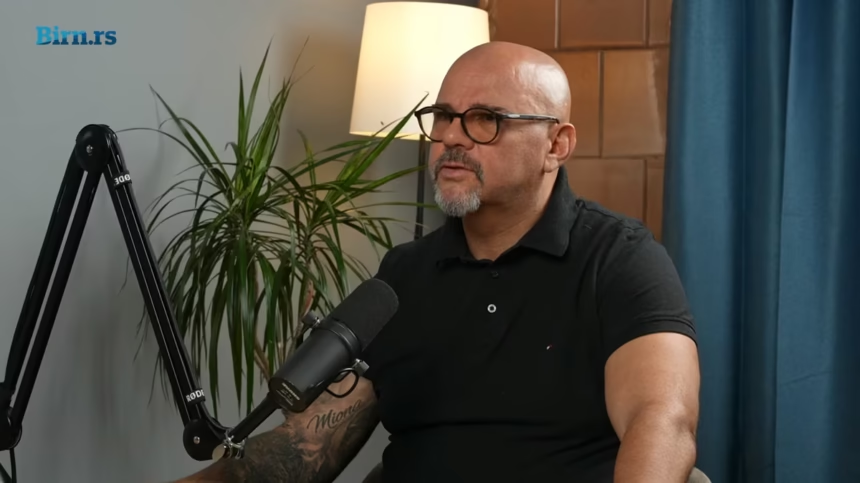
In an interview with the Balkan Investigative Reporting Network (BIRN), the 54-year-old from Novi Sad described what he said were the mechanisms used to recruit activists for confrontations, distribute cash payments and collect so-called “guaranteed votes.” He also alleged that he received money directly from Nenad Barac, director of the public utility company Novi Sad Heating Plant (JKP Novosadska Toplana).
Marjanović said he had been an SNS activist for more than a decade and had taken part in political gatherings across Vojvodina and elsewhere in Serbia. According to his account, his responsibilities became increasingly connected to confrontations after the collapse of the Novi Sad railway station canopy on November 1, 2024, which triggered widespread protests.
Allegations of armed groups at “Ćacilend”
Marjanović said he spent more than two weeks in Pionirski Park in Belgrade before the major student-led protest on March 15, 2025. The park, opposite the Serbian presidency, became known as “Ćacilend” after supporters of the authorities established a camp there.
He alleged that groups brought to the site were prepared to use force if clashes occurred with students or opposition supporters.
“My role was to lead a group of men to the most risky and critical locations, such as Ćacilend,” Marjanović told BIRN, describing how he and the men he led were positioned at the front lines of political gatherings.
He also claimed to have seen at least 100 people carrying revolvers inside the camp, saying some openly carried them on their belts or tucked into their waistbands.
According to Marjanović, members of his group had pepper spray, batons and balaclavas, which were kept in a tent in the park. He alleged that some people consumed alcohol or psychoactive substances while carrying out assignments that included intimidation and physical violence.
Marjanović said he was paid €500 per day for his presence in Ćacilend, while the men he led received €200 each.
He further alleged that preparations for the March 15 gathering included instructions to defend the camp by any means necessary if it came under pressure.
Claims of infiltration at anti-government protests
The former activist also alleged that individuals recruited by the SNS were sometimes sent into crowds of students and other protesters to provoke incidents that could then be blamed on the demonstrators.
He cited gatherings in Belgrade, Bačka Palanka, Bački Petrovac and Novi Sad, including protests in August and October. Marjanović said that, in some cases, men from other towns were brought in because local protesters would not recognize them.
He alleged that these individuals were instructed to throw stones and use pyrotechnics against police, potentially creating the impression that student protesters were responsible for the violence.
Marjanović stressed that he was not claiming every confrontation had been staged, but said he had personally witnessed what he described as the use of infiltrators at several events.
He also recounted an incident in which he was struck in the mouth by a bottle and hit in the leg by a stone, saying he believed the attacks may have come from people on his own side.
Alleged cash payments and pressure on voters
Marjanović said another part of his work involved contacting voters identified as likely SNS supporters and ensuring they went to polling stations. He alleged that both he and the people working with him received money for these activities.
He said payments had typically been around €100, adding that he had heard claims of significantly higher amounts—between €400 and €500 per vote—being offered more recently. BIRN’s report did not independently establish those alleged newer payments.
According to Marjanović, Nenad Barac directly approved the number of people assigned to events and provided the money used to pay them. He alleged that cash was handed over in Barac’s office at the Novi Sad Heating Plant’s administrative headquarters, or left with the director’s secretary when Barac was absent.
Marjanović estimated that, since the Novi Sad canopy collapse, he had personally collected between €350,000 and €400,000 from the company for these activities. He said he had submitted message exchanges with Barac as supporting evidence.
Barac declined to answer BIRN’s questions about the alleged payments, asking how the outlet had obtained the information before ending the conversation.
Marjanović also said he had received a salary through another Novi Sad public utility, Lisje, despite never reporting for work. He described the arrangement as a fictitious job through which he was compensated for his political services.
Alleged threats after leaving the party’s activities
Marjanović said his relationship with the SNS deteriorated after he helped two students who had entered Ćacilend, an action for which he said he was reprimanded. He later refused to travel to Kula ahead of local elections held on March 29, 2026.
He said he ultimately decided to stop participating, partly because of concerns about his daughter and his family’s future. He acknowledged that his political involvement had brought him financial and other privileges, including being paid despite not attending work.
After withdrawing from the activities, Marjanović alleged that he received threats from Bojan Mihajlović, a former MMA fighter and SNS activist, and Mihajlović’s associate Vladimir Zukić.
He claimed the two men confronted him in a car in May and that Zukić struck his vehicle’s window. Marjanović said he reported the incident to police and alleged that Zukić had threatened to harm his child.
Mihajlović and Zukić declined to answer BIRN’s questions and denied knowing Marjanović, according to the report.
Mihajlović was also among a group of SNS supporters deported by Montenegrin authorities at Tivat Airport in June, following a security assessment that they could pose a threat to national security, BIRN reported.
Marjanović said he was aware that he had benefited from the arrangements he described and expressed hope that other party activists would reconsider their involvement.
“I hope there will be changes and that this will no longer happen,” he said, according to BIRN.
The allegations in the interview have not, in the material provided, been established through a court ruling. Barac did not respond substantively to BIRN’s questions, while Mihajlović and Zukić denied knowing Marjanović.