Newly disclosed messages from the encrypted Sky communication platform reportedly point to alleged links between Serbia’s political leadership and the criminal network of convicted drug trafficker Darko Šarić, including claims of arrangements concerning his surrender, criminal proceedings and potential sentence reductions.
In an investigative report published on October 15, Serbian outlet Radar said it had obtained previously unpublished Sky messages exchanged between Šarić, who was in detention at the time, and his close associate Bojan Stanojković in 2020. The publication said the messages describe alleged agreements involving people close to the country’s political leadership and individuals who could influence judicial proceedings.
According to Radar, the messages include references to people identified by the aliases “Oskar,” “Čvarak,” “Edo,” “Markus” and “Dolar.” The outlet said earlier correspondence had linked “Oskar” to former Serbian President Aleksandar Vučić, “Edo” to then Interior Minister Nebojša Stefanović, and “Markus” or “Markos” to senior security official Marko Parezanović. It argues that “Čvarak” may also refer to Vučić, citing a message that describes a promise of a possible presidential pardon.
The allegations have not been independently verified for this report. The identities behind aliases used in encrypted messages remain a central part of the claims made by Radar.
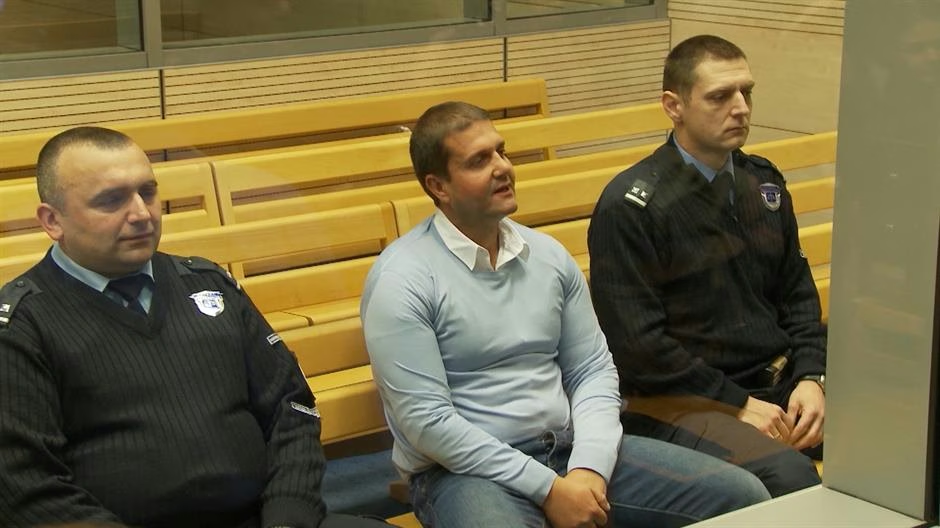
Alleged promises concerning Šarić’s sentence
One of the messages, dated June 1, 2020, reportedly recounts a conversation between businessman Uliks and a person identified as “Čvarak.” According to the published transcript, the person allegedly said Šarić would not serve more than 10 years in prison, that charges related to money laundering would be resolved in his favor, and that some seized property would be returned.
The message also attributes to “Čvarak” a promise to address any unfavorable outcome involving judges or sentencing through a presidential pardon, even if it came at a political cost.
Radar said the correspondence suggested that an arrangement had been discussed ahead of Šarić’s surrender to Serbian authorities in March 2014. The alleged terms included a prison sentence of around 10 years, acquittal on money-laundering charges and the return of part of his confiscated assets.
Šarić surrendered in 2014 in connection with cases involving the smuggling of nearly six tonnes of cocaine and money laundering. His legal proceedings subsequently underwent several developments, including the annulment of a 15-year sentence for cocaine smuggling by Serbia’s Supreme Court.
Claims of political financing
The newly published messages also contain allegations that Šarić helped finance the Serbian Progressive Party (SNS).
In a message dated May 20, 2020, Šarić’s brother, Duško Šarić, reportedly told him that he expected to meet the brother of “Oskar” to hand over “2,000 votes.” In another message from November 2020, Darko Šarić allegedly complained that he had provided the party with €2.1 million through a businessman identified as Uliks.
The messages, as presented by Radar, suggest that the alleged contacts extended beyond discussions about Šarić’s court cases to political support and access to senior officials. The claims about party financing have not been independently established in this report.
Alleged meetings involving security and judicial officials
The report describes messages from May 25 and 26, 2020, concerning a meeting at the headquarters of Serbia’s Security Intelligence Agency (BIA). According to the correspondence, participants allegedly included Marko Parezanović and the president of the Belgrade Court of Appeal, while other officials were reportedly involved indirectly.
Duško Šarić allegedly told his brother that the group was seeking to reach “Oskar” through “Markus,” in the hope that he would speak to judges. The messages also refer to “Edo,” identified by Radar as then Interior Minister Nebojša Stefanović.
The report further alleges that BIA chief Bratislav Gašić entered one meeting unexpectedly. The outlet said the correspondence was exchanged shortly before an urgent meeting at BIA, which it linked to discussions about Šarić’s ongoing legal cases.
In a separate passage, the messages reportedly describe efforts to influence judicial decisions involving appellate judge Milimir Lukić. Lukić has said that Serbia’s Organized Crime Prosecutor’s Office should have opened a case and fully investigated possible attempts by senior politicians to interfere in judicial proceedings.
Prosecutors’ concerns over access to Sky evidence
The report also revisits concerns raised by Serbia’s chief organized crime prosecutor, Mladen Nenadić, in late 2025. According to Radar, Nenadić said Europol provided Sky communication material to Serbia’s Interior Ministry rather than directly to prosecutors, leaving the prosecution dependent on the police to supply relevant evidence.
He reportedly warned that prosecutors could be deprived of crucial material if the ministry failed to provide requested messages or supplied information unrelated to their investigations.
Radar said the newly obtained correspondence added to questions about whether the full body of encrypted communications had been made available to investigators and whether alleged attempts had been made to discredit cooperating witnesses, prosecutors, police officers, intelligence officials and judges.
Šarić has faced additional proceedings stemming from Sky communications, including a case concerning an alleged attempt to discredit a cooperating witness. He has also been charged alongside Veljko Belivuk in a separate case involving four killings of members of the rival Škaljari criminal group in Greece. The allegations in those proceedings must be distinguished from findings established by final court judgments.
The newly published messages raise serious allegations about possible political interference in criminal proceedings and the relationship between senior officials and organized crime. Their authenticity, the identities behind the aliases and the extent to which the exchanges reflect actual decisions would need to be established through a full investigation and judicial examination.