The victory of the Student List and Aleksandar Vučić’s defeat in Serbia’s snap parliamentary elections received sharply different coverage across the country’s newspapers on the morning after the vote.
While some outlets declared the end of the Vučić era, tabloids close to the ruling establishment attempted to divert attention from the election results, focusing instead on attacks against political opponents and claims of a campaign against the Serbian president, Klix reports.
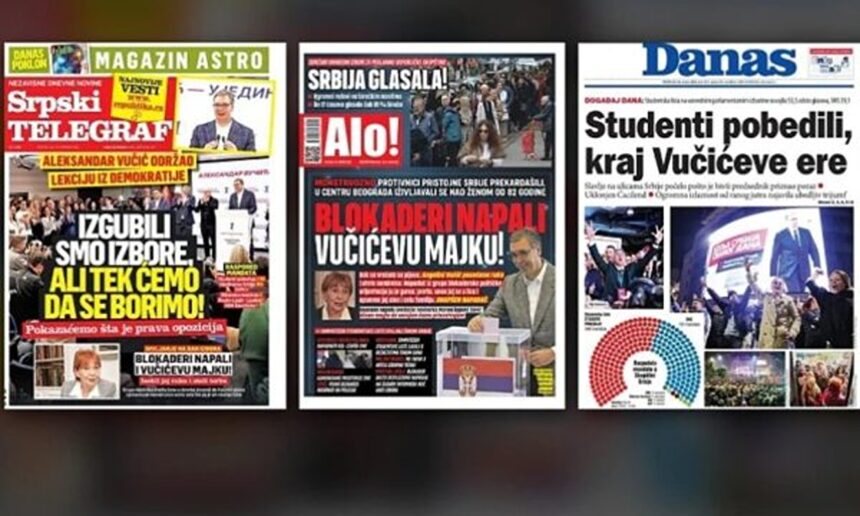
The newspaper Danas led its front page with the headline “Students Win, the End of the Vučić Era,” highlighting results that put the Student List at 53.5% of the vote, compared with 39.1% for the Serbian Progressive Party (SNS).
According to projections published by the newspaper, based on data processed by Ipsos and CeSID, the Student List is expected to secure 140 seats in parliament, while Vučić’s electoral list is projected to win 103.
Danas also reported that citizens took to the streets to celebrate after the Serbian president conceded defeat, while “Ćacilend,” a camp set up by government supporters, was dismantled.
By contrast, the pro-government tabloids Alo and Srpski telegraf gave prominent coverage to allegations that Vučić’s mother, Angelina, had been attacked.
Alo ran the headline “Blockaders Attack Vučić’s Mother!” claiming that her hand had been cut and her groceries stolen as she returned from the market. The newspaper reported that a suspect had been arrested. The same allegation also appeared on the front page of Večernje novosti.
Meanwhile, Srpski telegraf featured Vučić’s statement, “We Lost the Elections, but We Will Keep Fighting!” alongside a headline claiming that the president had “given a lesson in democracy.”
The newspaper Politika, unlike the tabloids, reported that Vučić had conceded defeat and was the first to congratulate the Student List. It also published seat projections showing the Student List with 140 seats and Vučić’s list with 103.
Večernje novosti, meanwhile, devoted its main headline to high voter turnout, declaring: “Serbia Turns Out in Force to Vote.” Elsewhere on its front page, the newspaper promoted claims of a “dirty campaign against Vučić and our country,” naming Zagreb, Sarajevo and Podgorica.
The contrasting front pages highlight the deep divide in Serbia’s media landscape, where outlets aligned with the government have often framed political developments differently from publications critical of Vučić’s rule.