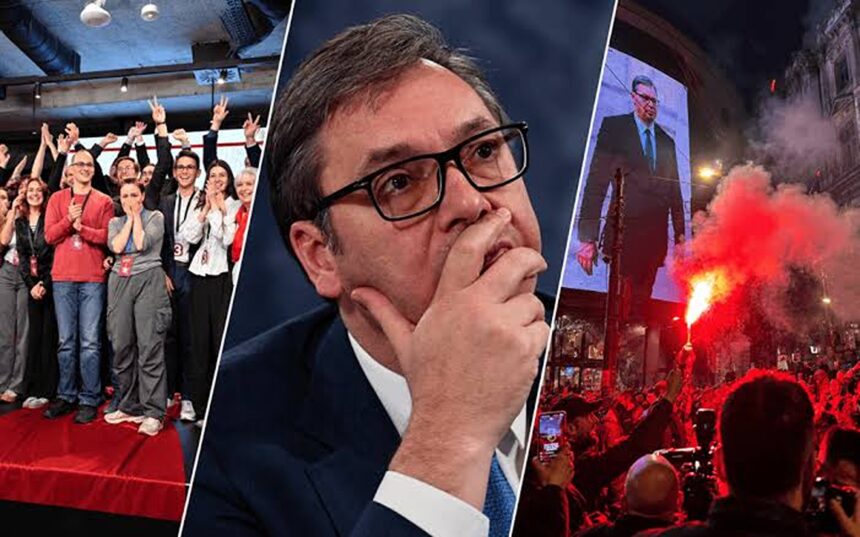
Serbian President Aleksandar Vučić has conceded defeat in the parliamentary elections after years of political dominance, but the victory of the student-led opposition may not herald a major shift in Serbia’s foreign policy. In its coverage of the vote, The New York Times highlighted the limited differences between Vučić and the victorious Student List on several contentious issues, including Kosovo’s status and Serbia’s relations with Russia and the European Union.
The elections took place after two years of student-led protests weakened Vučić’s grip on power. The vote largely became a referendum on the Serbian leader, whom the newspaper described as Europe’s longest-serving leader outside the former Soviet Union.
The result followed a major political shift in neighbouring Hungary, where voters removed nationalist populist Viktor Orbán, a close ally of Vučić, from power six months earlier.
According to The New York Times, Vučić adopted many of Orbán’s methods of governance and ultimately followed his example in conceding defeat. The newspaper’s comparison highlights the broader political context in which both leaders built their influence and the challenges facing Serbia as it enters a new phase.
“It is clear that we have lost these elections,” Vučić was quoted as saying.
His early concession was followed by celebrations in central Belgrade, where tens of thousands of people, many of them young, gathered in the streets. Car horns and fireworks filled the night as crowds waved Serbian flags and celebrated a result that many had feared might never materialise, the NYT reported.
The vote was also marked by reports of violence and irregularities at polling stations. According to the newspaper, some voters had feared that Vučić might follow the example of his former political mentor, Slobodan Milošević, who claimed victory in the 2000 elections before mass protests forced him to acknowledge defeat.
The newspaper also quoted Ratko Knežević, a former Montenegrin diplomat, who described the result as a turning point in Serbia’s political trajectory.
“What happened tonight in Serbia is not merely the electoral defeat of an incumbent government, but a tectonic shift in the political order established in 1987,” Knežević said.
The year 1987 marked a pivotal moment in the rise of Serbian nationalism. During a visit to Kosovo, Milošević pledged to protect Serbs against ethnic Albanians, a declaration widely associated with the political developments that followed and the deterioration of relations across the former Yugoslavia.
“Milošević built a system in which all of Serbia’s neighbours became enemies, while any criticism of the government was considered treason and Vučić has perfected that model,” Knežević said.
Despite Vučić’s electoral defeat, questions remain over the extent to which a new parliamentary majority will change Serbia’s political direction. As The New York Times notes, the Student List’s positions on Kosovo, Russia and the European Union suggest that a change in leadership may not necessarily translate into a fundamental shift on some of the most consequential issues facing the country.