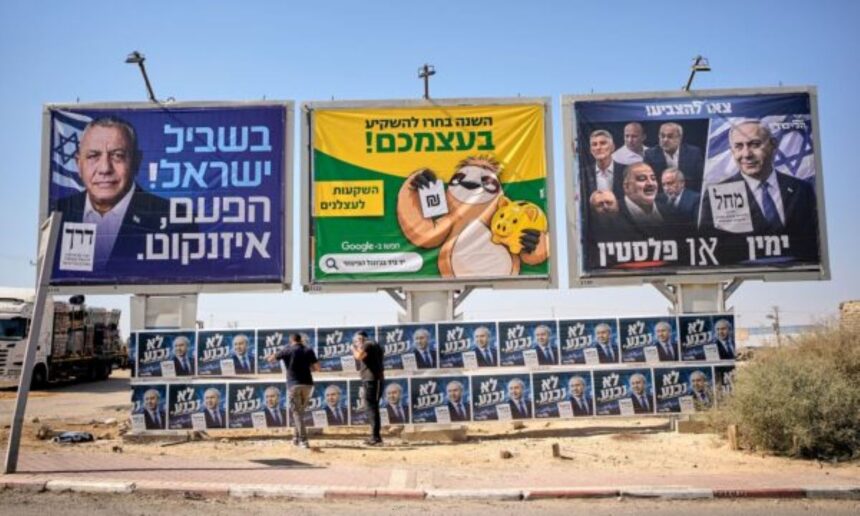
Israelis are voting in one of the country’s most consequential elections in years, with voters deciding whether Prime Minister Benjamin Netanyahu should remain in power or whether the country should take a different political direction.
Nearly every recent Israeli election has been viewed as a referendum on Netanyahu, the country’s longest-serving prime minister. This time, however, the stakes are particularly high, with the outcome likely to shape not only Israel’s leadership but also its domestic policies, security strategy and international standing, CNN reports.
The election is the first national vote since the Hamas-led attack on October 7, 2023, which exposed the deadliest security failure in Israel’s history. The subsequent wars in Gaza, Lebanon and Iran have mobilized much of Israeli society while contributing to the country’s growing international isolation.
For many voters, the election offers an opportunity to judge the leadership in place when the October 7 attack occurred, decide who should lead the country through continuing security challenges and determine how the burden of military service should be shared.
Netanyahu’s outgoing government, the first in several decades to complete a full four-year term, relied on far-right and ultra-Orthodox coalition partners. Their influence helped push Israel toward a more nationalist and religious political direction.
Netanyahu also became the first sitting Israeli prime minister to stand trial on corruption charges. His government’s proposed judicial overhaul, which critics said would weaken the Supreme Court and other checks on executive power, triggered mass protests in 2023.
Tuesday’s election will test whether Israel continues along that nationalist, conservative and religious path or begins to change course.
However, the result may not become clear for weeks. Opinion polls suggest that neither Netanyahu’s bloc nor the opposition is likely to secure an outright parliamentary majority, raising the prospect of another prolonged political deadlock rather than a decisive resolution.
Who is running, and who is leading?
Israelis vote for party lists rather than individual candidates. The country’s political landscape is divided along national, religious, ethnic and ideological lines, producing a crowded electoral field.
Thirty-six parties were registered for the election. Only those that cross the electoral threshold of 3.25% qualify for seats in the Knesset, Israel’s 120-member parliament.
Polls suggest that between 11 and 13 parties could cross the threshold, with seats allocated through proportional representation.
The two largest parties are expected to be Netanyahu’s right-wing Likud and Yashar, a new centrist party led by Gadi Eisenkot, a former chief of staff of the Israel Defense Forces who has emerged as Netanyahu’s main challenger.
The latest Channel 12 poll cited in the report puts Eisenkot’s party ahead with 23 seats, compared with 21 for Likud. Other polls offer different projections.
Channel 14, a broadcaster considered supportive of Netanyahu, forecasts 30 seats for Likud and around 20 for Eisenkot’s party. In direct comparisons over who would be better suited to serve as prime minister, Eisenkot has consistently led Netanyahu by a relatively stable margin, according to the report.
Nevertheless, finishing first in the election does not guarantee the premiership. A candidate must secure the support of at least 61 members of the Knesset to form a government, and no party has ever won an outright majority on its own.
The decisive contest will therefore take place after the votes are counted, as party leaders negotiate potential coalitions. Those negotiations can last days, weeks or even months.
Netanyahu’s bloc falls short of a majority in polls
Most opinion polls project that Netanyahu’s bloc, comprising Likud, two far-right parties led by Bezalel Smotrich and Itamar Ben-Gvir, and two ultra-Orthodox parties, will win between 49 and 55 seats.
That would leave the bloc short of the 61 seats needed to form a government.
The opposition appears stronger on paper but remains deeply divided.
To Eisenkot’s right are parties led by former Prime Minister Naftali Bennett and former Defense Minister Avigdor Liberman. To his left is the Democrats party, led by Yair Golan.
Neither Bennett nor Liberman has endorsed Eisenkot, and both have their own ambitions to become prime minister, complicating efforts to unite the opposition behind a single candidate.
Arab parties could hold the balance of power
According to the polls, any alternative government could need the support or abstention of Arab parties to secure a parliamentary majority.
However, some opposition leaders have ruled out cooperation with Arab political parties, potentially narrowing their options for forming a government.
With neither side holding a clear path to a majority, several scenarios remain possible: a prolonged political deadlock, a minority government, a national unity government or another election.
The vote is therefore not simply a contest between Netanyahu and his challengers. It is also a test of whether Israel’s fragmented political system can produce a stable governing coalition after years of division and conflict.