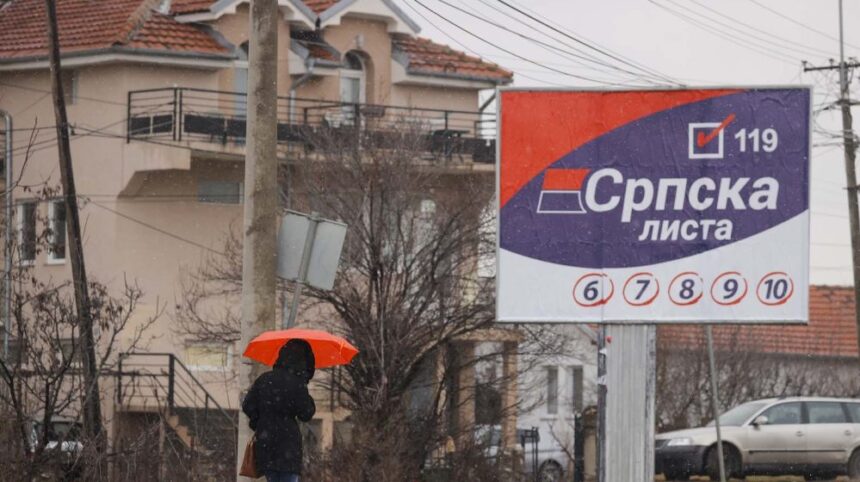
The defeat of the Serbian Progressive Party (SNS) in Serbia’s parliamentary elections has raised questions about the future of Serb List, widely regarded by its critics as the SNS’s political extension in Kosovo, and the extent to which a new government in Belgrade will continue supporting the party.
Although the SNS secured 71.97 percent of the vote among voters in Kosovo, compared with 20.62 percent for the Students’ List, the nationwide results in Serbia were different. The Students’ List won approximately 53 percent of the vote, securing an absolute majority in the Serbian Parliament and paving the way for a change of government.
The new government will therefore face decisions about its policy toward Kosovo and the Serbian community there, including its relationship with Serb List, whose representatives hold positions in the Kosovo Parliament, local governments and institutions operating within Serbia’s system.
Serb List has nine of the ten parliamentary seats reserved for the Serb community in Kosovo and has traditionally held a dominant position in Serb-majority municipalities.
However, the party took six days after the election to issue its first public statement on the results, prompting criticism and questions about its political direction.
Students’ List calls for a change in priorities
Vladan Kuzmanović, a professor associated with the Students’ List, said Serb List would have to start working in the interests of Serbs living in Kosovo rather than serving the political interests of the SNS.
He said the Students’ List intended to help citizens live with dignity before continuing negotiations concerning Kosovo, which he argued had reached a dead end under the previous government’s policies.
Kuzmanović also said the party wanted to address pressure from local power structures and criminal groups, while improving the position of the Serbian community in Kosovo.
The challenge for the incoming government will be determining how to influence Serb List without undermining its promises to represent and protect Serbs in Kosovo.
Orlović: Serb List has lost political influence
Ivan Orlović, president of the Serbian Democracy party and a member of the North Mitrovica Municipal Assembly, told Danas that the SNS defeat had weakened Serb List’s political standing.
He argued that the party had not been guided by an ideology or a consistent program for improving the position of Serbs, but had instead focused on maintaining its political power and serving the interests of its officials.
“ They have no ideology of their own. They are used to receiving orders from Belgrade,” Orlović said.
He added that the new government could exert influence through Serbian institutions operating in Kosovo, where Serb List officials continue to hold positions.
According to Orlović, reviewing budget allocations and monitoring the use of funds intended for Serbs in Kosovo could be among the ways to establish accountability.
He also called for scrutiny of how public money had been spent, arguing that some officials had used their positions for personal gain. These allegations have not been independently established in the article.
Orlović described the election results among Kosovo voters as encouraging, despite what he said were organized voter transports and pressure on public-sector employees.
He argued that Serb List had lost support even among people it had previously considered part of its secure electorate.
Nevertheless, he does not expect immediate changes in the party’s representation in Kosovo’s institutions. He believes Serb List will attempt to establish relations with the Students’ List, but questioned whether such efforts would succeed.
Orlović also said Serb List would struggle to survive without political and institutional support from Serbia, given the close social, economic and cultural ties between the Serbian community in Kosovo and Belgrade.
Savić: New government must examine Serb List’s record
Zoran Savić of the NGO Aktiv told Danas that the election results showed the continuation of support for the SNS among Kosovo Serbs, despite what he described as the consequences of the party’s policies for Serbia’s institutional presence in Kosovo.
He also alleged that public-sector employees had faced threats of dismissal or non-renewal of contracts if they did not vote for the SNS. Savić said some voters had waited for hours at administrative crossings to cast their ballots.
Regarding possible cooperation between the incoming government and Serb List, Savić argued that such cooperation should not take place, citing the party’s conduct toward students during the protests and election campaign.
“Serb List is the political wing of the SNS in Kosovo,” he said, pointing to the continued presence of Aleksandar Vučić’s photograph in the party’s offices as an indication of its close relationship with the Serbian president.
Savić also criticized Serb List for not publicly commenting on the election results for several days.
He said the new government should focus not on forcing the party to change its political positions, but on examining the conduct of its representatives over the past 14 years, particularly within Serbian institutions operating in Kosovo.
Among the issues he called for investigation were alleged politically motivated employment practices, pressure on voters, dismissals of employees considered politically unsuitable and appointments of allegedly unqualified personnel.
Savić further cited the murder of Kosovo Serb politician Oliver Ivanović and the September 2023 armed attack in Banjska as events whose broader circumstances and consequences, in his view, should be examined by future judicial proceedings.
He argued that the incoming government should establish accountability where wrongdoing is proven and appoint officials capable of improving the daily lives of the remaining Serb population in Kosovo.
A difficult relationship ahead
The election results have created a new political situation for Serb List, which has operated for years in close alignment with the SNS-led government in Belgrade.
The incoming government will have to decide whether to maintain existing channels of cooperation, demand greater accountability from Serbian institutions in Kosovo, or pursue a different approach to political representation of the Serb community.
At the same time, the Students’ List will face the challenge of translating its campaign promises into policies that address the concerns of Serbs in Kosovo, including employment, security, public services and their participation in decisions affecting their future.
The extent of any change will depend not only on the new government’s approach to Serb List, but also on how it manages Serbia’s institutional, financial and political ties with the Serbian community in Kosovo.