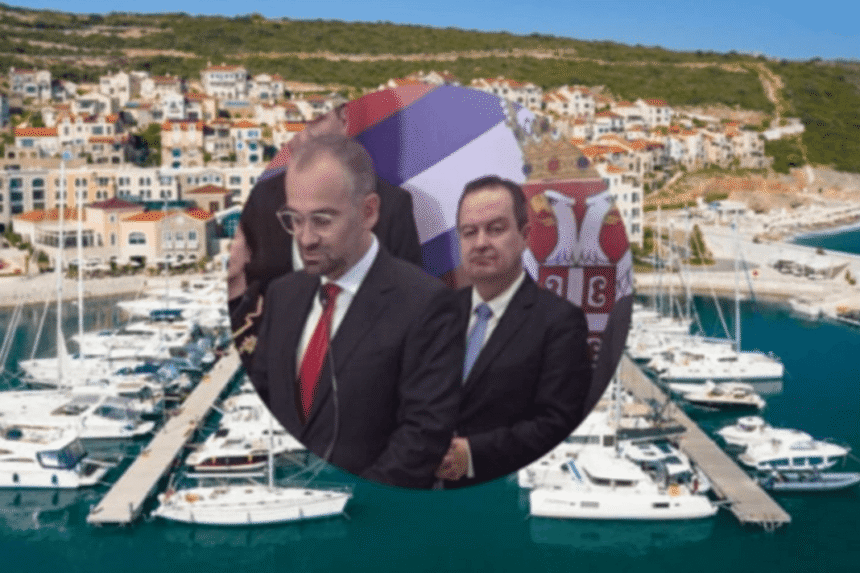
Documents, publicly available financial reports and media investigations in Montenegro have raised questions about the financial arrangements surrounding the luxury Luštica Bay development near Tivat and whether individuals connected to Serbia’s political establishment are among the buyers of its high-end properties.
The investigation also examines the potential role of Belgrade-based Alta Bank in financing Luštica Development, the company behind the Adriatic resort.
One figure connecting the business and political circles is Dejan Ljevnaić, a controversial operator described by the source as close to former Serbian President Aleksandar Vučić. Ljevnaić previously served as strategic director of Luštica Bay but was removed from the position in August following a series of controversies.
Luštica Bay, with its marina, luxury apartments and villas, has become one of Montenegro’s most expensive tourism developments. Behind its international image, however, lies a complex network of state-owned land, private investment, property transactions and financial arrangements.
Alta Bank and the proposed €15 million loan
One of the most concrete connections identified by the investigation concerns Alta Bank.
According to documents from the Montenegrin government and reporting by the Podgorica-based newspaper Vijesti, Luštica Development requested government approval in 2026 to use its rights over the marina and coastal promenade as collateral for a €15 million loan from Alta Bank in Belgrade.
The proposed loan carried a fixed interest rate of 8.5%, a five-year repayment period and a 12-month grace period.
The Montenegrin government initially approved the request on June 29 but reversed its decision on July 28.
According to Vijesti, the mortgage was never registered, while the company stated that it did not have any active credit arrangements with Alta Bank at the time.
The proposed financing arrangement is therefore documented, but the specific loan was not completed.
Questions nevertheless remain about why Luštica Development sought financing from Alta Bank and whether the two companies had any previous financial cooperation.
Audit report raises questions over related-party loans
Luštica Development’s 2025 financial statements contain another issue highlighted by the investigation.
The independent auditor issued a qualified opinion, noting that the company had reported €36.8 million in short-term loans to related legal entities without calculating expected credit losses in accordance with international accounting standards.
The auditor said it was unable to determine how any potential impairment adjustments would affect the company’s reported profit.
This does not automatically mean that the financial statements were falsified. However, it identifies a significant issue concerning the company’s financial reporting and the assessment of loans to related parties.
Publicly available business records list Slobodan Sekulić as one of Luštica Development’s authorized representatives. Information from Montenegro’s Ministry of Finance also connects him to the company during 2025.
According to information provided to the reporting outlet, a criminal complaint concerning the company’s operations was filed in September 2025. The allegations in that complaint, as well as claims concerning possible influence over the audit, have not been independently verified.
Šapić surname appears in property records
Another document examined by the investigation is an entry in Montenegro’s land registry, concerning property record number 263 in the cadastral municipality of Nikovići.
A preliminary purchase agreement dated October 2021 lists the Belgrade-based company ŠAPA LIGHTS DOO as the buyer of apartment I 922, Luštica Development as the seller and Dragan Šapić as guarantor.
The preliminary agreement was entered into the land registry in August 2024.
The document does not disclose the apartment’s price, financing arrangements or whether the purchase was ultimately completed. Nor does the appearance of the Šapić surname establish a connection with Aleksandar Šapić, the former mayor of Belgrade.
Nevertheless, given previous investigations by BIRN and KRIK into Aleksandar Šapić’s assets, the possibility of business or family connections is presented as a matter of public interest requiring further verification.
Former Brnabić chief of staff among alleged property buyers
The investigation also names Miloš Popović, former chief of staff to former Serbian Prime Minister Ana Brnabić, among individuals allegedly connected to property purchases at Luštica Bay.
According to a source familiar with the transactions, an apartment was purchased at the end of 2023 from a previous owner rather than directly from Luštica Development. The source claims that Popović’s wife, Marina, was registered as the owner.
The same source estimated the transaction’s value at approximately €950,000 and alleged that payment was made through a company registered in Dubai and supposedly connected to the buyer’s family.
However, the reporting outlet said it had not obtained the purchase agreement, banking records or an updated land registry extract confirming these claims.
Consequently, the origin of the funds, the identity of the actual payer and any possible connection between the transaction and political office cannot be established from the available documentation.
The land registry material also identifies Novak Stajić as a buyer under a preliminary agreement with Luštica Development dated June 2022.
A source claimed that the final installment for his apartment was paid by a third party in Switzerland. The relevant contracts and payment records have yet to be independently verified.
Questions over financial transparency
The investigation raises three broader questions: how a major tourism development built on state-owned land is financed, who purchases its most expensive properties and whether the financial transactions involved are sufficiently transparent.
The available material confirms that Luštica Development pursued a proposed financing arrangement with Alta Bank. It also documents the auditor’s reservations concerning loans to related entities and identifies several property transactions in the land registry.
However, the documents do not establish that these transactions are interconnected or that they form part of an organized illegal scheme.
Further investigation would be needed to establish who financed the individual purchases, what role intermediaries played and whether the competent authorities examined the origin of the funds.
Alta Bank closure adds another dimension
The investigation has gained additional significance following the National Bank of Serbia’s decision to revoke Alta Bank’s operating license.
The bank, owned by businessman Davor Macura, was shut down amid a separate investigation into suspected financial irregularities and the alleged removal of approximately 45 billion dinars, equivalent to more than €380 million, from its vaults.
Macura has been described in media reports as having close ties to the Serbian Progressive Party (SNS) and the political establishment associated with former President Aleksandar Vučić.
The bank’s closure came days after the SNS lost power in the October 25 elections, ending its 14-year period in government, according to the source.
The timing and the allegations surrounding Alta Bank have added to questions about the financial networks involving businesses and politically connected individuals in the region. However, the available evidence does not establish that the bank’s alleged financial irregularities were connected to Luštica Development or the property transactions described above.
The central issue remains whether the ownership structures, financing arrangements and movement of funds connected to one of the Adriatic’s most expensive tourism developments can be fully documented and independently scrutinized.