Twenty years after adopting its 2006 Constitution, Serbia continues to claim Kosovo as part of its territory, despite having lost control over it in 1999. While Kosovo has built and operates its own independent institutions, Belgrade continues to preserve a territorial claim over a country it does not govern.
The departure of Aleksandar Vučić from the presidency and the SNS’s defeat in the October 2026 parliamentary elections have opened a new political chapter in Serbia. But a change of leadership does not automatically mean an end to the policies that have kept Kosovo at the centre of Serbian nationalism for decades. The constitutional claim remains in place, and the new political leadership must answer a fundamental question: will it finally abandon Serbia’s claim over Kosovo, or will it continue a policy that denies the reality of Kosovo’s independence?
For two decades, Serbia has maintained this claim through its highest legal document, using it as a political instrument while participating in international negotiations with Kosovo. Belgrade has signed agreements concerning the normalisation of relations, accepted commitments relating to Kosovo’s sovereignty and territorial integrity, yet has refused to remove the claim that Kosovo belongs to Serbia from its Constitution.
How Serbia Embedded Its Claim over Kosovo in the Constitution
The origins of this constitutional claim date back to 2006, when Serbia was preparing for a decisive period of international negotiations over Kosovo’s status.
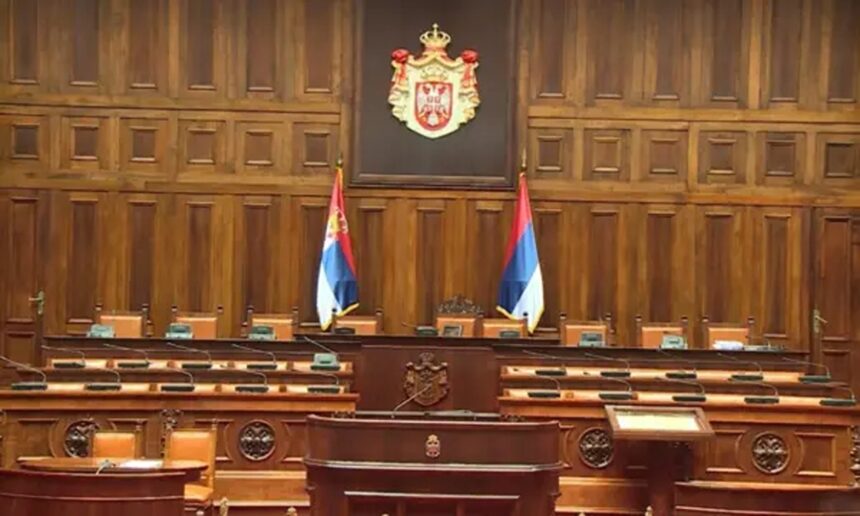
On 30 September that year, the Serbian Parliament adopted a new Constitution, which was put to a referendum on 28 and 29 October and entered into force on 8 November. Its preamble explicitly describes Kosovo as an integral part of Serbia’s territory, with the status of substantial autonomy within the Serbian state. It also obliges Serbian state institutions to protect Serbia’s interests in Kosovo through domestic and foreign policy.
The Constitution was adopted before Kosovo declared independence on 17 February 2008, while its final status was still being discussed internationally. Belgrade chose to embed its claim over Kosovo in the country’s highest legal document, seeking to preserve a territorial position that did not reflect the political reality on the ground.
The exclusion of Kosovo Albanians from the referendum is another essential part of this history. The majority population of Kosovo had no participation in the vote through which Serbia sought to define the territory’s constitutional status as part of its own state.
Article 182 of the Constitution also provides for substantial autonomy for Kosovo, with the details to be established through a separate law. That law has never been adopted.
The contradiction is clear: Serbia claims Kosovo as its territory but has neither exercised authority over it since 1999 nor implemented the legal framework for the autonomy described in its Constitution. The constitutional wording remains, but it does not change the reality of Kosovo as an independent state.
Vučić Leaves Office, but Serbia’s Claim Remains
Aleksandar Vučić did not introduce Kosovo into Serbia’s Constitution. That decision was made six years before he became prime minister. But during more than a decade in power, he did nothing to remove the claim or initiate a serious constitutional process to bring Serbia’s position into line with the reality of Kosovo’s independence.
Instead, Kosovo remained central to his political strategy. In international negotiations, Vučić presented himself as willing to pursue normalisation. At home, however, he continued to maintain the narrative that Kosovo was an inseparable part of Serbia.
This approach allowed him to address international pressure while retaining domestic nationalist support. Any compromise with Pristina could be portrayed as a sacrifice of Serbian national interests, while the constitutional claim remained untouched.
Vučić’s resignation from the presidency on 27 September 2026 and the defeat of his electoral list on 25 October marked the end of the SNS’s parliamentary dominance after 14 years in power.
But Serbia’s claim over Kosovo did not begin with Vučić, and it cannot be dismissed as merely his political legacy. It is embedded in the Constitution and remains the responsibility of the Serbian state. The new leadership cannot claim a genuine break with the past while continuing to uphold the same territorial claim.
Serbia’s International Commitments Contradict Its Constitutional Claim
The contradiction is particularly evident in the agreements reached through the European Union-mediated dialogue.
On 19 April 2013, Kosovo and Serbia signed the First Brussels Agreement on the normalisation of relations. It provided for the integration of police and judicial structures in northern Kosovo into Kosovo’s legal system, as well as the establishment of the Association of Serb-majority Municipalities.
On 27 February 2023, the parties agreed on the Agreement on the Path to Normalisation of Relations, followed by an implementation annex agreed in Ohrid on 18 March.
Article 2 of the 2023 agreement commits the parties to respecting the principles of independence, sovereignty and territorial integrity. Article 4 provides that Serbia will not object to Kosovo’s membership in international organisations.
Yet Vučić refused to present the agreement as formal recognition of Kosovo, while Belgrade failed to take sufficient steps to implement the commitments it had accepted.
Serbia cannot continue to make commitments concerning Kosovo’s sovereignty and territorial integrity internationally while maintaining a constitutional claim that contradicts those commitments at home.
The issue is not that Kosovo must prove its independence to Belgrade. Kosovo has its own institutions and exercises authority over its territory. The question is why Serbia continues to refuse to align its constitutional position with the reality it has been negotiating with for years.
The Brussels and Ohrid agreements did not automatically remove the constitutional claim. That responsibility remains with Serbia.
The Student List: Will the New Leadership Continue the Same Policy?
The Student List’s victory in the parliamentary elections of 25 October 2026 has created a new political reality in Serbia.
According to the final results, the Student List won 140 seats in the 250-member Parliament, while the list led by Aleksandar Vučić secured 103. This ended the SNS’s 14-year parliamentary dominance and gave the student movement a parliamentary majority.
However, an electoral victory built around demands to fight corruption, ensure institutional accountability and restore democratic functioning does not automatically establish a new policy towards Kosovo.
Kosovo was not one of the central issues in the Student List’s election programme, and the movement has not presented a detailed position explaining whether it intends to abandon Serbia’s constitutional claim.
That silence leaves an important question unanswered: will the new leadership finally distinguish between Serbia’s domestic political narratives and the reality of Kosovo’s independence, or will it preserve the same territorial claim under a different political administration?
The Student List holds 140 seats, but this is not enough to amend the Constitution. Any attempt to remove Kosovo from the preamble would require support beyond its parliamentary majority.
The new leadership will therefore have to demonstrate whether its promises of political change extend to Serbia’s policy towards Kosovo or stop at replacing the people who held power.
What Would It Take to Remove Kosovo from Serbia’s Constitution?
Amending Serbia’s Constitution is legally possible, but it requires a complex political and institutional process.
Under Article 203, an amendment initiative may be submitted by at least one-third of all members of Parliament, the President of the Republic, the Government or at least 150,000 citizens.
The proposal must first be approved by a two-thirds majority of the total number of MPs. An act amending the Constitution must also receive the support of two-thirds of Parliament.
Because the proposed change would affect the preamble, a referendum is mandatory. The amendment is approved if a majority of those voting support it.
With the current parliamentary composition, the Student List holds 140 seats, while 167 votes are required to reach a two-thirds majority in the 250-member Parliament. This means that the new government would need support from other parliamentary groups to amend the Constitution.
Removing Kosovo from the preamble would eliminate Serbia’s territorial claim from its highest legal document. It would be a significant political and legal step, although it would not automatically constitute formal diplomatic recognition of Kosovo. Recognition would require additional political and diplomatic decisions.
Nevertheless, removing the claim would mean that Serbia had finally stopped using its Constitution to assert ownership over a territory it has not governed since 1999.
The Real Test for Serbia After Vučić
Kosovo’s inclusion in the Serbian Constitution is not simply an outdated provision or an internal legal matter. It is a continuing expression of Serbia’s refusal to abandon its territorial claim over an independent state.
The European Union must therefore assess Serbia’s commitments through concrete actions, not declarations made during negotiations. Belgrade cannot claim to respect sovereignty and territorial integrity while maintaining a constitutional provision that claims Kosovo as Serbian territory.
The departure of Vučić and the SNS’s electoral defeat have created an opportunity for political change. But the new leadership will not demonstrate a genuine break with the past merely by promising democratic reforms or criticising the previous government. It must also address the policies that have shaped Serbia’s relationship with Kosovo.
The question is no longer whether Serbia has lost control over Kosovo. That reality has existed since 1999. The question is whether Serbia’s new leadership is prepared to stop denying it through its Constitution.
Vučić is no longer president. The SNS no longer holds the parliamentary majority. But Serbia’s claim over Kosovo remains written into its Constitution.
Twenty years after adopting that claim, Belgrade still refuses to remove it. The new government now has the opportunity to show whether Serbia is ready to abandon its territorial pretensions and accept the reality of an independent Kosovo.