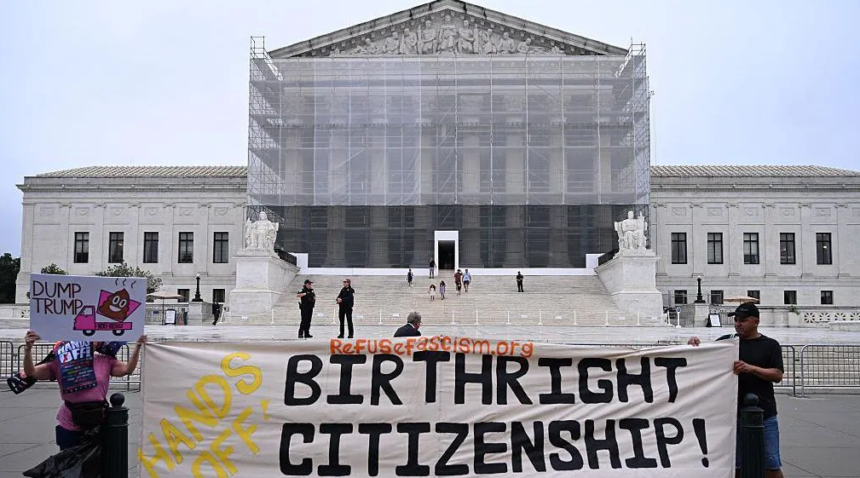
The U.S. Supreme Court has agreed to take up a landmark constitutional case: whether children born on American soil to parents who are undocumented or in the country on temporary visas are entitled to birthright U.S. citizenship.
The case centers on an executive order signed by President Donald Trump, aimed at ending birthright citizenship for these categories of children. The order was blocked by federal courts, which ruled that it violates the 14th Amendment of the U.S. Constitution.
The Supreme Court has not yet set a hearing date, and a final decision is expected in the coming months.
A 160-Year-Old Constitutional Guarantee
For nearly 160 years, the 14th Amendment has guaranteed that any person born in the United States is automatically a U.S. citizen — except for children of foreign diplomats and foreign military personnel.
Trump’s administration argues that the phrase “subject to the jurisdiction of the United States” excludes children of undocumented immigrants and temporary visitors.
Meanwhile, attorneys for the plaintiffs insist that no president has the authority to alter a constitutional guarantee as fundamental as birthright citizenship.
Data on Births to Noncitizen Parents
According to the Pew Research Center, around 250,000 babies were born in the U.S. in 2016 to parents without American citizenship.
By 2022, the number of U.S.-born citizens with undocumented parents reached 1.2 million.
A study by the Migration Policy Institute warns that eliminating birthright citizenship could increase the unauthorized population in the U.S. by 2.7 million by 2045, and up to 5.4 million by 2075 — creating a growing class of people born in the U.S. but without a clear legal status.