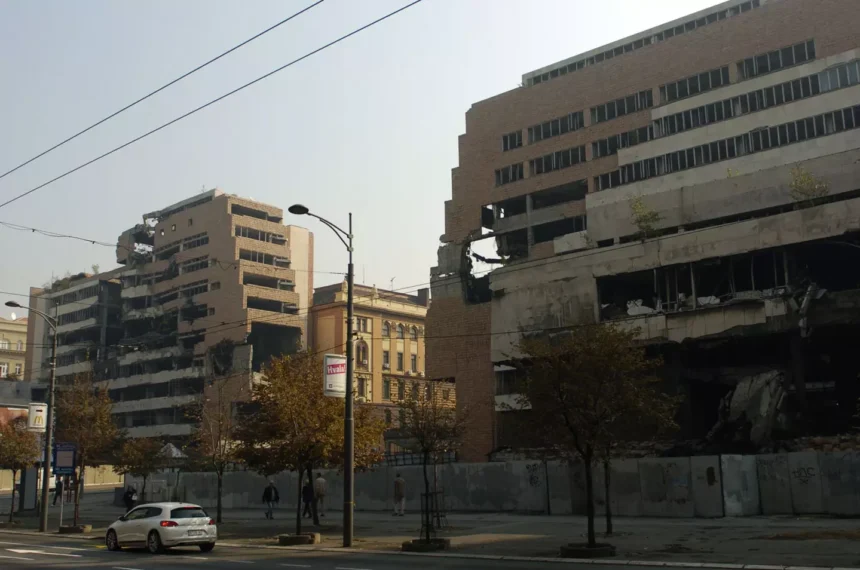
Following Jared Kushner’s withdrawal from the project linked to Serbia’s former General Staff complex, questions have emerged over whether the site could be renovated, or whether the Serbian government will seek a new investor.
Public debate in Serbia continues to intensify after Kushner’s company abandoned plans to develop a luxury complex on the site of the former Yugoslav Army General Staff building in central Belgrade.
A critical question now is whether Serbia may be required to pay compensation to Kushner’s company, given indications that contractual guarantees from the 2024 agreement may not have been fulfilled.
“Without the PR Shield of an American Partner”
Architect Miljan Salata, speaking to Deutsche Welle, highlighted another unresolved issue: the role of the second investor.
According to Salata, the project also involved Arab investor Mohamed Alabbar, through his company Eagle Hills, which is already active in the Belgrade Waterfront project.
“Without the PR shield provided by the American partner, and amid growing media pressure, it is questionable how willing the remaining investor will be to proceed,” Salata said.
He added that ongoing investigations and indictments related to the General Staff case have made the site less attractive to potential investors, although he believes authorities will continue searching for ways to push the project forward.
Cultural Heritage Versus Commercial Development
Estela Radonjić Živković, from Serbia’s Institute for the Protection of Cultural Monuments (RZS), also expects the government to seek a new investor, noting that authorities have consistently viewed the area as commercial real estate rather than an urban historical space.
She stressed that the removal of the General Staff’s cultural heritage status—despite its heavy damage during NATO’s 1999 bombing campaign—remains legally controversial.
Criminal Charges and Political Pressure
Kushner’s withdrawal coincided with indictments filed by Serbia’s Organized Crime Prosecutor’s Office against senior officials, including Culture Minister Nikola Selaković, for abuse of office and falsification of documents related to the removal of the site’s protected status.
President Aleksandar Vučić reacted sharply, threatening criminal charges against all those he accused of “destroying the investment”, including members of the police, prosecution, and institutions that resisted the legal changes.
Radonjić Živković warned that criminalizing professional work and intimidating public servants sets a dangerous precedent, undermining institutional independence and the rule of law.
Could Serbia Pay Compensation?
Media speculation has focused on whether Serbia may owe compensation to Kushner’s company if contractual obligations were breached.
“The attempt to strip the General Staff of its cultural status represents one of the greatest legal risks for the state,” Radonjić Živković said, adding that liability would fall on political decision-makers if the process is deemed unlawful.
Architects Propose an Alternative Solution
If a new investor is found, architects have pledged to oppose demolition and instead advocate for reconstruction of the complex, originally designed by Nikola Dobrović in the mid-20th century.
President Vučić has dismissed reconstruction, calling the building “structurally destroyed”, but architects argue otherwise.
They emphasize that the General Staff is severely damaged but structurally preserved, and that reconstruction of symbolic and historic buildings is standard practice across Europe and the world.
Reconstruction as an International Standard
Experts point to global examples such as Mostar’s Old Bridge, destroyed during war and later reconstructed and placed on UNESCO’s World Heritage List.
Similar conservation and reconstruction practices, they argue, demonstrate that the General Staff complex could be restored rather than demolished, preserving its architectural, historical, and symbolic value.