Zohran Mamdani was officially sworn in as Mayor of New York City shortly after midnight on Thursday, becoming the youngest mayor of the city in generations at just 34 years old.
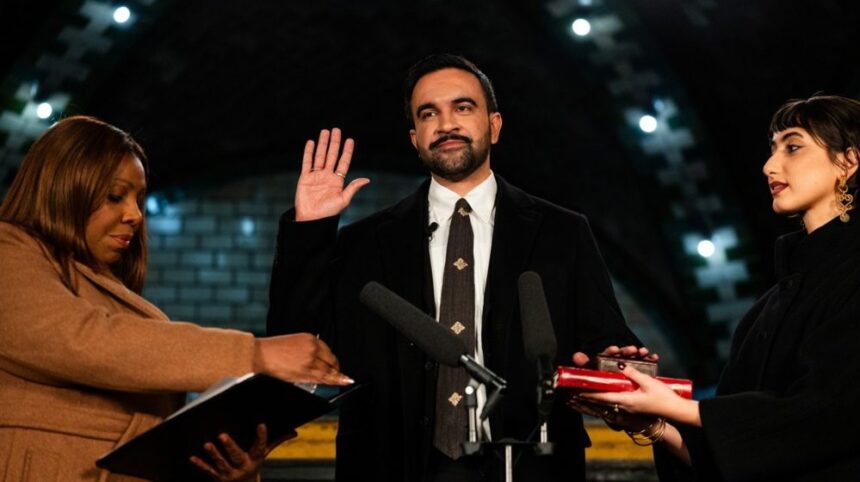
The Democratic Socialist leader took the oath of office in an unconventional ceremony held at the historic, abandoned City Hall subway station in Manhattan. Mamdani placed his hand on the Qur’an, marking a historic moment as the first Muslim mayor of the largest city in the United States.
“This is truly an honor and a privilege of a lifetime,” Mamdani said in a brief address following the ceremony, which was administered by New York Attorney General Letitia James, a close political ally.
In his first remarks as mayor, Mamdani highlighted the symbolic significance of the location, describing the former subway station as “a testament to the importance of public transportation to the vitality, health, and legacy of our city.” He also announced the appointment of Mike Flynn as the new Commissioner of the New York City Department of Transportation.
A formal public swearing-in ceremony is scheduled later in the day at City Hall, to be officiated by U.S. Senator Bernie Sanders, one of Mamdani’s most prominent political inspirations. The celebrations will conclude with a public gathering along Broadway’s “Canyon of Heroes.”
Beyond his religious milestone, Mamdani also makes history as the first mayor of South Asian descent and the first New York City mayor born in Africa. He was born in Kampala, Uganda, to acclaimed filmmaker Mira Nair and academic Mahmood Mamdani, before moving to New York at the age of seven. He became a U.S. citizen in 2018.
Mamdani rose through local politics after working on Democratic campaigns, winning election to the New York State Assembly in 2020, where he represented parts of Queens.
Ambitious Agenda, Complex Challenges
During a campaign that brought “affordability” to the center of political debate, Mamdani pledged far-reaching reforms aimed at easing the cost of living in one of the world’s most expensive cities. His platform includes free childcare, fare-free buses, a rent freeze for nearly one million rent-stabilized households, and pilot city-run grocery stores.
However, the new mayor now faces the practical realities of governing: sanitation services, infrastructure maintenance, public safety, and mass transit reliability—issues that directly shape daily life for millions of residents.
He takes office as New York City continues its recovery from the COVID-19 pandemic, with violent crime declining to pre-pandemic levels, tourism rebounding, and unemployment returning to earlier lows. Despite these improvements, soaring rents and persistent affordability concerns remain major sources of public anxiety.
Political Headwinds Ahead
Mamdani is also expected to face political friction with Republican President Donald Trump, particularly on immigration policy and federal funding. During the mayoral race, Trump had threatened to withhold federal funds from New York City and even suggested deploying the National Guard if Mamdani won. While the two later held a reportedly cordial meeting at the White House, policy clashes appear inevitable.
Additionally, Mamdani faces skepticism from parts of New York’s Jewish community due to his outspoken criticism of the Israeli government—an issue likely to remain politically sensitive.
In preparation for office, Mamdani’s team focused on continuity and institutional stability, including persuading Police Commissioner Jessica Tisch to remain in her role, a move seen as an effort to reassure business leaders and moderate voters concerned about abrupt changes to public safety policy.
As he begins his term, Zohran Mamdani steps into one of the most demanding roles in American politics, under intense national scrutiny and with expectations that his leadership could reshape not only New York City, but broader debates within the Democratic Party.