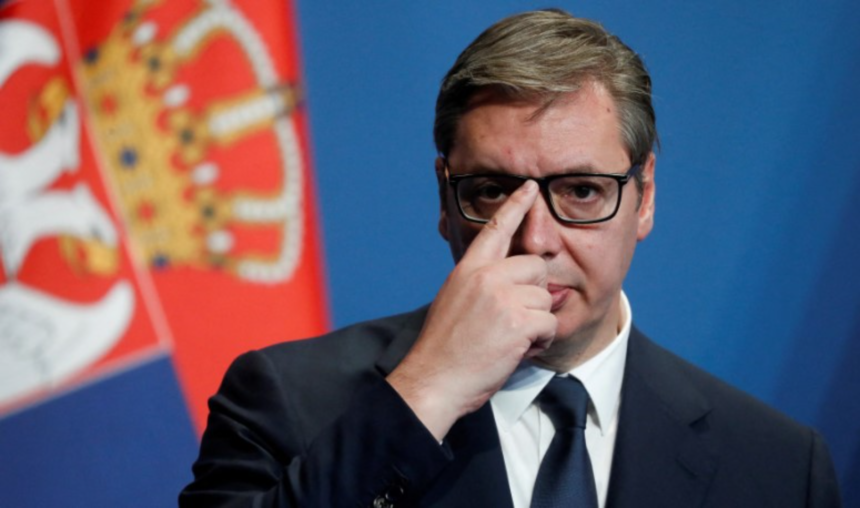
Security experts say recent claims by Serbian President Aleksandar Vučić regarding the armament of the Kosovo Security Force (KSF) are part of a broader psycho-strategic and propaganda campaign against Kosovo.
Following an extraordinary meeting of Serbia’s National Security Council on January 4, 2026, Vučić alleged that the KSF is being armed in violation of international law and claimed that a Croatia–Albania–Kosovo alliance directly threatens Serbia’s security interests.
Vučić described the situation as a serious security threat, stating that Serbia is preparing to defend itself—remarks that analysts say reinforce long-standing Serbian propaganda narratives.
Analysts: Vučić’s Claims Are Strategic Propaganda
Researcher Gurakuç Kuçi from the “Octopus” Institute told KosovaPress that the Serbian president’s statements should be viewed as psycho-propaganda operations.
According to Kuçi, Vučić is fully aware that Kosovo’s military development is taking place in coordination with NATO, yet deliberately portrays it as a threat to Serbia.
“Vučić knows very well that Kosovo is strengthening its military within NATO frameworks and in line with clear plans approved by the Alliance and the United States,” Kuçi said.
“Despite this, he uses the issue as part of a broader psycho-strategic operation, combining it with recent regional developments to create fear and political pressure.”
Kuçi emphasized that Kosovo’s institutions must be prepared to counter Serbia’s strategic communication (STRATCOM), particularly in the digital sphere.
Social Media and Disinformation as Immediate Threats
Kuçi highlighted social media and unregulated media outlets as an immediate area of concern, warning that coordinated manipulation is underway.
“Kosovo’s security institutions, together with civil society and credible media, must develop a counter-strategy to protect the public from propaganda and hybrid warfare,” he said.
“Numerous anonymous media platforms and social media networks are actively spreading divisive content that advances Serbian interests.”
Hibrid Info: Dangerous Narratives Create Panic
Festim Rizanaj, a researcher at Hibrid Info, said Vučić’s statements have amplified dangerous narratives, particularly among the Serb community in Kosovo.
According to Rizanaj, claims that Kosovo is arming itself to attack Serbia foster panic, fear, and a sense of victimhood, especially among communities that rely primarily on Serbian media.
“These narratives are dangerous because they create fear among Kosovo Serbs and misinform the public in Serbia about real developments,” Rizanaj said.
He urged audiences to verify information and rely on credible sources, especially on security-related issues.
Kosovo Ministry of Defense Rejects Claims
Kosovo’s Ministry of Defense dismissed Vučić’s allegations as false and tendentious.
In a statement to KosovaPress, ministry spokesperson Liridona Gashi stressed that the KSF’s development is strictly defensive and fully aligned with NATO standards.
“The Kosovo Security Force is developing its capacities for defensive purposes only, in accordance with Kosovo’s Constitution and in full coordination with our international partners,” Gashi said.
“The KSF is not oriented toward threatening or attacking any state. All military procurements are transparent and conducted with NATO member states—unlike Serbia.”
Dispute Over UN Resolution 1244
During the Security Council meeting, Vučić argued that the transformation of the KSF violates UN Security Council Resolution 1244, claiming it is being ignored by Western powers and Turkey.
He further alleged that the Prishtina–Tirana–Zagreb cooperation, including joint production of military systems, represents a direct threat to Serbia’s sovereignty and territorial integrity.
Kosovo’s institutions, however, reiterate that Resolution 1244 does not prohibit the establishment or development of the KSF, and that its transformation is constitutional, transparent, and internationally coordinated, including with NATO.
Serbia, meanwhile, continues to treat Resolution 1244 as legally binding, using it to contest Kosovo’s statehood and oppose the transformation of the KSF into a fully operational army.