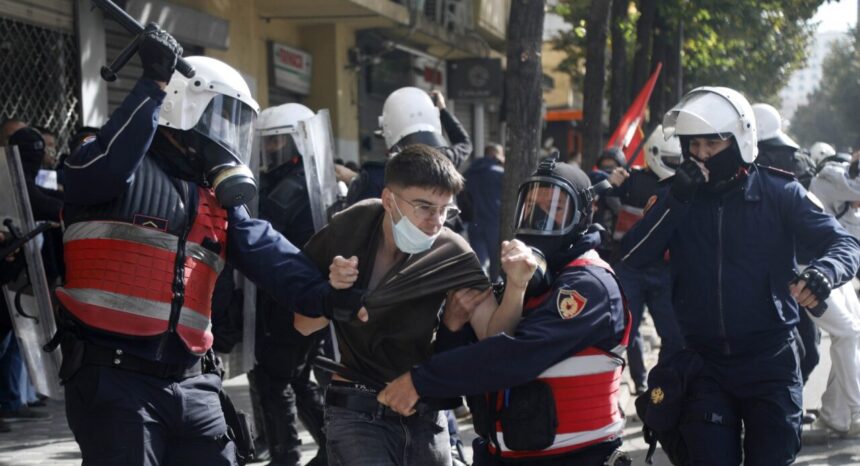
Albanian police have issued fines to 83 protesters in recent days under newly introduced legislation targeting anti-government demonstrations, prompting accusations that the government is using the measures to intimidate citizens and restrict their right to peaceful assembly.
On Thursday, police announced that they had issued 31 fines following Wednesday evening’s protest in Tirana, bringing the total number of penalties imposed under the new legislation to 83.
According to the police, those fined had blocked roads and obstructed vehicle traffic despite repeated warnings delivered through loudspeakers. Each individual received an administrative fine of 5,000 Albanian lek (approximately 55 euros).
The legislation was introduced by Prime Minister Edi Rama following months of daily anti-government demonstrations, which turned violent last month. It entered into force on October 28.
Rama has described the measures as a “legislative package against violence and urban anarchy”. The new provisions allow authorities to impose fines on protesters who fail to comply with police instructions.
The package also предусматри fines for participating in unauthorised gatherings, refusing to disperse when ordered by police, and concealing one’s identity with masks.
“Failure to comply with an order to disperse and the concealment of one’s identity shall be punishable by a fine of up to 5,000 euros for each participant,” Rama announced. Blocking traffic carries a fine of 55 euros.
Police imposed the first fines on Tuesday, penalising 16 protesters, followed by another 36 on Wednesday and 31 on Thursday.
Among those fined was photographer and activist Mei Seva, who told BIRN that she had been penalised while attending what she described as a peaceful demonstration outside the Prime Minister’s Office.
Seva said she had participated in the gathering, as protesters had been doing for more than 150 days, before going to a nearby shop to buy a snack. According to her account, a masked police officer without a visible identification number approached her and requested her identity card.
After photographing her ID, officers reportedly searched through photographs on a mobile phone before issuing her a 5,000-lek fine.
“When asked about the reason, they told me it was because I had blocked the road,” Seva said.
She described the measure as an intimidation tactic, arguing that the government was attempting to maintain its hold on power despite nearly five months of protests demanding its resignation.
Meanwhile, 15 civil society organisations have called on parliament to suspend the implementation of the legislation targeting public gatherings, describing it as unjustified and a violation of constitutional rights and freedoms.
The legislative package includes amendments to the Law on Assemblies, the establishment of a special electronic registry for individuals suspected of involvement in violence, and provisions governing compensation for damages caused during protests.
While acknowledging that acts of violence must be condemned and investigated, the organisations warned that the new measures could result in indiscriminate punishment of peaceful demonstrators.
“The violent actions of specific individuals cannot be used to broadly restrict citizens’ right to peaceful assembly, nor to impose collective responsibility upon protest participants or organisers,” the 15 organisations said in a joint statement.
Protests began over Zvërnec resort project
The demonstrations in Albania began on May 31, initially opposing a proposed luxury tourism resort in the protected environmental area of Zvërnec. The project has been linked to Jared Kushner, son-in-law of US President Donald Trump.
The protests subsequently expanded into a broader movement demanding the resignation of Rama’s government, which demonstrators accuse of corruption and economic mismanagement.
In October, the demonstrations escalated, with daily confrontations between police and young protesters. Despite mounting pressure and continued demonstrations, Rama has refused to step down.