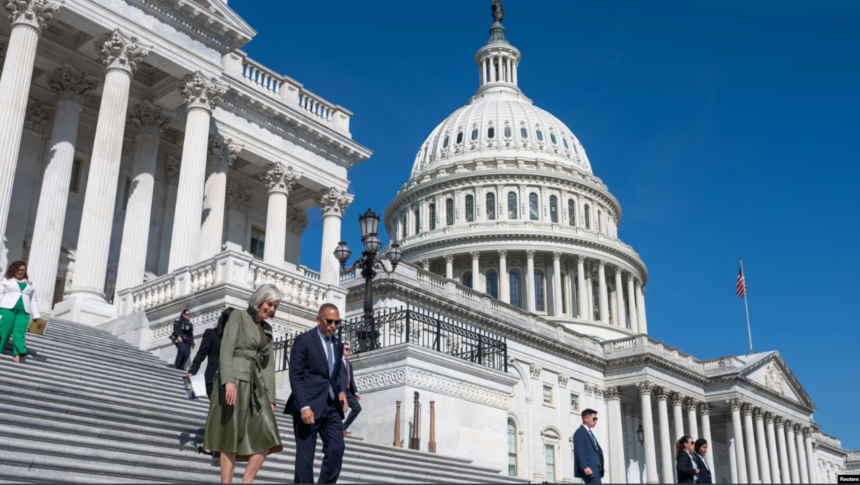
A Democratic majority in the US Congress could lead to closer scrutiny of the Trump administration’s policy towards Serbia and greater attention to relations between Kosovo and Serbia, according to American experts. However, they caution that no major diplomatic initiative should be expected in the immediate future.
The experts also suggest that Kosovo could use the changing political circumstances in Washington to take the initiative in improving relations with Kosovo Serbs and strengthening ties with lawmakers from both major US political parties.
The US midterm elections have reshaped the balance of power in Congress, a development that could have implications for American foreign policy. With Democrats gaining control of both chambers – the Senate and the House of Representatives – questions have emerged about what this could mean for Washington’s approach towards Kosovo.
Speaking to Radio Free Europe, American experts said the new congressional composition could bring greater engagement with the Western Balkans, while stressing that expectations should remain measured.
Robin Brooks, former Director for Central Europe and the Balkans at the US National Security Council, said that although Kosovo is not a daily priority for most American lawmakers, it remains an important ally of Washington.
According to Brooks, the new Congress, which begins its work in January next year, will initially focus on domestic issues, including high prices and the cost of medicines and fuel. Nevertheless, decisions made by the administration on foreign policy could also come under greater scrutiny.
She explained that Congress could hold the administration accountable if its actions conflict with American laws, values and norms. This could also include the way Washington asks other countries, including Kosovo, to cooperate on issues such as the deportation of individuals from the United States.
Although foreign policy may occupy a limited place on Congress’s agenda, lawmakers could have a more direct impact on relations between Kosovo and Serbia.
How could the change in Congress affect Kosovo-Serbia relations?
Edward P. Joseph, a professor at Johns Hopkins University, expects a Democratic-controlled Congress to apply greater pressure for a review of the Trump administration’s policy towards Serbia.
He said political developments in Serbia could further increase Washington’s attention and encourage the United States to pursue stronger engagement aimed at stabilising relations with Kosovo.
In Serbia, the Student List’s victory in the October 25 elections ended 14 years of rule by Aleksandar Vučić’s Serbian Progressive Party (SNS).
Joseph believes Kosovo should take advantage of these circumstances and urges Prime Minister Albin Kurti to reconsider his approach towards the country’s Serb community.
“Kurti has a rare opportunity to take the initiative and propose new policies that would improve relations both with Kosovo Serbs and with Serbia. On the other hand, if he continues with his current approach, Kosovo will face greater pressure and criticism,” Joseph said.
Over the years, Kurti has repeatedly faced criticism from the United States and the European Union over what they describe as unilateral actions in northern Kosovo, taken without coordination with Western allies and which, according to them, have increased tensions and insecurity among Kosovo Serbs.
Daniel Fried, a former US ambassador and senior State Department official, also sees some opportunities for more creative diplomacy in the region following the change of power in Serbia and the loss of Republican control of the US Congress.
“I would not expect a major initiative anytime soon,” Fried said, adding that closer cooperation between the United States and Europe could nevertheless help steer Serbia towards European integration.
He argued that Kosovo should seek to avoid being viewed exclusively through the prism of its disputes with Serbia and instead strengthen its own relationship with Washington. Achieving this, however, will require initiative from Kosovo itself.
“ Kosovo should also rely more strongly on its founding principles: democracy, the rule of law and its (wonderful) flag, which represents Kosovo as a state for everyone who lives in it,” Fried said.
Brooks, meanwhile, argued that Kosovo should not base its foreign policy exclusively on the current US administration.
“Trying to please the Trump administration was a mistake from the very beginning,” she said.
According to Brooks, this approach has drawn Kosovo into initiatives that have not necessarily delivered long-term benefits, including the Board of Peace.
She said Kosovo should focus on its European future and strengthen engagement with both political parties in the US House of Representatives and Senate.
One area where American lawmakers could play a role, Brooks noted, is encouraging the five EU member states that do not recognise Kosovo’s independence – Spain, Greece, Romania, Cyprus and Slovakia – to reconsider their positions.
The experts’ assessments suggest that the changing balance of power in Washington could create new opportunities for Kosovo, particularly through stronger bipartisan engagement and closer coordination with European partners. However, they stress that any progress will also depend on Kosovo’s own diplomatic initiatives and its approach to regional relations.