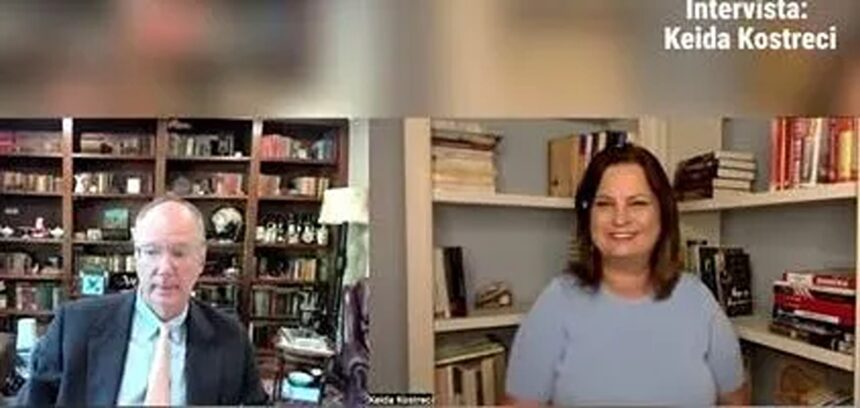
Following the Hague Special Court’s verdict against former Kosovo President Hashim Thaçi and other former KLA leaders, journalist Keida Kostreci interviewed Professor Paul Williams, an international law expert based in Washington, who strongly criticized the decision.
The full interview is reproduced below.
Keida Kostreci: Professor Williams, as I am sure you already know, the verdict in The Hague has been issued, and Mr. Thaçi, the former prime minister and president, along with three other former KLA leaders, have been found guilty and received lengthy sentences. What is your initial reaction?
Prof. Paul Williams: My initial reaction is that this is part of Europe’s effort to create a moral equivalence between the parties to the conflict in the former Yugoslavia. I can go into more detail about the quality of the judgment and the court’s political illegitimacy, but the narrative here is actually not about the conflict in Kosovo. It is about Europe’s continued pursuit of a policy of reconciliation and accommodation with Serbia, and this is simply an additional dimension of that policy.
Keida Kostreci: You are saying that this is another failure by Europe to hold the real perpetrators—namely Serbia—accountable. But in fact, this court was established—or primarily established—under the auspices of the United States and received strong U.S. support. How do you respond to that?
Prof. Paul Williams: Yes, this was a terrible mistake on the part of the Americans. The establishment of the court was driven by the fact that Europe had taken a hesitant and delayed approach to stopping the genocide and crimes against humanity that were taking place in the territory of the former Yugoslavia. To be honest, that war is a stain on the soul of Europe. Their solution is to cover up that stain through moral equivalence, and they succeeded in manipulating the Americans into supporting and pressuring Kosovo to establish this court.
I do not think the Americans devoted much energy to this issue or thought deeply about it. They needed it in exchange for other political concessions that Europe was making on the broader stage, and perhaps they thought the court would deal only with significant individuals, such as members of the Serbian regime’s forces who had committed atrocities in Kosovo. I think that if the Americans had known who would be indicted and how things would unfold, they would never have had anything to do with this court.
Keida Kostreci: You have been involved in this matter. Have you seen evidence that Mr. Thaçi and the other former KLA members committed the crimes for which they have now been convicted?
Prof. Paul Williams: Keida, as you know, I testified for the defense of Hashim Thaçi and the other accused, so I have a particular perspective on this. And in reading the summary of the judgment that was published today, what struck me was the extent to which an effort has been made to establish and assign guilt.
In virtually all of the other war-crimes proceedings we have seen before the International Criminal Tribunal for the former Yugoslavia, the Rwanda tribunal, and all the other tribunals, the cases involved direct command and control, the issuing of orders, and the direct commission of crimes. They involved serious and widespread atrocities: the siege of Sarajevo, the rape camps in Foča, the expulsion of 1.8 million Kosovars from Kosovo.
Here, essentially, they have constructed an argument based on the fact that these four individuals held positions that, under normal circumstances, would have given them power and authority. But, as I testified, in the chaotic circumstances of KLA activity and Serbia’s war of aggression against Kosovo, there was no traditional command-and-control structure.
In fact, one of the sentences in the summary was quite revealing. It refers to the fact that these individuals tolerated and accepted these crimes taking place. Now, that may be true—and the fact that crimes occurred appears quite clear—but attributing command responsibility and control to these four individuals is not only a major distortion of the law, but also a major distortion of political legitimacy.
And this seems insignificant compared with all the other international criminal proceedings that have taken place around the world. That is what I find quite shocking. We can also talk about how one-sided the process has been and how it moved away from its original jurisdiction. But that is my quick response.
Keida Kostreci: Let us continue and talk precisely about that…
Prof. Paul Williams: One of the things that I find shocking regarding the court’s legal legitimacy—or illegitimacy—and its political illegitimacy is the way it was originally established. And this also somewhat answers your question about why the Americans supported it.
The Council of Europe produced a fabricated report concerning the trafficking and removal of organs, which is scandalous. It turned out that this had not happened. It turned out that it was not mentioned at all in the prosecution’s case. And, of course, it was not mentioned in the summary of the judgment either.
But after the court was established and it became clear that there was no evidence for that matter, they began looking for other illegal activities or crimes that had occurred in order to attribute them to someone.
And what seems extremely illegitimate to me about that decision is the fact that terrible crimes had been committed against the people of Kosovo by the Serbian regime and Serbian paramilitaries, and they did not go and investigate those crimes. They specifically sought crimes that might have been committed by Kosovo’s political leaders so that they could create moral equivalence.
“Everyone is responsible. Do not blame us, Europe, for failing to act properly to stop these atrocities, because the situation was extremely complicated.”
You see, now we have these tribunal decisions concerning Kosovo that reinforce our inadequate response to Serbia’s crimes against humanity and against virtually all of its neighboring states.
Keida Kostreci: As you know well, these cases have value not only in themselves; they are also used in international law and political decision-making as precedents for other cases. So what are the implications of this decision for other cases, considering that we now have another war in Europe—and this could happen tomorrow between Russia and Ukraine, or in other conflicts around the world that you know better than I do?
Prof. Paul Williams: The establishment, operation, and judgment of this court will drastically undermine the effort toward legitimate justice for genuine victims around the world.
And I am shocked on two levels. First, because I have been deeply involved in Kosovo’s journey toward independence and understood that this was a strained effort to establish command responsibility and control, or what they call “joint criminal enterprise.”
But secondly, I am also deeply involved in other conflicts around the world, including Ukraine, in establishing justice mechanisms. Victims, parties, and others will look at this and say: “Wait a minute, we are not going to pursue these kinds of justice and accountability mechanisms because they can be so easily manipulated politically and turned against the victims.”
Think about this: There are 1.8 million victims of Serbia’s war of aggression in Kosovo who are being retraumatized by the operation and political illegitimacy of this tribunal, simply so that Europe can feel better about its inadequate response to Serbia’s war crimes.
And that is shocking to me. As I continue advising parties on transitional justice mechanisms, I will do so with extraordinary caution. You have to be extremely careful when constructing any kind of transitional justice mechanism that could fall victim to political capture.
This tribunal was created for political reasons, but you can see how these courts can be politically manipulated. And that is truly concerning for victims around the world of genuine atrocities committed by those who bear primary responsibility for those atrocities.
Keida Kostreci: Given that you have followed Kosovo and its politics for a long time, are you concerned about the consequences and instability within the country and the wider region that such a decision could cause? And what do you think the consequences will be for politics?
Prof. Paul Williams: I think that in Kosovo, the clear path forward is for the government of Kosovo to dissolve this court. They have waited long enough to see whether this court would actually be fair, depoliticized, and do the right thing—that is, begin investigating some of the atrocities committed by the Serbian regime, particularly those involving sexual and gender-based violence.
None of that happened.
But they somehow hoped to allow the judicial process to play out. And as things became clearer, the case would be dismissed or the defendants would be acquitted.
Now, there is an appeals process, but that will take several years. This is the right moment for the government of Kosovo to say: “Stop. This was a mistake. This court has been captured by political interests. It is a Kosovo court. We can amend the constitution; Kosovo can amend its constitution to dissolve this illegitimate court.”
I think the consequences for the region will be dramatic. And Europe, while trying to cover up the stain on its soul, has actually made the situation much, much more tense.
Serbs in Republika Srpska, Serbs in Serbia—who have just concluded celebrations for Mladić at his funeral, the man responsible for the genocide in Srebrenica and the siege of Sarajevo—will feel empowered by this.
“Look, we can commit war crimes. We can undermine stability in the region. And the Europeans will create a court that punishes the victims and creates moral equivalence between the parties.”
This will add fuel to the intense nationalism we see in Serbia and Republika Srpska. And it will cause destabilization. It will empower Serbia to continue its destabilizing efforts in the territory of the former Yugoslavia.
Keida Kostreci: What can the United States and the U.S. government do? There is something of a paradox here, because the current administration in this country has openly criticized courts.
What do you expect to happen, or what would you hope to see?
Prof. Paul Williams: I am astonished that the U.S. government, on the one hand, can be so hostile toward the International Criminal Court and, on the other, completely ignore what the Kosovo Specialist Chambers are doing to one of its key allies in the region and to a party that has been a victim—first, a direct victim of war crimes, and now a political victim of this tribunal.
I think the United States simply has not focused on this issue. And the more attention the Albanian-American community gives to this matter, I have the impression that if the U.S. administration were to stop and focus on the destabilizing impact that this tribunal and this decision have had and will have on the region, it could take effective steps within hours to work with Kosovo to dissolve this tribunal and put the process of victim catharsis back on the right track.
That may or may not be something this administration cares about, but promoting stability and restoring it in the region is something this administration genuinely has an interest in.
Keida Kostreci: There is, however, another perspective. A professor was quoted in a New York Times article this morning saying that this decision demonstrates that international justice—international criminal justice—works. How would you respond to that? And while you answer, I can find the name.
Prof. Paul Williams: If the purpose of the tribunal is to punish the victim population, deny the historical record, and eliminate the catharsis of victims—if that is the standard—then yes, I suppose these courts work.
But no. These tribunals were established to prosecute those who bore primary responsibility for the most serious crimes: genocide, widespread crimes against humanity, and widespread war crimes.
Bad things happen during war, and attributing responsibility for these things to political leadership simply because they allegedly “tolerated and accepted” them is not the purpose of these tribunals.
Think about the tens of thousands, hundreds of thousands of people who are killed in these conflicts. That is precisely why those responsible end up before these international tribunals.
And what happened here involved terrible things—detentions, torture, killings—but these things occur in all conflicts. To attribute responsibility for them to the political leadership when there was virtually no effective command-and-control mechanism—no, that is not what international tribunals are supposed to do.
This demonstrates that such tribunals are being exploited for political processes or purposes.
Keida Kostreci: In fact, it was Alex Whiting, the former deputy prosecutor at the Kosovo Specialist Chambers, who described the sentence as a sign of the resilience of international law at a time when the United States and other countries have ignored or attacked the International Criminal Court.
This also reminds us that many members of the prosecution teams were American and Western, which creates another problem, does it not?
Prof. Paul Williams: Yes. What you highlighted—the quote from Alex—actually represents another layer of the tribunal’s political illegitimacy.
Many people have genuine concerns about the position of the United States toward the International Criminal Court and its engagement in transitional justice around the world. And they are so determined to challenge this that they cling to this tribunal and this illegitimate decision to say: “Look, look, courts really do work.”
But in fact, this is precisely the argument that Americans make.
So, if you think about it, Trump and his administration may exaggerate their concerns about the ICC, but their fundamental concern is this: create a tribunal designed to prosecute those who bear primary responsibility for the most serious crimes, and it ends up turning against you.
What did the Kosovars do? They created a tribunal to prosecute those who supposedly bore primary responsibility—as it later emerged—for crimes that in fact had not occurred, such as the organ-trafficking allegations, and the tribunal turned against the political leadership of Kosovo that had created it.
So, in fact, what happened with the Kosovo tribunal supports Trump’s argument, which is unfortunate because he takes the issue to an extreme and insists on that position.
But, in fact, this confirms not that special courts work, but that a legitimate idea—even though this was not particularly legitimate from the beginning—can genuinely be exploited to undermine global security when it is directed against the United States and its allies, as well as regional security, just as this court has undermined regional security by turning against the very party that established it in order to promote justice.
Keida Kostreci: So, from your comments here, I understand that you agree with your colleague Jason Steinbaum’s argument that this court has been a failure.
Prof. Paul Williams: It is worse than a failure.
It was created to serve a political purpose, namely to establish moral equivalence—and it has succeeded in doing so—which constitutes a moral failure and a failure of the principles of the realism-based approach that our European friends claim to follow.
It is also a failure in terms of providing catharsis for victims and a failure to promote or contribute, even minimally, to security in the region. In fact, it will undermine security by empowering those who bore responsibility—states and state or sub-state entities—for the war of aggression against the people of the former Yugoslavia.
Keida Kostreci: You have spoken about your concerns, but what is your hope? And if the Kosovo government takes your advice, and that of others, to dissolve this court, what happens then? Would those convictions become invalid—only in the technical sense of international law, if you could explain?
Prof. Paul Williams: Yes. In fact, I do not know the answer to that technical question because this is the first type of court to be created in this manner.
An interesting legal question that I would like to put to some of my Kosovo colleagues is: Can the president of Kosovo pardon these individuals? Because that could also be a way of dealing with this travesty of justice.
My hope is that the Kosovo government will dissolve this misguided justice project and that the global effort toward genuine accountability and meaningful transitional justice can get back on track.
I also hope that the people of Kosovo and the victims of Serbia’s war of aggression against Kosovo will not have to live with this inaccurate historical record of moral equivalence hanging over them for decades to come.
And that is precisely why it is so important for the Kosovo government to act.
They somehow think: “Oh, this is only against the KLA or the PDK.” No, no, no, no.
The world, influenced by Serbian propaganda, will see this as a delegitimization of Kosovo’s path toward self-determination and independence, saying: “You see, everyone is responsible.”
Just a group of people in the Balkans who could not get along, who killed one another, and so on.
This feeds that narrative. And it is deeply concerning that the people of Kosovo, who fought a noble war for self-determination in the face of Serbian aggression, will have to live with that historical narrative.
Keida Kostreci: If we describe the political context within Kosovo itself—and I am taking on the role of the political expert here—the situation is complex. Within Kosovo, although the public is united and concerned about this moral equivalence, Mr. Thaçi as a politician and his party are not particularly popular. And, as we know, there have been allegations of corruption, which is why voters removed them from power…
Prof. Paul Williams: Political leaders, at certain moments, have to rise above partisan interests. They have to act on behalf of the entire population, the entire country, and the future citizens of their country.
Now, domestically, politics has its own dynamics, but I have always been impressed by Kosovo’s politicians and citizens. They know how to rise above these issues when it comes to the Rambouillet negotiations, the Vienna talks on final status, the declaration of independence, or efforts to secure international recognition.
This is one of those moments—a historic turning point—and it is the responsibility of whoever leads Kosovo’s political apparatus to take action to correct this injustice being done to Kosovo, its people, and future generations.
Keida Kostreci: Professor Williams, thank you very much for your thoughts and for your time.
Prof. Paul Williams: Thank you, Keida. It is always a pleasure to speak with you.