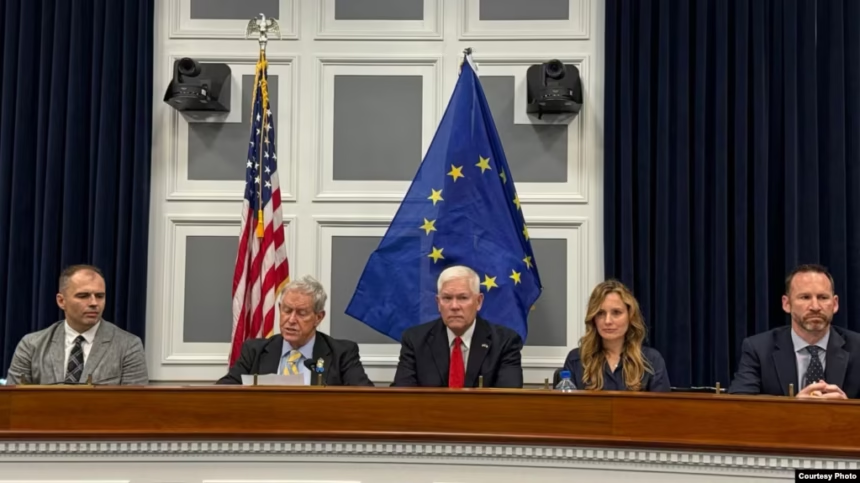
U.S. lawmakers and foreign-policy analysts raised concerns about the integrity of Serbia’s upcoming parliamentary elections during a congressional briefing on September 16, warning about alleged political pressure, corruption and growing Russian, Chinese and Iranian influence in the country.
The briefing was organized by the Congressional Caucus Against Kleptocracy, chaired by Congressman Joe Wilson, ahead of Serbia’s snap parliamentary elections scheduled for October 25.
The event featured analysts Ivana Stradner of the Foundation for Defense of Democracies, Reuf Bajrović of the U.S.-Europe Alliance and Luke Coffey of the Hudson Institute.
Opening the briefing, Wilson said he was concerned that the elections might not be free and fair.
“There are strong indications that Russia and the security apparatus controlled by Aleksandar Vučić are using every trick to rig these elections,” Wilson said, pointing to alleged manipulation of voter lists, propaganda and the use of state resources for political purposes.
Stradner described the elections as a test of whether Serbian citizens would be able to freely determine their political future.
“The integrity of these elections will test whether the Serbian people can freely determine their future without pressure, intimidation or foreign interference,” she said.
She accused the government of President Aleksandar Vučić of systematically weakening democratic institutions, exerting control over the media and using surveillance technologies against political opponents. She also argued that Serbia was simultaneously deepening its ties with Russia, China and Iran.
Stradner called on Washington to consider sanctions and visa restrictions against individuals she said were responsible for corruption, political violence and undermining democratic institutions, while urging greater U.S. pressure on Serbia over its cooperation with countries Washington considers geopolitical rivals.
Criticism of Western policy toward the Balkans
Reuf Bajrović criticized what he described as a longstanding Western approach that has prioritized larger states in the Western Balkans at the expense of neighboring countries.
“My basic argument is simple: appeasing regional heavyweights at the expense of neighboring democracies does not contain instability; it subsidizes it,” Bajrović said.
Turning to Bosnia and Herzegovina, Bajrović said Republika Srpska leader Milorad Dodik and HDZ BiH leader Dragan Čović had cooperated in efforts to block the introduction of technologies intended to strengthen electoral integrity.
“They are very successful in working together when it comes to blocking basic technologies for election integrity,” he said.
Bajrović also called on U.S. authorities to abandon what he described as a practice of making decisions concerning Bosnia and Herzegovina, Montenegro, Kosovo and North Macedonia without fully involving those countries.
Luke Coffey of the Hudson Institute said stability in the Western Balkans remained important to U.S. interests because of its connection to European security and economic prosperity.
He described Serbia as “the main Russian stronghold in the Balkans” and argued that Belgrade remains closely connected to Moscow.
“President Vučić must be viewed as he is, not as we would like him to be,” Coffey said, calling for what he described as a more realistic Western approach toward Serbia.
Elections scheduled for October 25
The congressional briefing comes ahead of Serbia’s early parliamentary elections, which were called after President Aleksandar Vučić dissolved the National Assembly and signed decrees scheduling the vote for October 25.
According to the briefing organizers, the discussion also examined the potential for electoral manipulation, the role of Serbia’s student-led anti-corruption movement and the possible implications of the election for Russian, Chinese and Iranian influence in the region.
The October vote will be Serbia’s 15th parliamentary election since the introduction of a multiparty system and the 11th early parliamentary election during that period.
The concerns expressed at the briefing were presented by individual U.S. lawmakers and analysts and do not, by themselves, constitute an official assessment of the integrity or outcome of Serbia’s elections.