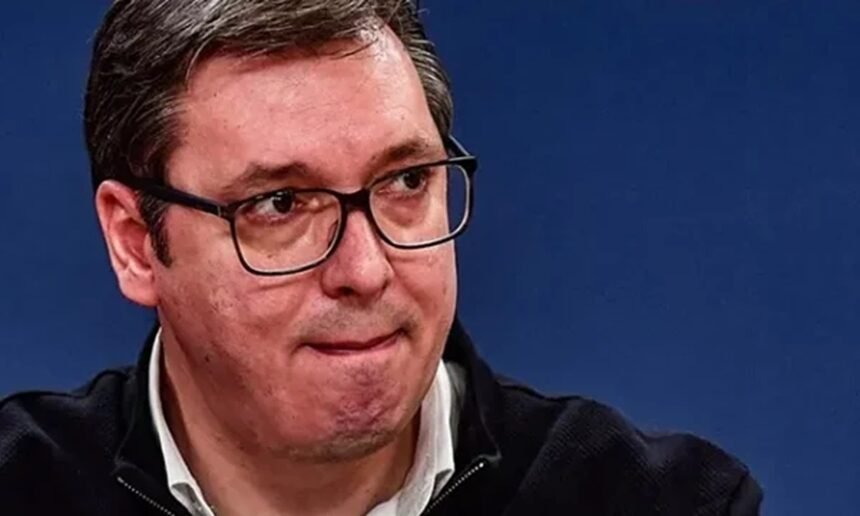
Serbian President Aleksandar Vučić has used the first-instance verdict against former Kosovo Liberation Army (KLA) leaders to reinforce a familiar political narrative, presenting himself as a defender of Serbs and emphasizing crimes that he says were not adequately addressed by the court.
Speaking after the Kosovo Specialist Chambers sentenced former KLA leaders Hashim Thaçi, Kadri Veseli, Jakup Krasniqi and Rexhep Selimi on several war-crimes charges, Vučić displayed photographs depicting alleged crimes against Serbs and other non-Albanian civilians.
He repeatedly focused on the six counts concerning crimes against humanity on which the defendants were acquitted, arguing that the court had failed to take into account the full extent of the crimes he associated with the KLA.
“All of that was not taken into account,” Vučić said, adding that there was no reason “either to rejoice or to mourn” over the verdict.
But beyond the legal arguments, Vučić’s response provides an opportunity to revive one of his most established political themes: portraying himself and the Serbian state as the principal defenders of Serb victims of the Kosovo war.
The timing also gives the Serbian president a potentially useful political issue ahead of the elections. By placing photographs of alleged victims at the center of his response and emphasizing what he described as the court’s failure to address the most serious crimes, Vučić can shift the public discussion from the details of the convictions toward the broader narrative of Serbian victimhood and unresolved justice.
His message was not simply that the verdict should be examined legally, but that Serbs should remain dissatisfied with the outcome and continue to wait for further proceedings.
Turning the verdict into a political message
Vučić also stressed that the case is not over, pointing to the appeals process and possible further legal review.
“We are mixing this with the Hague Tribunal. Here there is another instance,” he said, arguing that even if the judgment is upheld on appeal, further proceedings could remain possible.
“Even if the verdict is confirmed, which I find difficult to believe, there is also a third instance — the Constitutional Court of so-called Kosovo,” Vučić said.
The statement allows him to combine two messages: presenting the verdict as insufficient for Serbian victims while simultaneously urging his supporters not to treat it as final.
That approach also gives the president political room to portray Serbia as a side that has once again been denied full justice, regardless of the convictions handed down by the court.
The Specialist Chambers, however, found the four former KLA leaders guilty of several war crimes, while acquitting them of the six counts concerning crimes against humanity. The first-instance judgment remains subject to appeal.
A familiar electoral narrative
The response fits into a broader pattern in Vučić’s political messaging, in which Kosovo and the protection of Serbs are repeatedly presented as matters of national responsibility.
With elections approaching, the verdict offers an emotionally powerful subject around which that narrative can be renewed. Rather than allowing the discussion to remain confined to the legal findings of the Specialist Chambers, Vučić has placed the alleged suffering of Serbian victims and the perceived shortcomings of international justice at the center of his response.
This does not establish that the president’s reaction was motivated solely by electoral considerations. But the political timing is significant.
The Hague verdict gives Vučić an opportunity to speak directly to voters who remain deeply affected by the Kosovo conflict, while reinforcing his long-standing image as the political figure responsible for defending Serbia’s interests and the rights of Serbs in Kosovo.
For Vučić, the significance of the judgment therefore extends beyond the courtroom. The verdict provides another opportunity to turn Kosovo, unresolved wartime grievances and the question of justice for Serbian victims into a central political issue — and potentially to extract political momentum from an emotionally charged moment ahead of the elections.