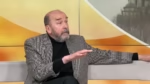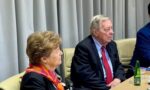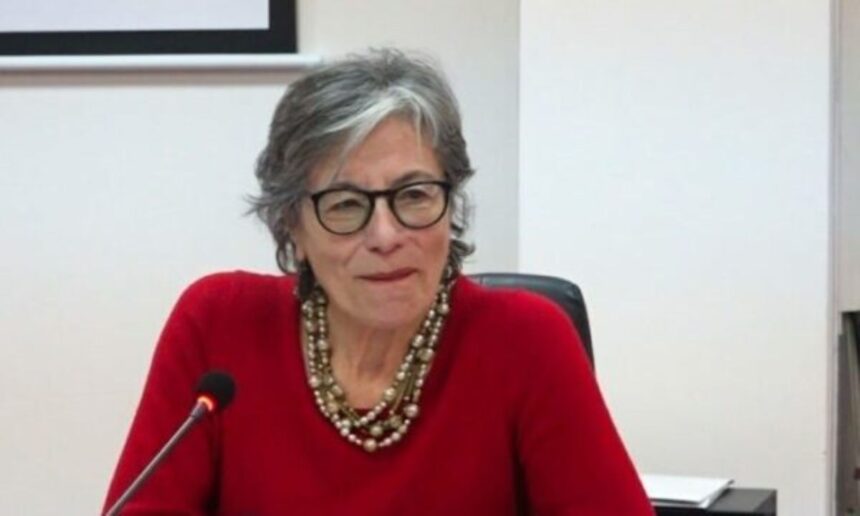
Prominent Italian academic, sociologist, and former UNMIK media commissioner Anna Di Lelio has issued a critical assessment of the ongoing legal processes at the Kosovo Specialist Chambers (KSC) in The Hague. Her commentary arrives at a highly sensitive geopolitical moment, as the international tribunal nears its highly anticipated final verdicts in the trial against former Kosovo Liberation Army (KLA) leaders Hashim Thaçi, Kadri Veseli, Jakup Krasniqi, and Rexhep Selimi.
Di Lelio, who recently co-authored the book The Strongest Bond alongside journalist Garentina Kraja documenting war crimes and systemic sexual violence perpetrated against women during the conflict, shared her analysis in an op-ed compiled for the high-level “Bridges of Memory” international conference. The event was co-organized by the Kosovar Institute for Policy Research and Development (KIPRED) and the civic organization “Liria ka emër” (Freedom Has a Name).
Redefining Transitional Reconciliation
Reflecting on her post-war tenure as Kosovo’s temporary media commissioner under the United Nations mission, Di Lelio challenged the standard, top-down international frameworks often imposed on war-torn societies regarding historical healing.
- Core Queries: Di Lelio asserted that any genuine institutional discourse surrounding post-conflict reconciliation—whether in the Western Balkans or globally—must first address foundational, uncomfortable questions: “Reconciliation between whom?” and “Reconciliation for what?”
- The Transparency Deficit: Observing panels that gathered global experts in transitional justice, Di Lelio noted that she was profoundly struck by the sharp, consensus-driven criticism leveled against the Hague tribunal by legal scholars. Panels repeatedly flagged a systemic lack of institutional transparency and highly compromised methodologies regarding evidence collection and verification.
Kosovo Specialist Chambers (KSC) Trial Profile (June 2026 Status)
========================================================================
Defendants       --> Hashim Thaçi, Kadri Veseli, Jakup Krasniqi, Rexhep Selimi.
Core Controversy --> Reliance on circumstantial evidence; heavily redacted testimonies.
Co-Organizers    --> KIPRED & "Liria ka emër" (Bridges of Memory Conference).
Key Critiques    --> Severe deficit in public transparency; flawed evidentiary filters.
========================================================================
The Danger of Flawed Evidentiary Filters in International Law
To articulate the grave institutional risks posed by the Special Court’s current trajectory, Di Lelio drew a vital structural parallel to the theoretical frameworks of a renowned Stanford University academic.
Anna Di Lelio: “The intense legal debates surrounding the Special Court vividly recalled the historic warnings of Stanford University historian Carlo Ginzburg. Ginzburg famously demonstrated that while both historians and judges are strictly bound to connect oral testimonies with physical, material evidence, their errors carry vastly different weights. Unlike a historian’s error, which can be corrected over time by subsequent academic research, a flawed judicial logic built upon circumstantial evidence or unverified hearsay yields devastating, irreversible consequences for innocent individuals and utterly compromises the integrity of justice itself.“
By echoing these warnings on the margins of the Prishtina summit, Di Lelio is adding her influential voice to a growing chorus of European legal experts who fear the Specialist Chambers are prioritizing political expediency over rigorous judicial standards. The critique underlines a growing domestic and international anxiety that a verdict constructed on fragile or politically manipulated evidence will permanently fracture the prospects of long-term regional stability.