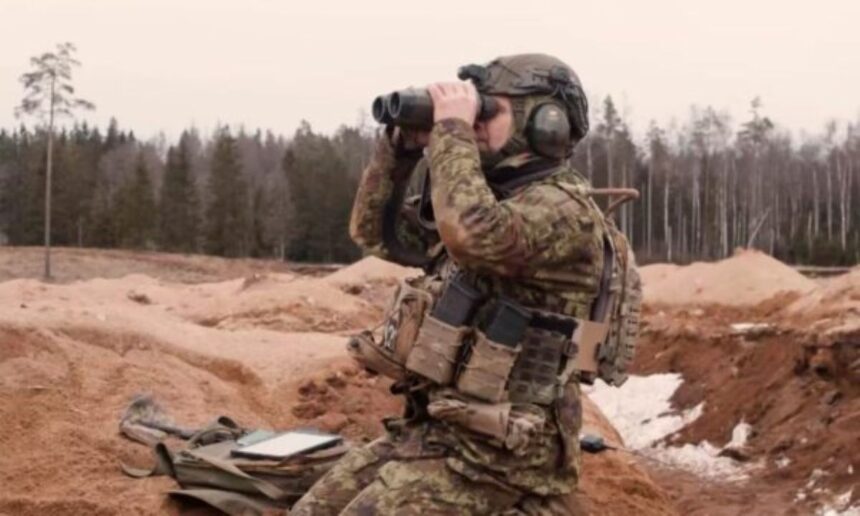
The Baltic states are stepping up preparations for a potential Russian threat as concerns grow over increasing airspace violations, drone incursions and other forms of suspected Russian hybrid activity along NATO’s eastern flank.
A letter seen by Radio Free Europe/Radio Liberty (RFE/RL) highlights growing concern over what its authors describe as a “deteriorating security environment” amid the rising frequency of airspace violations and drone incursions.
The July 30 letter was addressed to European Commission President Ursula von der Leyen and signed by European Commissioners Kaja Kallas of Estonia, Andrius Kubilius of Lithuania and Valdis Dombrovskis of Latvia, along with commissioners from Poland and Finland.
The letter was one of several warnings issued during the summer over the potential for Russian aggression. Concerns intensified following a reported August 25 visit to Moscow by CIA Director John Ratcliffe, who, according to sources familiar with the trip, urged the Kremlin not to escalate tensions with U.S. allies — particularly Estonia, Latvia and Lithuania.
The visit followed a Wall Street Journal report citing U.S. intelligence assessments that Russia could test NATO’s resolve with a limited incursion as early as this autumn.
Baltic diplomats speaking to RFE/RL on condition of anonymity said there had been additional indications of covert Russian operations during the summer, although there was no evidence of an imminent conventional attack.
They also warned that such operations could extend beyond the Baltic region. Recent suspected Russian involvement in attempted assassinations, fires and drone incursions in NATO countries including Germany, Poland and Slovakia has reinforced those concerns.
How Prepared Are the Baltic States?
At first glance, Estonia, Latvia and Lithuania appear relatively well positioned to respond to a range of potential Russian threats.
The three countries have warned about Russian malign activity for years and have invested heavily in both conventional defense and resilience against hybrid threats.
All three are either on track to meet or are working toward NATO’s long-term defense-spending target of 5 percent of GDP by 2035. The European Union has also pledged and begun channeling billions of dollars in defense and security financing toward the region.
The Baltic states have also developed advanced defense technologies, with Estonia emerging as a particularly active hub for military innovation.
Estonian company DefSecIntel Solutions, for example, has developed artificial-intelligence software capable of analyzing captured imagery and presenting information through a unified interface.
“We decided to stand alongside our Ukrainian colleagues. Since autumn 2022, we have been on the front line with them. Our technologies are being used there, and that has certainly given us a major boost,” Jaan Hein, the company’s vice president, told Current Time.
He said the company’s technology is being used to help protect Estonia’s borders as well as those of numerous other countries.
Another Estonian startup, Wayren, has developed software designed to run on smartphones, tablets and other battlefield devices, helping protect data communications from external interference.
“Estonia is unique in several respects. As a small country with a relatively small industry, we specialize in highly advanced technologies,” Wayren co-founder Henri Harm told Current Time.
“Not so much in large platforms such as tanks or ships, as larger countries do, but in smart and innovative solutions that can be integrated into such systems and provide an advantage,” he said.
But a closer look reveals significant vulnerabilities.
Funding Remains a Major Weakness
Negotiations over the European Union’s next seven-year budget have begun with a European Commission proposal that includes roughly $145 billion for security and defense investments.
However, some of the bloc’s largest net contributors, including Germany, have made clear that they favor a smaller overall EU budget.
Several EU officials fear that defense could become one of the areas facing cuts in the new financial framework.
That concern is reflected in the letter to von der Leyen, which calls for additional investment to strengthen the security and economic resilience of countries on the EU’s eastern frontier.
The commissioners also proposed that the entire European Commission urgently visit one of the frontline countries this autumn, arguing that the escalation of threats against the Baltic states requires greater political attention.
Tank Traps Instead of a “Drone Wall”
The letter’s central demand is additional financing, including roughly $115 billion aimed at strengthening the business and investment environment in frontline countries.
It warns that increased Russian drone activity and other hostile actions are already affecting the regional business climate and public confidence in security.
The proposed measures include rapid-response capacity for disruptions to electricity and gas infrastructure, regional reserves of essential goods and civil-defense equipment, shelters and evacuation infrastructure, as well as stronger capabilities to respond to hybrid, cyber, sabotage, electronic and information threats.
One notable omission is the long-discussed “drone wall” project.
The concept, which gained significant attention last year, envisioned equipping the EU’s eastern flank with interconnected sensors and capabilities to detect and neutralize hostile drones.
Progress, however, has been limited.
“It is easier to talk about a drone wall than to build one. But let’s be honest, nobody has one yet — not even the Ukrainians,” one Baltic official told RFE/RL.
The obstacles are financial, technical and legal. There is still no clear agreement over who should finance such an expensive system, while key components — including sensors, radars and an effective command-and-control architecture — have yet to be fully developed.
There is also an ongoing debate over whether such a system should eventually operate autonomously or remain under human supervision.
Rail Baltica and the Suwałki Gap
Another major concern is Rail Baltica, a strategically important infrastructure project that has faced years of delays and rising costs.
Launched in 2015, the project was intended to connect Estonia, Latvia and Lithuania — whose railway networks still largely reflect their Soviet-era infrastructure — with Poland and the wider EU rail network.
The original target of opening the line this year was abandoned long ago, while the revised 2030 deadline is also under pressure because of rising costs, weaknesses in the original planning, repeated design changes and disputes within and between the participating countries.
Rail Baltica is considered strategically important because it would create a vital corridor for the movement of NATO troops and military equipment.
It would also strengthen the defense of the Suwałki Gap, the narrow land corridor connecting Poland and Lithuania between Belarus, Russia’s ally, and the Russian exclave of Kaliningrad.
Military planners have long considered the corridor one of NATO’s most vulnerable strategic points in the event of a conflict with Russia.
Lithuania has sought to address that vulnerability by approving legislation this year for a military training area in the corridor and beginning preparatory work near the village of Kapčiamiestis.
The facility is expected to accommodate up to 4,000 Lithuanian and allied NATO troops for training.
It would complement Germany’s 45th Armored Brigade, which is being deployed north of the corridor, as well as a U.S.-led multinational NATO battalion stationed to the south in Poland.
Meanwhile, Latvia, Lithuania and Poland have strengthened their borders with Belarus with fences, trenches and other defensive infrastructure designed both to deter potential military incursions and to prevent irregular migration.
The three countries have accused Belarus and Russia of facilitating illegal migration attempts since 2021, allegations that Moscow and Minsk have rejected.
Questions Over the Right Defense Strategy
Despite these preparations, some experts question whether the region is investing in the right capabilities.
Valdas Tutkus, a former commander of Lithuania’s armed forces, has criticized the emphasis on traditional defensive infrastructure.
“We are buying a thousand trucks. We are building a defensive line, even though we are fully aware that modern warfare will not be fought with tanks,” Tutkus told Current Time.
He also questioned the rationale behind the planned training area at Kapčiamiestis, arguing that the government had failed to provide sufficient public justification.
“If the Defense Ministry had explained it clearly enough, we could discuss the issue. But unfortunately, for now, everything I have heard is: ‘Trust us, we need it,’” he said. “Unfortunately, I have not heard a single argument.”
The debate reflects a broader challenge facing NATO’s eastern flank.
The Baltic states are investing heavily in conventional defense, infrastructure, cyber capabilities and advanced technologies, while simultaneously preparing for a form of Russian pressure that may never resemble a traditional invasion.
Drones, sabotage, cyberattacks, disinformation and covert operations are increasingly becoming part of the security environment.
For Estonia, Latvia and Lithuania, the challenge is therefore not simply building enough tanks, troops or border defenses. It is developing a resilient security architecture capable of responding to a broad spectrum of threats while ensuring that European funding, NATO planning and national defense strategies remain aligned.
The Baltic states may be among NATO’s most alert members when it comes to Russia. The question now is whether Europe can match their sense of urgency with the money, infrastructure and capabilities needed to deter the threats they increasingly see on their doorstep.