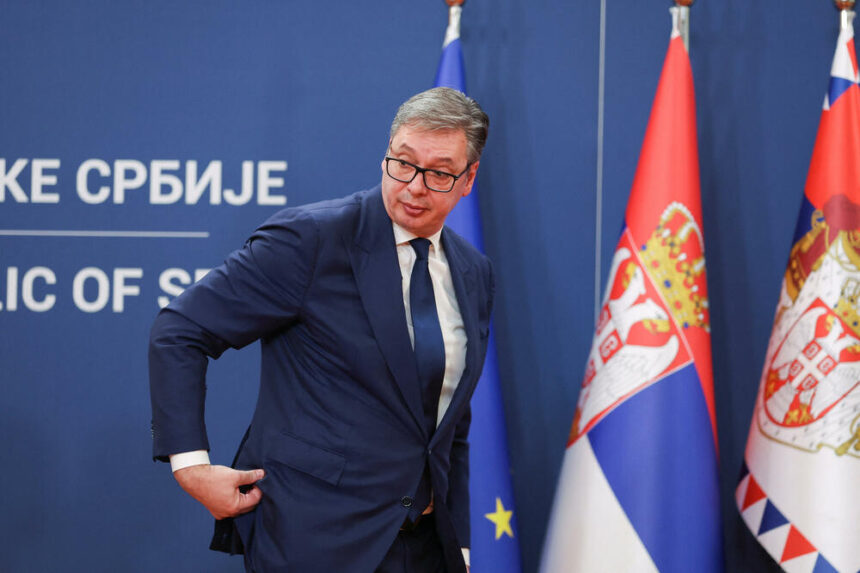
Serbian President Aleksandar Vučić is intensifying his political campaign ahead of potentially early parliamentary elections, as opposition pressure grows and signs of an increasingly coordinated strategy to preserve the ruling Serbian Progressive Party’s grip on power become more visible.
The latest signals range from suggestions that Serbia’s Constitution could be changed to allow Vučić to seek another presidential term, to warnings about potential post-election unrest and the possibility of preventive arrests.
When Parliament Speaker Ana Brnabić casually raised the possibility of constitutional changes that could allow Vučić to be elected president again, while SNS official Vladimir Đukanović urged Serbian security services to “keep all four eyes open” and prevent possible post-election “chaos in the streets,” the statements raised questions about whether the government is preparing for a contested election or simply seeking to intimidate opponents and reassure its supporters.
The developments have also fueled broader questions about the ruling party’s electoral strategy.
There may be no clearer indication that the government feels its support slipping than the intensive campaign being personally led by Vučić himself. This is taking place even before elections have formally been called and after several previously announced election dates failed to materialize.
The latest dates under discussion — October 18 or 25 — appear more plausible, particularly given plans to distribute one-off financial assistance to citizens in September and the intensity of the government’s political messaging during a prolonged heatwave.
Vučić in Every Village
The SNS campaign has never truly stopped, but its current form is noticeably different both in intensity and style.
Instead of the large rallies that once characterized Vučić’s political appearances, the president has increasingly adopted a model resembling the “Student in Every Village” initiative, adapted to his own political style.
He occasionally enters larger cities, but usually under tightly controlled conditions: a hospital in Novi Pazar, a school in Raška or a fenced-off area near a police station outside Kraljevo. Major central squares, where he once appeared before large crowds, are increasingly avoided.
His planned visits to Užice and Novi Sad are expected to be handled differently, with heightened security and strict logistical arrangements.
Ahead of Vučić’s planned visit to central Užice, residents of surrounding buildings were reportedly instructed to keep their windows closed, shutters down and café terraces shut.
The restrictions have fueled speculation over whether authorities are attempting to prevent protests or public displays of opposition during his visit.
The timing of a recent indictment against four Užice activists has also drawn attention. The activists, who were arrested last summer following a mass blockade of a major road, are accused of assaulting an official — an offense carrying a potential sentence of up to 12 years in prison.
Local observers have interpreted the timing as a possible preventive measure designed to discourage protests during Vučić’s visit, although no protest had been formally announced at the time the Radar report was prepared.
In a further example of political irony, opposition councilors in the Užice city assembly proposed creating an official committee to organize a ceremonial reception for the president, apparently anticipating what would happen. SNS councilors rejected the opposition proposal.
A Strategy Built Around Personalization
Vučić’s continued willingness to visit small towns despite frequent confrontations with dissatisfied citizens suggests that the strategy may be producing the desired political effect.
The model is relatively straightforward: responsibility for failures is shifted onto local representatives of the ruling political machine, while Vučić himself is portrayed as the leader who can solve citizens’ problems.
Among poorer sections of the population, this can reinforce the perception that the president is the only political figure capable of addressing basic economic and social needs — that Vučić is personally well-intentioned, but surrounded by incompetent officials, while those protesting against the government are portrayed as acting against the state.
The enormous amount of media exposure surrounding Vučić is another key component of the strategy.
According to the monitoring organization CRTA, Vučić appeared live on television 49 times during just the first 11 days of August — twice as many live appearances as he made during the entire month of August last year.
When confronted with the figures, Vučić responded simply: “That is my job.”
He has also promised to continue breaking media-appearance records, while saying that after he eventually resigns, he would appear live on television “not even a twentieth” as often.
Why he continues to announce a possible resignation while simultaneously expanding his political presence remains unexplained.
And Vučić is not campaigning alone.
According to an analysis by the Center for Investigative Journalism of Serbia, 22 senior state officials organized at least 160 official visits across the country between April 1 and August 17.
The scale of these activities is significant given that elections have yet to be formally called.
The question is whether this level of state-backed political mobilization, combined with familiar pre-election practices such as media dominance, disputed voter-roll issues, alleged vote-buying, threats and political pressure, will be enough to deliver the victory the ruling camp continues to predict.
The Mystery Surrounding SPS and SDP
The political calculations extend beyond the SNS itself.
Opinion polls indicate stable support — and potentially growing support — for the still largely undefined Students’ List, which has emerged as the main challenger to the ruling establishment.
Against that backdrop, the decisions of former coalition partners such as the Socialist Party of Serbia and the Sandžak Democratic Party to run separately in the next election have fueled speculation that their electoral strategies could form part of a broader arrangement with SNS designed to maximize the ruling bloc’s overall vote.
The situation surrounding the SDP is particularly complicated.
Rasim Ljajić resigned as party leader at the republican level in July, citing his inability to devote sufficient time to the party because of other responsibilities, particularly his work with Partizan. He subsequently resigned from his position at the football club as well.
Ljajić rejected suggestions that his departure had been coordinated with Vučić, pointing instead to the fact that SNS had recently removed five SDP officials from their positions.
He also argued that, had relations been normal, SDP would have continued running together with SNS, while denying speculation about a possible agreement with the student movement.
Meanwhile, another development has raised questions about political bargaining in the Sandžak region.
The Serbian state has stopped opposing the unification of the country’s two Islamic communities, leading to the signing of a charter establishing a unified Islamic community.
The decision, which had been awaited for two decades, has triggered speculation about a possible political trade-off involving the three largest Bosniak parties: SDP, the Party of Democratic Action and the Party of Justice and Reconciliation.
The SDA has initiated discussions about a possible joint parliamentary list, while SDP has expressed willingness to negotiate. SPP leader Usame Zukorlić has not rejected the initiative, instead linking a final decision to the party congress scheduled for September 4.
Whether the development involving the Islamic community will translate into additional minority votes for the ruling camp remains unclear.
Minority Lists as an Electoral Tool
Another potential source of parliamentary seats lies in Serbia’s electoral system for minority parties.
Special electoral rules intended to facilitate minority representation can also be exploited to establish parties that critics describe as artificial minority lists.
The Russian Party, for example, has previously played a role in electoral arrangements that helped SNS retain power in Niš.
The broader strategy may also involve Branimir Nestorović, whose political movement helped prevent the fall of the SNS administration in Belgrade.
For the next election, Nestorović’s political camp could potentially be strengthened by Vladimir Gajić’s People’s Party, Aleksandar Vulin’s Socialist Movement and a more explicitly pro-Russian orientation.
Former businessman and politician Bogoljub Karić is also increasingly visible, traveling around Serbia and making a range of political and economic promises.
Taken together, these developments suggest that the ruling establishment is preparing for an election in which every available political mechanism could matter.
The strategy combines intense presidential campaigning, extensive appearances by state officials, possible alliances with smaller political forces, minority-party calculations and the mobilization of political narratives designed to divide supporters from opponents.
Whether this “recipe” will be enough to preserve SNS dominance is ultimately a question for the voters.
But the preparations indicate that the ruling camp is already treating the next election as a high-stakes battle — and is mobilizing accordingly.