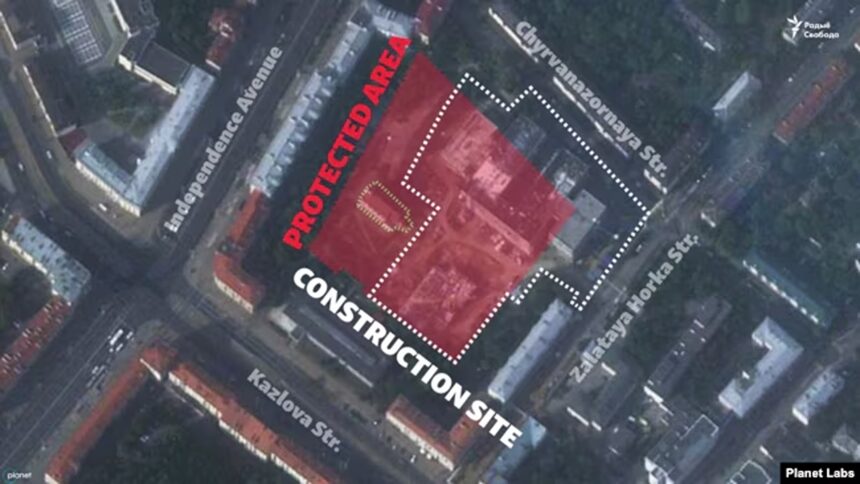
Belarusian authorities are building a major complex for the KGB’s National Security Academy on the site of a historic Catholic cemetery in central Minsk, according to an investigation by Radio Free Europe/Radio Liberty (RFE/RL).
The construction is taking place near St. Roch’s Church in the Zalataya Horka district, where Catholic graves survived partly through the Soviet era. The site had been designated a protected historical area in 2018, with regulations prohibiting new construction and underground infrastructure.
However, documents obtained by RFE/RL indicate that President Aleksandr Lukashenko approved a state investment provision allowing the project to proceed. The decree reportedly enables authorities to bypass legal protections for historic burial grounds. Officials have disclosed little about the project, which has been publicly described only as a “multifunctional building.”

A major security academy complex
Project documents describe a complex covering approximately 36,000 square metres across three sections. One six-storey building is designed for teaching and accommodation for 1,250 students, with 627 beds. Plans also include a shooting range, an arms storage facility, a cafeteria, sports facilities, a swimming pool and saunas.
The project’s chief engineer, Yuliya Serada, confirmed that a presidential decree had been issued but said the site’s protected status had not changed. She also indicated that archaeological work had not been planned, despite the historical significance of the location.
Independent architects and heritage advocates say the project demonstrates the selective enforcement of Belarusian law.
“Cemeteries are cemeteries. Nobody should be building there,” said Ales Bialiatski, the Belarusian human rights activist and 2022 Nobel Peace Prize laureate. He described the construction of a KGB training facility on the site as particularly cynical, given the historical persecution of the Catholic Church by Soviet security services.
Catholic community raises concerns
The development comes amid continued pressure on the Catholic Church in Belarus. According to the report, at least 20 Polish Catholic priests have been barred from serving or forced to leave the country since the beginning of the year.
Local churchgoer Paval Khadzinski, whose ancestor was buried in the historic cemetery, said the community deserves answers about human remains uncovered during excavation.
“When Christian cemeteries are destroyed, it is an insult to both the dead and the living,” he said, calling for a proper memorial and the reburial of the remains according to Christian rites.
The cemetery was closed to burials around 1920. In 2019, the local priest had welcomed its protected status as a guarantee against future construction. That protection has now been undermined by the new development.
The case raises serious questions about the preservation of religious and cultural heritage in Belarus, the transparency of state decisions, and the extent to which presidential authority can override existing legal safeguards.
#Belarus #Minsk #KGB #AleksandrLukashenko #CatholicChurch #ReligiousFreedom #HumanRights #CulturalHeritage #AlesBialiatski #RFE