The involvement of Chinese mining giant Zijin and the Russian-majority owned Petroleum Industry of Serbia (NIS) in the drafting of Serbia’s national mining strategy has ignited a fierce debate over corporate influence and environmental protections.
The “Strategy for the Management of Mineral and Other Geological Resources,” which outlines Serbia’s extraction goals through 2040 (with projections to 2050), serves as the legal foundation for all future mining regulations in the country. However, the inclusion of two of the nation’s largest industrial polluters in the government working group has led experts and NGOs to question whether the state is prioritizing foreign investment over the health of its citizens.
Consultative Process or Corporate Capture?
The Ministry of Mining and Energy defended the move, characterizing the participation of Zijin and NIS as a “standard and justified part of a broader consultative process.” According to the Ministry, engaging with stakeholders ensures that regulations are grounded in the “real-world conditions” of the industry.
A spokesperson for Zijin told Radio Free Europe (RFE) that their role was strictly to share operational expertise and provide a better understanding of the metallurgical sector.
However, critics argue this “consultation” feels more like a concession. Bogdan Šolaja, an academic and president of the “Environment” board at the Serbian Academy of Sciences and Arts (SANU), expressed grave concerns.
“The trend of changing laws results in adapting regulations and inspection controls to foreign investors rather than to the state,” Šolaja told RFE. “In our opinion, this is to the detriment of the state, placing Serbia in a colonial position.”
Environmental Red Flags
The controversy is heightened by the track records of the companies involved:
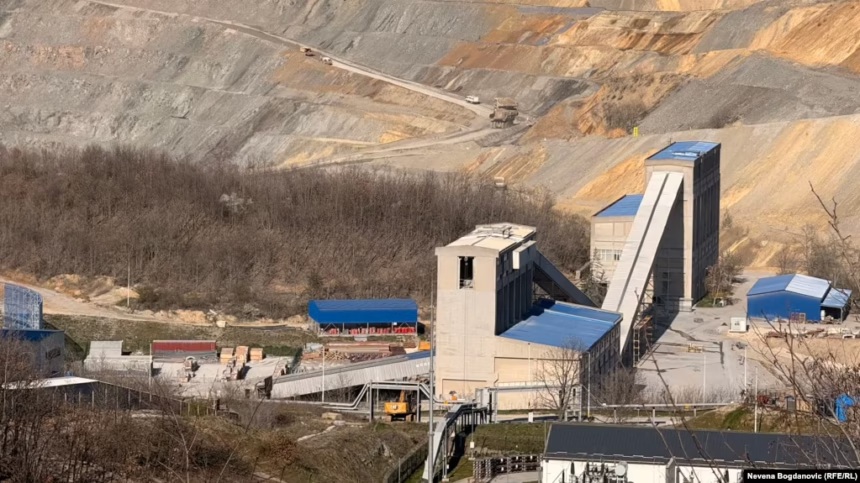
- Zijin: Operates massive copper and gold mines in Bor and Majdanpek. Despite being a top exporter, the company has faced numerous legal proceedings regarding environmental pollution and, as recently as April 2026, labor inspections regarding worker exposure to heavy metals.
- NIS: Majority-owned by Russia’s Gazprom Neft and currently under U.S. sanctions. The company operates Serbia’s only oil refinery and remains on the national register as a major polluter.
Environmental organizations, such as “Pravo na vodu” (Right to Water), warn that the new strategy ignores the issue of “meager mining royalties.” Currently, metal ore royalties in Serbia stand at 5%, while NIS pays a preferential rate of just 3%—a legacy of the 2008 sale agreement with Russia.
The Lithium Question
Beyond copper and oil, the Strategy also addresses the controversial Jadar lithium project. While the multinational firm Rio Tinto placed the project in a “care and maintenance” phase following mass protests, the new Strategy explicitly mentions the possibility of exploitation “if environmental standards are met.”
The European Commission recently designated Jadar as a strategic project for critical raw materials, estimating it could supply 90% of Europe’s lithium needs. For Serbian activists, the inclusion of lithium in a strategy co-drafted by mining corporations is a signal that the government is preparing to bypass public opposition.
Looking Ahead
With the Strategy now adopted by the Serbian Parliament, the Ministry is moving toward a new Law on Mining and Geological Research. While the Ministry has not confirmed if Zijin and NIS will be part of that specific working group, they noted that private entities “may be consulted,” maintaining that consultation does not equate to companies “determining legal solutions.”
For the residents of Bor and environmental advocates across the country, the thin line between “expert advice” and “legislative lobbying” remains a source of deep distrust.