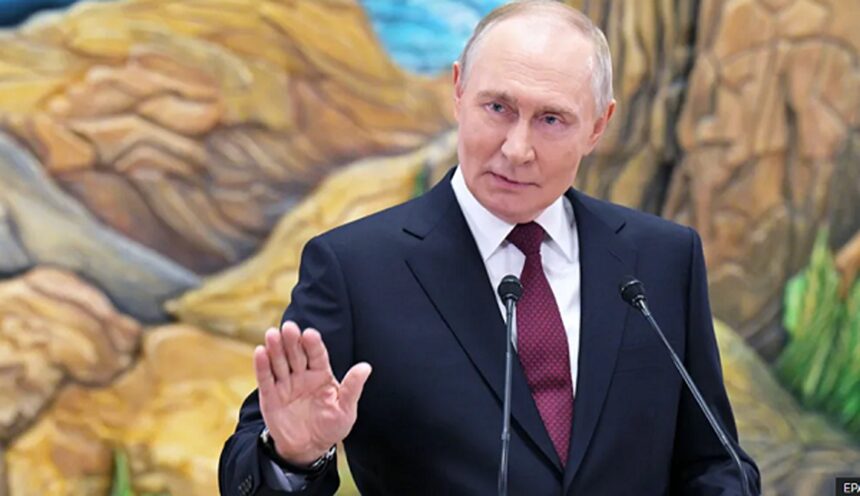
Russian President Vladimir Putin has invited several high-ranking members of the Alternative for Germany (AfD) party to the upcoming St. Petersburg International Economic Forum (SPIEF), a move signaling Moscow’s continued efforts to bypass diplomatic isolation by cultivating ties with Europe’s far right.
The forum, scheduled for June 2026, has historically been dubbed “Putin’s Davos.” Once a staple for mainstream European leaders like Angela Merkel, it has become a pariah event for Western officials following the full-scale invasion of Ukraine. However, for the AfD, it represents an opportunity to reinforce a platform centered on “pragmatic” energy ties with Russia.
AfD Lawmakers Confirm Attendance
At least two members of the Bundestag—Markus Frohnmaier and Steffen Kotré—plan to attend the forum. According to invitations seen by POLITICO, the letters were signed by Putin’s advisor, Anton Kobyakov, and stress that the Russian President is expected to attend the plenary session in person.
“We are confident that pragmatic cooperation will help strengthen your business, political, and cultural ties for the benefit of a just world and a secure future,” the invitation reads.
Stefan Keuter, the AfD lawmaker responsible for approving party travel requests, confirmed he would sign off on the trip, stating there is “absolutely no reason not to” attend from a political standpoint.
Strategy Ahead of State Elections
The decision to attend marks a notable shift in party optics. Earlier this year, AfD co-leader Alice Weidel reportedly discouraged high-profile trips to Russia to avoid alienating moderate voters in western Germany. However, the political calculus has changed as the party looks toward two critical state elections in eastern Germany this September.
In the former East Germany, the AfD leads in several polls, bolstered by a voter base that is statistically more favorable toward:
- Renewing ties with Moscow.
- Restoring the flow of cheap Russian natural gas.
- Ending economic sanctions that the party argues have harmed German industry more than the Russian economy.
A Pattern of “Pragmatic” Engagement
This is not the first time AfD members have broken ranks with the German government’s foreign policy. Lawmaker Steffen Kotré previously sparked backlash for attending a BRICS conference in Sochi in late 2025.
The St. Petersburg forum is seen by the Kremlin as a vital tool for projecting economic stability. By inviting European lawmakers, Moscow aims to demonstrate that it still has “friends” within EU parliaments, even as Brussels remains officially committed to decoupling from Russian influence.
As the June forum approaches, the presence of German federal lawmakers in St. Petersburg is expected to draw sharp condemnation from the ruling coalition in Berlin, further polarizing the debate over Germany’s future role in European security and energy independence.