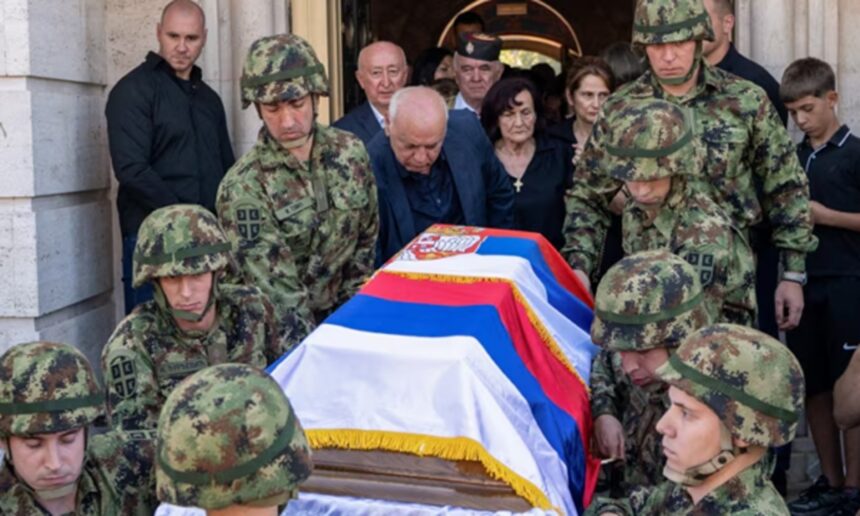
Former commander of the Army of Republika Srpska, Ratko Mladić, who was convicted by the Hague Tribunal of genocide and other war crimes in Bosnia and Herzegovina, was buried in Belgrade on Monday with state and military honors.
Mladić, who died on August 27 in The Hague while serving a life sentence, was buried at Topčider Cemetery.
The ceremony included military honors, farewell speeches and public tributes in which his wartime past was glorified.
In the presence of members of the Serbian Army, political leaders from Republika Srpska and Serbian officials, those gathered chanted Mladić’s name and applauded as his coffin was taken to the cemetery.
The European Union and the United States had warned that honoring and glorifying individuals convicted of war crimes is unacceptable.
Porfirije Led the Funeral Service
Mladić’s coffin was displayed during the day at the Church of St. Luke in Belgrade, where the funeral service was led by Serbian Orthodox Church Patriarch Porfirije.
During the ceremony, members of the Serbian Army’s honor guard stood watch while prayers were offered asking that “General Ratko’s sins, committed knowingly and unknowingly,” be forgiven.
Porfirije said that Mladić’s name “will remain deeply engraved in the memory and prayers” of a large part of the Serbian and Orthodox population.
He also said that the Serbian people “harbor deep gratitude” toward Mladić, portraying him as a “soldier and commander who, in difficult times, stood at the head of his people’s army.”
Who Paid Tribute to Mladić?
Among those who traveled to Belgrade to pay tribute to Mladić were Bosnian and Serbian political figures, including Bosnian Serb leader Milorad Dodik, Republika Srpska President Siniša Karan, Banja Luka Mayor Draško Stanivuković and Željka Cvijanović, a member of the Presidency of Bosnia and Herzegovina.
Several Republika Srpska officials and Serbian government ministers also attended.
Those present included Serbian Defense Minister Bratislav Gašić, Justice Minister Nenad Vujić, Culture Minister Nikola Selaković and Minister without Portfolio Nenad Popović. Russia’s ambassador to Belgrade, Alexander Botsan-Kharchenko, was also present, as was Danilo Vučić, the son of Serbian President Aleksandar Vučić.
Members of the Russian motorcycle group Night Wolves, known for their support for the Kremlin, were also among those attending.
Serbian President Aleksandar Vučić did not attend the funeral, saying beforehand that he could not be present because of the scheduled visit to Belgrade by Uzbek President Shavkat Mirziyoyev.
Vučić said he had “done everything” to ensure that the funeral was conducted “with dignity” and rejected criticism from the European Union over the treatment of Mladić.
Warnings From the United States and European Union
US Senators Jeanne Shaheen, Chuck Grassley and Keith Self called on authorities in Serbia and Republika Srpska to distance themselves from the Mladić funeral.
In a joint statement, the senators recalled Mladić’s responsibility for the genocide and other crimes in Bosnia and Herzegovina, describing them as among the most horrific crimes committed in Europe since the Second World War.
They specifically cited the Srebrenica genocide, in which more than 8,000 Bosniak men and boys were killed, as well as the nearly four-year siege of Sarajevo.
The senators warned that officially commemorating or glorifying Mladić would dishonor the memory of his victims and the region, which continues to live with the consequences of his campaign of ethnic cleansing.
They urged the governments of Serbia and Republika Srpska to ensure that no official statement or action portrays Mladić as anything other than “a convicted architect of genocide.”
Two US congressmen, Greg Murphy and Marc Veasey, also visited Potočari on Monday to pay tribute to the victims of the Srebrenica genocide and reaffirm US support for preserving historical truth and promoting accountability.
The US Embassy in Bosnia and Herzegovina said the delegation paid tribute to those who lost their lives and expressed solidarity with survivors.
The EU Delegation in Bosnia and Herzegovina said that glorifying war criminals, denying genocide and promoting historical revisionism contradict fundamental European values and have no place in the EU or in countries seeking membership.
EU Enlargement Commissioner Marta Kos canceled a planned visit to Serbia, saying that the glorification of a person convicted of war crimes and genocide in Bosnia and Herzegovina is “incompatible with the values on which the European path is based.”
State Resources and the Glorification of Mladić
A memorial ceremony for Mladić was also held on Saturday, September 5, at the House of the Serbian Army in Belgrade.
Among those attending were Serbian Justice Minister Nenad Vujić and Republika Srpska President Siniša Karan.
The Youth Initiative for Human Rights in Serbia condemned what it described as the “misuse of state resources” in transporting Mladić’s body and in preparations surrounding the commemorative events.
In media narratives in Belgrade and Banja Luka, Mladić was portrayed as a victim of the Hague Tribunal, with claims that he had been prevented from receiving medical treatment in Serbia. His conviction and the suffering of his victims were largely pushed into the background.
The OSCE Mission to Bosnia and Herzegovina said it was concerned about the live broadcast of the Mladić memorial ceremony by Republika Srpska’s public broadcaster, RTRS, during which speakers repeatedly glorified him.
The OSCE called on the Communications Regulatory Agency to assess the broadcast without delay and respond proportionately to any violations identified.
“Respect for facts established by courts and for the dignity of victims and survivors is essential for responsible journalism, reconciliation and lasting peace in Bosnia and Herzegovina,” the OSCE said.
The tribute to Mladić took place despite Bosnia and Herzegovina’s criminal law prohibiting and punishing the public denial of genocide, crimes against humanity and war crimes established by final court judgments, as well as the glorification of individuals finally convicted of war crimes.
Such offenses can carry prison sentences of up to five years.
The burial of Ratko Mladić has therefore become more than a funeral. It has become another major confrontation over historical truth, accountability and Serbia’s relationship with Europe.
For the victims of Srebrenica and Sarajevo, the question is not how Mladić is remembered by his supporters.
It is whether the crimes for which he was convicted will be remembered at all.