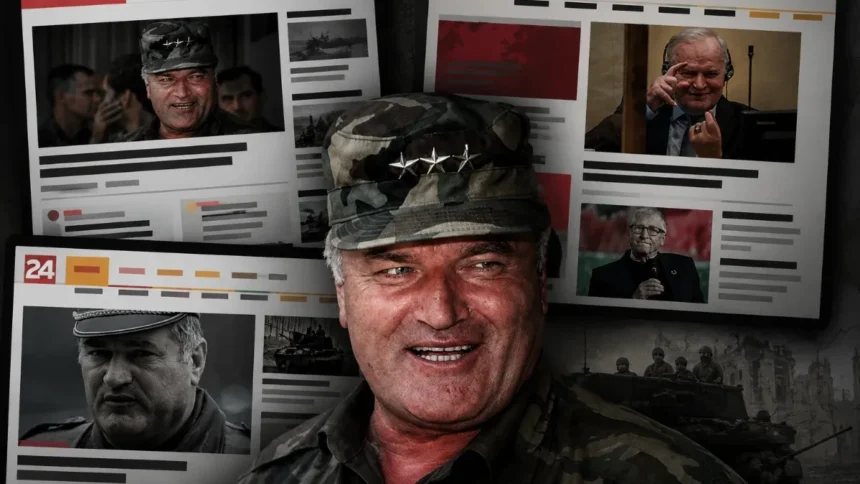
The death of convicted war criminal Ratko Mladić has triggered a sharp media backlash in Serbia after several major Croatian outlets used highly critical headlines to report his death, prompting an angry response from the pro-government, pro-SNS Serbian tabloid Alo.
Mladić, the former commander of the Main Staff of the Army of Republika Srpska, died at the age of 84 after being convicted by the International Criminal Tribunal for the former Yugoslavia and sentenced to life imprisonment for genocide, crimes against humanity and war crimes.
Croatian media uses “butcher,” “monster” and “war criminal”
Several major Croatian news organizations immediately highlighted Mladić’s wartime record in their coverage.
Index published the headline “Ratko Mladić, the Butcher, Has Died,” while its subheadline described him as “one of the worst monsters of the 20th century.”
Jutarnji list reported his death under the headline “War Criminal Ratko Mladić Has Died,” while also publishing a separate article focusing on his refusal to repent for his crimes and his confrontations with judges during the Hague proceedings.
The Croatian portal 24sata similarly used the headline “Ratko Mladić, the Butcher, Has Died!” and prominently identified him as a war criminal.
The descriptions reflect the fact that Mladić was convicted by the UN tribunal for some of the gravest crimes committed during the Bosnian War, including genocide in Srebrenica.
Pro-SNS Alo furious over the headlines
The Croatian coverage has drawn a particularly angry reaction from Alo, a Serbian tabloid widely associated with the pro-government and pro-SNS media camp.
In its own report, Alo accused Croatian media of competing over who could use the “most brutal” description of Mladić and portrayed the headlines as evidence of what it characterized as hostility toward the former Bosnian Serb commander.
The outlet objected specifically to the use of terms such as “butcher,” “monster” and “war criminal,” arguing that Croatian media had abandoned what it described as neutral reporting in favor of openly hostile characterizations.
Alo’s reaction is itself revealing: rather than focusing exclusively on the judicial record behind Mladić’s conviction, the Serbian outlet presented the Croatian headlines as an attack on Serbian national identity and as another example of the continuing confrontation between Serbian and Croatian narratives about the wars of the 1990s.
A legacy that remains deeply divisive
Mladić’s death has once again exposed the radically different ways in which his legacy is treated across the region.
International courts found him responsible for genocide, crimes against humanity and war crimes and sentenced him to life imprisonment. His conviction included responsibility for the Srebrenica genocide and crimes committed during the siege of Sarajevo, while he was acquitted of genocide charges relating to six other municipalities.
At the same time, parts of Serbia’s political and media establishment have continued to portray Mladić in nationalist terms rather than treating his legacy solely through the findings of international courts.
That tension was visible immediately after his death. Croatian outlets emphasized his criminal conviction and the victims of the crimes attributed to him, while Alo focused on the language used by those outlets and condemned what it portrayed as an excessively hostile portrayal of the former VRS commander.
The clash over the headlines demonstrates that Mladić’s death has not closed one of the region’s most contentious historical chapters. Instead, it has reopened the same battle over memory, responsibility and national narratives that has persisted for decades.