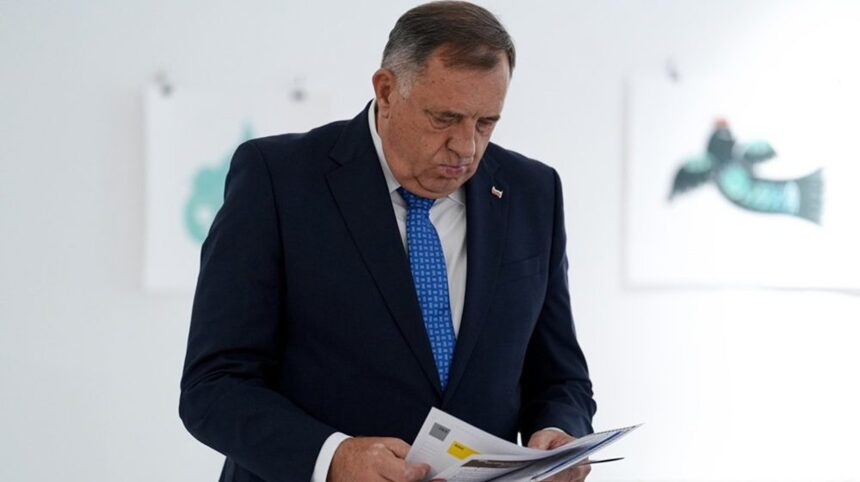
Dodik, Izetbegović and Čović represent different nationalist agendas, but their political survival rests on a system that keeps Bosnia and Herzegovina divided, dysfunctional and trapped in the hands of entrenched elites. While they fight over power, influence and ethnic representation, ordinary citizens face economic decline, mass emigration and a future that is becoming increasingly difficult to imagine.
A discussion on Radio Free Europe featuring Sarajevo professor Enver Kazaz and Banja Luka social psychologist Srđan Puhalo paints a bleak picture of Bosnia and Herzegovina after the latest elections: nationalist parties remain dominant, political dynasties are consolidating their influence, and the country’s most urgent problems continue to be pushed aside.
The central question is brutal: Are these political leaders defending their communities, or exploiting ethnic fears to preserve their own power?
Dodik: A political dynasty built around one man
Milorad Dodik remains the dominant force in Republika Srpska, and the strong electoral performance of his SNSD party reinforces his control over the entity’s political landscape. But the discussion raises concerns about the possibility of his son, Igor Dodik, becoming prime minister.
Puhalo argues that the votes Igor received were largely votes for his father, who dominated the campaign. He also questions whether Igor possesses the expertise and political capacity required to lead Republika Srpska.
The implication is hard to ignore: when a father’s political influence becomes the strongest qualification for his son’s rise to power, the boundary between public institutions and a family’s political interests becomes dangerously blurred.
Kazaz describes Dodik as an authoritarian and calculating nationalist who continually pushes the boundaries of his political ideology. He argues that, despite Dodik’s grip on power, Republika Srpska is suffering economically, demographically and culturally.
The contradiction is stark. Dodik presents himself as the defender of Serb national interests, yet the commentators describe an entity struggling with economic hardship, population loss and the departure of socially active citizens. Nationalist rhetoric may mobilise voters, but it cannot reverse these problems on its own.
Izetbegović: Family legacy cannot substitute for political leadership
Bakir Izetbegović and the Party of Democratic Action (SDA) face a different crisis. Despite the party’s strong performance, Izetbegović failed to win election to Bosnia and Herzegovina’s state presidency.
Kazaz is sharply critical of Izetbegović’s leadership, describing him as politically incompetent and arguing that he relies heavily on the symbolic legacy of his father, Alija Izetbegović. He also points to public distrust surrounding the Izetbegović family and alleged connections between political power and wealthy business interests.
The discussion further raises concern about the increasingly hard-line positions of some SDA figures. Kazaz argues that the party’s electorate has become more radicalised amid dissatisfaction with Izetbegović’s leadership.
A family name may secure political loyalty, but it cannot guarantee competence, public trust or effective governance. The question facing SDA is whether it can offer a credible political future beyond inherited influence, established networks and nationalist mobilisation.
Čović and Dodik: Different agendas, overlapping interests
Dragan Čović and the Croatian Democratic Union of Bosnia and Herzegovina (HDZ BiH) are criticised for their close political alignment with Dodik’s SNSD.
The commentators warn that the two political leaders could exercise considerable influence at state level through their positions in Bosnia and Herzegovina’s complex institutional system, particularly the House of Peoples.
Čović continues to push for changes to the electoral law, while Dodik seeks to preserve his leverage over state institutions. Kazaz argues that their alliance strengthens both leaders’ bargaining power and could further weaken the functioning of the state.
Puhalo questions whether HDZ’s declared commitment to the European path will take precedence over its political objectives, suggesting that the party could use its alliance with SNSD to extract further concessions.
The danger is that ethnic grievances become permanent political bargaining tools. When leaders repeatedly turn disputes over representation into struggles for institutional control, the costs are borne by a society already exhausted by political deadlock.
The commentators also warn that whichever Bosniak party enters government alongside SNSD and HDZ could face a political backlash after four years of cooperation, particularly if voters conclude that it has sacrificed its promises in exchange for government positions.
Nationalism thrives while the country loses its future
The discussion goes beyond the three political figures. Kazaz argues that nationalism remains entrenched because it draws on fear of other ethnic groups, patronage networks and political control over parts of society.
He describes a system in which political loyalty can be reinforced by dependence on public institutions and state-owned companies. Puhalo similarly argues that disappointment with the previous governing coalition helped push voters towards nationalist parties.
Meanwhile, the country is ageing, young people are leaving, and the economic outlook remains deeply troubling.
Kazaz cites the dramatic decline in student enrolment at his own faculty department: from 60 students in the past to just two this year. He warns that the population is ageing rapidly and that remittances from the diaspora remain essential to many households.
Puhalo warns that Bosnia and Herzegovina risks becoming a society dominated by older people, abandoned communities and environmentally damaging industrial projects. Both commentators question how sustainable the country’s institutions can remain if its working-age population continues to shrink.
Their criticism exposes a painful contrast: political leaders continue to compete over nationalist symbolism, while the country struggles to retain the people needed to sustain its economy and public services.
A political system serving itself
The discussion also questions whether Dodik will abandon his opposition to European integration in exchange for European funding. Kazaz doubts that financial incentives alone will change Dodik’s political approach, pointing to expensive borrowing and the difficult economic conditions in Republika Srpska.
The wider concern is that European integration becomes another instrument in political bargaining rather than a consistent programme of reform.
The same problem affects Bosnia and Herzegovina’s institutional architecture. Disputes over representation, the distribution of power and constitutional arrangements repeatedly overshadow reform, economic development and the everyday needs of citizens.
None of this means that every political agreement between SNSD, HDZ and Bosniak parties is automatically illegitimate. But the commentators’ warning is clear: coalitions formed around the distribution of influence, without credible progress on urgent problems, risk reinforcing the very dysfunction that frustrates voters.
Bosnia and Herzegovina cannot build a future if every election changes the distribution of political power while leaving the underlying system intact.
Dodik’s dominance, Izetbegović’s reliance on political inheritance and Čović’s leverage through institutional alliances all raise the same fundamental question: who ultimately benefits when nationalist parties remain in control?
The answer cannot simply be that each leader claims to defend his own people. That claim must be measured against results economic opportunity, functioning institutions, credible reforms and a future in which young people have a reason to stay.
A country cannot survive indefinitely on nationalist slogans while its citizens leave, its population ages and its institutions remain paralysed. The political elites may continue fighting over who controls Bosnia and Herzegovina, but the greatest risk is that, by the time they are finished, fewer and fewer citizens will believe there is anything left worth staying for.