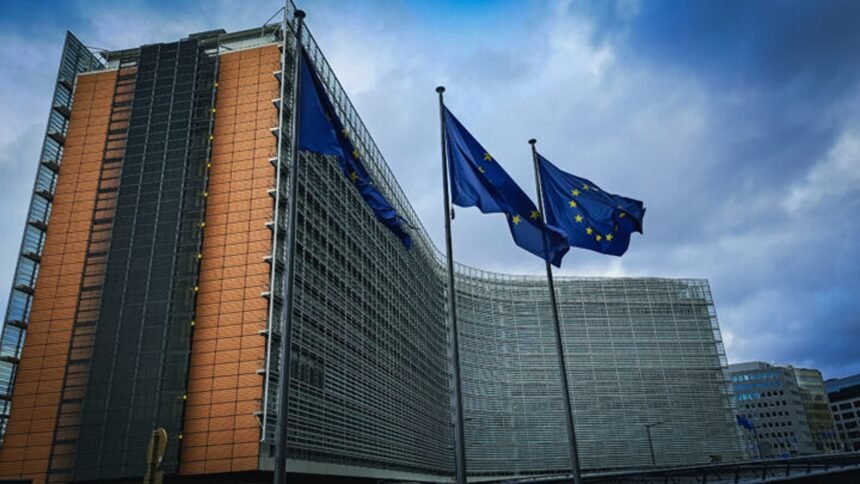
The European Union continues to demand a “sustainable de-escalation of tensions” in northern Kosovo as a precondition for lifting restrictive measures imposed on Pristina.
Despite recent nationwide local elections, most of the EU’s punitive measures remain in place, leaving Kosovo frustrated and economically affected.
According to a European Commission spokesperson, further steps depend on “a stable reduction of tensions in the north.” The official added that inclusive and peaceful local elections and a regular transition of power are essential for progress toward lifting sanctions.
Von der Leyen Urges Stability, Avoids Concrete Promises
Three days after the elections, European Commission President Ursula von der Leyen visited Kosovo for less than three hours but made no statement on sanctions. In a post on X (formerly Twitter), she urged Kosovo to “build strong institutions and reduce tensions”, without clarifying which tensions she referred to.
The EU introduced sanctions against Kosovo in June 2023, following the escalation of security incidents in the north after Serb boycotts of local elections.
One of the EU’s conditions for lifting the measures was allowing Kosovo Serbs to vote on the dismissal of Albanian mayors in four northern municipalities. Although Pristina organized such votes in 2024, the measures were not lifted, as Serb List boycotted again.
Analysts Call EU Approach “Asymmetric”
Political experts describe the EU’s stance as unclear and asymmetric.
Donika Emini, from the Balkans in Europe Policy Advisory Group (BiEPAG), said the process of lifting sanctions is “extremely difficult politically,” even if Kosovo fulfills all conditions. “Decisions must pass through EU member states and the Council, making a formal lifting nearly impossible,” she said.
Emini questioned the EU’s broad demand for “de-escalation,” asking what it concretely means:
“Is organizing peaceful, inclusive elections enough, or does Brussels expect Kosovo to reverse decisions made in the north since 2022?”
Meanwhile, political analyst Melazim Koci argued that Kosovo has already achieved the requested de-escalation through the elections and participation of Serb representatives, calling the EU’s continued sanctions “unjustified and politically inconsistent.”
Kosovo Claims Compliance; EU Offers Limited Relief
Kosovo’s leadership insists it has met all EU demands.
President Vjosa Osmani and Prime Minister Albin Kurti have repeatedly called for the immediate removal of punitive measures, citing the peaceful and inclusive conduct of the October 12 local elections.
According to the European Commission, some measures have begun to be lifted gradually — including the resumption of technical assistance projects and restarting Stabilisation and Association Agreement (SAA) sub-committees.
However, most restrictions remain, such as the suspension of IPA 2024 funds, exclusion from high-level EU events, and frozen investment projects.
A June 2025 report by the GAP Institute estimated that the sanctions have cost Kosovo €613.4 million in delayed or suspended EU projects, with €7.1 million lost entirely.
Double Standards and Future Prospects
Analysts argue that Brussels risks damaging its credibility in the Western Balkans by maintaining sanctions on Kosovo while taking no action against Serbia for the Banjska attack in 2023.
“If the EU wants to preserve its moral authority, it must urgently lift the sanctions against Kosovo,” said Koci.
Emini added that Kosovo must now intensify diplomatic engagement with EU capitals to secure consensus among all 27 member states — noting that even a single veto from Hungary or Slovakia could block progress.
As of now, Kosovo remains under restrictive EU measures, even as Serb List returns to power in several northern municipalities following the latest elections.