The European Union is preparing a major overhaul of its enlargement policy that could allow candidate countries to integrate gradually into European structures before securing full membership, while strengthening safeguards for democracy and the rule of law.
European Commissioner for Enlargement Marta Kos said Tuesday in Zagreb that the world has changed and that the EU’s enlargement process must change with it.
Kos described the current moment as a potential new “Helsinki moment,” comparing it with the developments of the 1990s that preceded the EU’s major post-Cold War enlargement.
According to Kos, the European Commission is preparing a new proposal for how an EU with more than 30 member states could function effectively.
One of the central ideas under consideration is to move away from the traditional model in which candidate countries must wait for full membership before gaining meaningful access to European structures and benefits.
Under the proposed approach, candidate countries could be gradually integrated into selected areas of the EU before becoming full members.
Kos pointed to existing examples, including candidate countries’ participation in the Single Euro Payments Area (SEPA) and integration with European energy networks.
“We need a more structured approach to overcome the time that we no longer have,” Kos said, arguing that accession processes lasting decades can leave candidate countries increasingly vulnerable to political pressure and influence from geopolitical rivals of the EU.
Brussels seeks stronger safeguards for new members
Another major element of the proposed reform would involve stronger mechanisms to prevent democratic backsliding and violations of the rule of law after a country joins the EU.
Kos warned that the Union should not allow “Trojan horses” inside the bloc, referring to the possibility that a country could meet membership requirements before accession but subsequently abandon democratic standards.
The proposal could nevertheless trigger debate within the EU, as special safeguards targeting newer members could create concerns that they would be treated as second-class members.
Fewer opportunities for vetoes
The enlargement debate is also expected to address decision-making within the EU itself.
Kos said some reforms could potentially be introduced without changing the EU treaties, avoiding lengthy negotiations and complicated ratification procedures among member states.
One objective is to create a more flexible decision-making system with fewer opportunities for a single member state to block decisions affecting the wider Union.
The EU is also considering whether its institutions could be made smaller and more efficient as the bloc prepares for potentially significant enlargement in the coming years.
Montenegro and Albania among countries highlighted
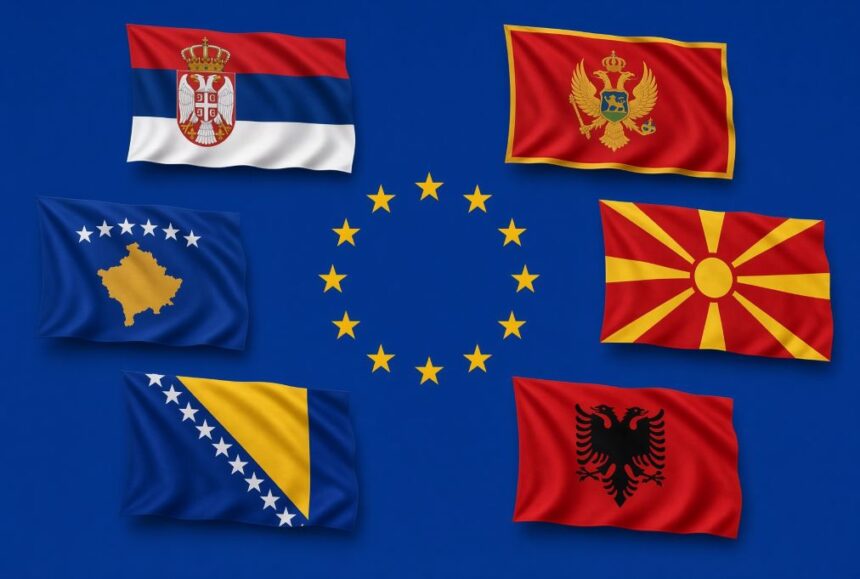
Kos singled out Montenegro as the most advanced candidate country in the accession process.
She also highlighted Albania’s progress, particularly in the area of the rule of law, as well as the technical progress made by Ukraine and Moldova on their paths toward EU membership.
Iceland was also mentioned after its decision to restart its EU accession process.
The review of enlargement policy comes as Europe faces a fundamentally changed geopolitical environment. Russia’s war against Ukraine has increased pressure on the EU to strengthen political, economic and security ties with candidate countries.
Ukraine’s accession process is seen as one of the factors pushing Brussels to reconsider how enlargement should work in practice.
Kos’s message is that the EU itself must change if it wants to expand.
Rather than requiring candidate countries to wait years or decades for full membership, Brussels is considering a model in which integration and access to EU benefits would advance step by step, while democratic standards, the rule of law and respect for European values would remain subject to stronger safeguards.