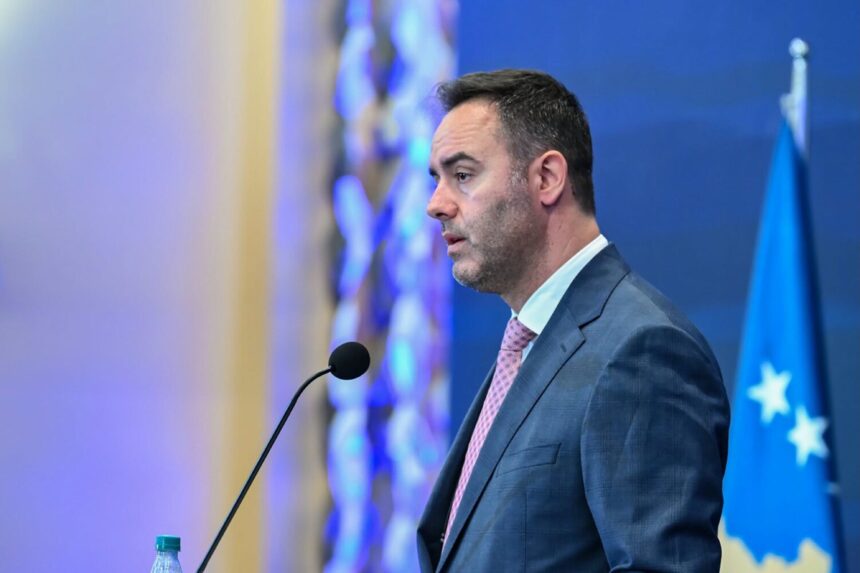
Kosovo’s First Deputy Prime Minister and Foreign Minister, Glauk Konjufca, has warned that Serbia’s territorial ambitions pose a serious threat to Kosovo’s sovereignty and regional stability, urging the European Union to exert decisive pressure on Belgrade to hand over Milan Radoičić and others accused in connection with the September 2023 armed attack in Banjska.
In an interview with Hungary Insider, Konjufca discussed the risk of renewed armed confrontation between Kosovo and Serbia, the lack of accountability for the Banjska attack, and the role of NATO and the EU in preventing further escalation. He also addressed Hungary’s political transition under Prime Minister Péter Magyar, the prospects for closer Kosovo-Hungary relations, and Kosovo’s ambitions to join the EU and NATO.
Konjufca argued that Serbia’s political rhetoric must be assessed alongside its actions, pointing to statements by senior Serbian officials about Kosovo and Radoičić’s continued public appearances alongside figures close to Serbian President Aleksandar Vučić.
“When the Serbian deputy prime minister declares that the Serbian flag will sooner or later fly over Prizren again, while Milan Radoičić, who has admitted organising the armed attack in Banjska, appears publicly alongside Vučić’s son at a ruling-party rally, we see a troubling continuity between Serbia’s territorial ambitions and the political protection offered to those responsible for armed aggression against the Republic of Kosovo,” Konjufca said.
He recalled that an armed group attacked Banjska in northern Kosovo in September 2023, killing Kosovo Police officer Afrim Bunjaku. According to Konjufca, a court in Prishtina ruled in April 2026 that the operation aimed to separate northern Kosovo from the rest of the country and annex it to Serbia.
The minister also cited Serbia’s military deployment near Kosovo’s border following the attack and the subsequent reinforcement of NATO’s peacekeeping presence in Kosovo.
Konjufca further referred to the November 2024 explosion that damaged the Ibër-Lepenc canal, a key part of Kosovo’s water and energy infrastructure. He said the Special Prosecution had presented evidence that, in its assessment, implicated Serbian state structures in preparations for the attack.
“These developments demonstrate a continuing pattern of territorial revisionism pursued through political intimidation and attempts to destabilise the functioning of our state,” Konjufca said, adding that the international community should recognise the seriousness of the threat.
Konjufca calls for decisive EU action over Radoičić
Asked what Radoičić’s public appearances alongside Vučić’s son indicated about Belgrade’s willingness to ensure accountability, Konjufca described them as evidence of a longstanding political relationship.
He recalled that Vučić had publicly praised Radoičić before the Banjska attack and acknowledged their close political ties afterward. Konjufca said Radoičić remained free in Serbia and continued to attend political events, despite admitting that he organised the armed operation.
The minister called on the EU to pressure Serbia to hand over Radoičić and other suspects to Kosovo’s judicial authorities.
“We expect the European Union to exert decisive pressure on Belgrade to hand over Radoičić and the other accused individuals to the judicial authorities of the Republic of Kosovo,” he said.
Konjufca also referred to calls by the European Parliament in 2023 for targeted restrictive measures against Radoičić, arguing that they should now be translated into concrete action.
“Justice for Banjska is essential to preventing further aggression and establishing long-term security in our region,” he said.
Kosovo warns of risk of renewed confrontation
Konjufca said Kosovo takes the possibility of a new armed confrontation seriously, citing Serbia’s continued claims over Kosovo’s territory and previous military deployments near the border.
He identified any renewed concentration of Serbian combat forces along Kosovo’s borders or another armed attack against Kosovo’s territory or critical infrastructure as a serious escalation.
Preventing such developments, he said, requires credible deterrence, a strong NATO presence through KFOR, and close coordination with American and European partners.
“We will continue strengthening our defence institutions while remaining committed to diplomacy, constructive dialogue and peaceful relations with all our neighbours,” Konjufca said.
He added that lasting peace in the Western Balkans depends on respect for the sovereignty and territorial integrity of every state.
Kosovo welcomes prospects for closer ties with Hungary
Addressing political changes in Hungary under Prime Minister Péter Magyar, Konjufca said Kosovo respected the democratic choice of the Hungarian people and looked forward to strengthening bilateral relations.
He described Hungary as a valued partner since it recognised Kosovo’s independence in March 2008, highlighting its continued contribution to Kosovo’s security through KFOR.
Konjufca said Prishtina wanted to expand economic ties with Budapest and secure Hungarian support for Kosovo’s European integration, including obtaining EU candidate status and opening accession negotiations.
EU membership and international recognition remain priorities
Konjufca reiterated that Kosovo’s strategic future lies in the European Union and NATO. He cited a European Commission survey indicating that 83 percent of Kosovo’s citizens support EU membership, which he said was the second-highest level of support in the Western Balkans after Albania.
He also referred to Kosovo’s ranking in the World Justice Project’s 2025 rule-of-law assessment, saying the country placed third among 15 countries in Eastern Europe and Central Asia.
The minister said Kosovo was fully aligned with the EU’s Common Foreign and Security Policy but remained frustrated by the lack of formal progress on its EU membership application, submitted in December 2022.
Prishtina’s priorities, he said, include securing candidate status, opening accession negotiations through a credible merit-based process, expanding international recognition and advancing its NATO membership ambitions.
“ Kosovo has demonstrated its commitment to the European project through its democratic choices and its conduct as a responsible international partner,” Konjufca said, calling on European governments, particularly those in Central Europe, to assess Kosovo’s progress on the basis of concrete achievements.
Advancing Kosovo’s European integration, he added, would strengthen both regional stability and the European project.