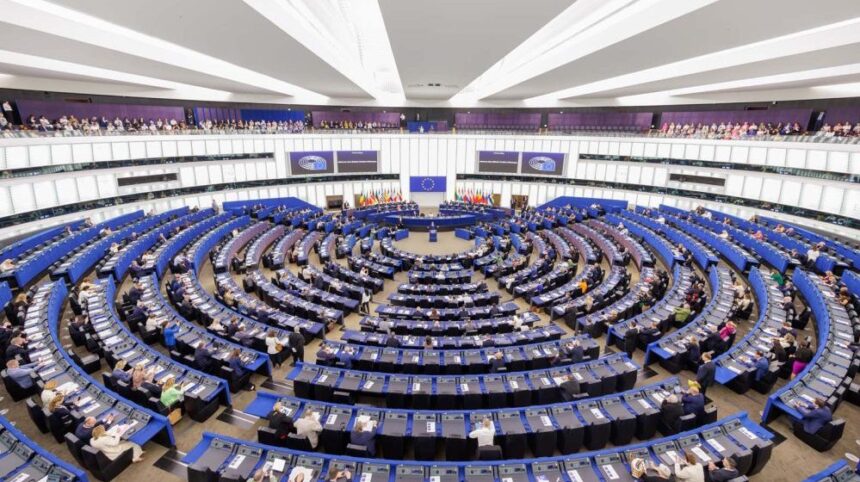
In one of its sharpest political reprimands to date, the European Parliament (EP) has adopted a sweeping report declaring that Serbia’s EU accession process has effectively ground to a halt due to severe democratic backsliding.
The European Parliament made it unequivocally clear that “cosmetic reforms” and declarative commitments are no longer enough, warning that further democratic regression will result in a direct freeze of EU financial assistance and development funds. According to political analysts and civil society leaders, Brussels has effectively signaled that the only viable exit strategy from Serbia’s deepening domestic paralysis is the implementation of genuinely free and fair elections.
Key Takeaways from the European Parliament’s Stance
- Accession Frozen: Despite recent, rapid legislative changes passed by Belgrade over the last six months to secure the opening of Cluster 3, member states have withheld consensus, leaving the process stalled.
- The Implementation Gap: The EP explicitly rejected the government’s propaganda that adopting laws and action plans equates to progress, pointing to a persistent chasm between formal paper alignment and reality.
- Funding Interruption: For the first time, nearly 500 MEPs have overwhelmingly backed tying European financial aid directly to measurable benchmarks in the rule of law, media freedom, and electoral conditions.
Expert Analysis: Has Belgrade Lost Its Political Legitimacy?
Speaking to Danas, Naim Leo Beširi, Director of the Institute for European Affairs, and Dragana Đurica, Secretary General of the European Movement in Serbia, broke down what this landmark report means for the ruling coalition and domestic stability.
                  [ EU Institutional Divide on Serbia ]
                                    |
          +-------------------------+-------------------------+
          |                                                   |
          v                                                   v
 [ European Parliament ]                            [ European Commission ]
 Boldly calls out "state capture."                  Maintains cautious diplomacy due
 Demands full ODIHR implementation                  to regional stability, migration,
 and threatens financial cuts.                      and geopolitics (Kosovo).
Naim Leo Beširi: “A Repeat Pattern of State Capture”
Beširi pointed out that while the European Commission and Council often use tempered diplomatic language to preserve regional stability, the European Parliament is closer to the reality on the ground.
He emphasized that international watchdogs have documented a distinct, repetitive pattern of electoral manipulation across the 2022, 2023, and 2024 election cycles:
“Vučić’s regime can no longer simultaneously take money and political legitimacy from the European Union while using state-controlled media to paint the EU as an enemy to local citizens. The space for this double-game is shrinking. The EP has explicitly noted that some recent local elections were held under an atmosphere of fear, repression, and institutional pressure.”
— Naim Leo Beširi, Institute for European Affairs
Dragana Đurica: “The Strongest Political Message to Date”
Đurica described the EP’s resolution as a historic turning point, stressing that the message is fundamentally directed at the ruling regime, not the people of Serbia.
“The political space for member states to treat the current regime as an indispensable partner is narrowing. The EU knows exactly who it is dealing with now. However, the EU has not turned its back on the citizens of Serbia—which is precisely why MEPs are insisting on the complete, non-partial implementation of ODIHR recommendations.”
— Dragana Đurica, European Movement in Serbia
The Core Issues: Unimplemented ODIHR Recommendations
According to European election observers, the core structural flaws invalidating fair political competition in Serbia rest on four main systemic issues:
| Systemic Failure | Real-World Impact |
| State-Party Overlap | Total misuse of public administrative resources for ruling party campaigns. |
| Voter Registry Manipulation | Ongoing lack of transparency and independent audits regarding the unified voter list. |
| Public Sector Coercion | Severe institutional pressure exerted on public enterprise employees to secure votes. |
| Media Monopoly | Radical pro-regime bias and aggressive anti-EU narratives across national broadcasters. |
The Bottom Line: Without addressing these core democratic pillars, Brussels warns that Belgrade can no longer present its European integration path as a “successful reform story,” leaving the ruling coalition’s political legitimacy profoundly damaged on the international stage.