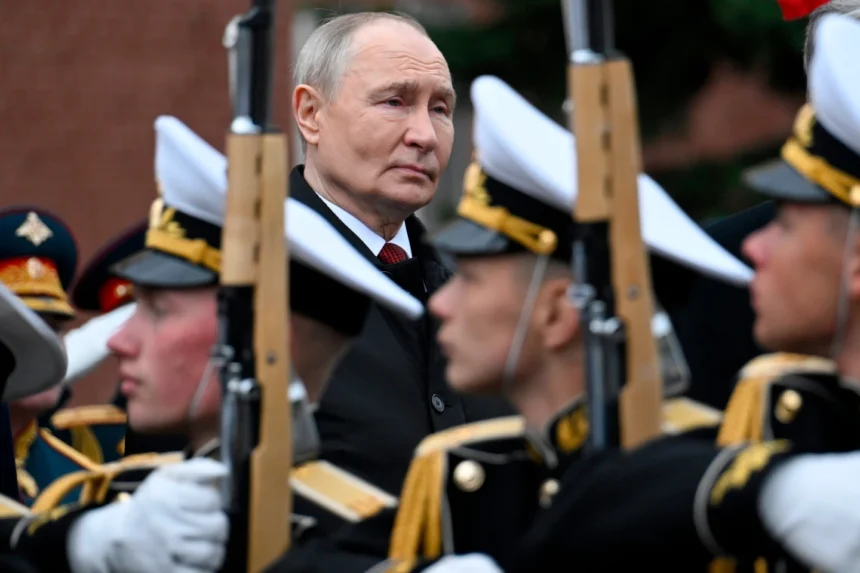
Confronted by a grinding battlefield stalemate in Ukraine and a noticeable erosion of domestic approval ratings, Russian President Vladimir Putin appears poised to launch a massive, high-intensity aerial offensive against the Ukrainian capital.
As the conventional conflict grinds into its fifth year, Moscow’s latest maneuver—a formal warning to execute “consistent and systematic” missile strikes on Kyiv accompanied by a demand for foreign embassies to evacuate—signals a dangerous bid to reshape the domestic narrative and project military dominance to an increasingly war-weary Russian public.
The Battlefield Gridlock Shifts the Momentum
Despite minor territorial gains secured by Russia last year, the 1,000-kilometer (600-mile) front line has effectively frozen. Ukrainian forces have successfully mounted localized counterstrikes, utilizing innovative tactical concepts to stall the Russian advance in the strategic Donetsk region.
[The Strategic Stalemate & Escalation Loop]
  Frontline Gridlock (Donetsk Stagnation)
            │
            ▼
  Ukraine Deep Strikes (Drone hits on Moscow suburbs & Russian energy hubs)
            │
            ▼
  Domestic Discontent (Economic strain, rising taxes, tech shutdowns in Russia)
            │
            ▼
  Kremlin Retaliation (Hypersonic Oreshnik strikes & promised Blitz on Kyiv)
Simultaneously, Ukraine has aggressively expanded its deep-strike capabilities inside the Russian Federation, using long-range drones to paralyze oil refineries and weapons factories. A recent drone swarm penetrating Moscow’s heavily fortified suburbs killed three residents, shattering the Kremlin’s carefully manufactured illusion that the war remains a distant event.
In a telling sign of vulnerability, Russian lawmakers recently passed legislation forcing commercial banks—rather than the military—to foot the bill for installing localized drone-jamming hardware on their properties.
A Fading Spell: Economic Fragility and Internal Grumbling
Independent analysts note that the initial economic boost generated by Russia’s massive wartime spending has largely dissolved, giving way to a volatile “dual economy” characterized by hyper-inflated military production and civilian stagnation.
| Domestic Pressure Point | Institutional Impact / Reality |
| Recruitment Deficit | Volunteers are drying up despite exorbitant wages; Russia is now losing more troops than it can actively recruit, raising the specter of a forced mobilization. |
| Digital Backlash | State-mandated cellular internet restrictions and messaging app blocks have disrupted daily life, drawing unprecedented public criticism from elite Kremlin loyalists like IT tycoon Natalya Kasperskaya. |
| Sinking Credibility | Independent and state polls show an erosion in Putin’s core popularity. Once-loyal social media influencers and despondent business owners are increasingly criticizing aggressive tax hikes and state repression. |
Exploiting the Western Arsenal Drain
Moscow is overtly timing its impending blitz on Kyiv to exploit critical shortages in Ukraine’s air defense network. The active U.S. military engagement in Iran has drastically drained Western missile arsenals, severely delaying the delivery of American-made Patriot air defense systems that Kyiv desperately requires to safeguard its skies.
[The Air Defense Depletion Corridor]
  U.S. Conflict in Iran ──► Drains American Missile Arsenals ──► Delays Patriot Deliveries to Kyiv ──► Exploited by Russia
“Kyiv’s air defenses have been exhausted enough to make a massive attack efficient,” noted Moscow-based military analyst Sergei Poletaev, highlighting the tactical window Russia believes it has uncovered.
Hypersonic Warnings and Threats to NATO’s Flanks
The opening salvo of this projected aerial campaign occurred on Sunday, when Russia deployed its new Oreshnik hypersonic missile in a devastating strike on Kyiv that killed two and flattened civilian infrastructure. Following the strike, Russian Foreign Minister Sergey Lavrov placed a direct call to U.S. Secretary of State Marco Rubio, delivering a blunt warning regarding the coming bombardment and reiterating the demand to clear out foreign diplomats.
Secretary Rubio confirmed the tense exchange, noting to reporters, “The danger in all of these wars as they continue… is that they always have the threat of escalation, of spreading into something new.”
Beyond Ukraine, the Kremlin is expanding its geopolitical threats to Europe. The Russian Defense Ministry published a detailed target list of manufacturing facilities inside NATO territories allegedly producing drone components for Kyiv. Concurrently, Russia’s Foreign Intelligence Service warned the Baltic states that their NATO membership would not insulate them from devastating military retaliation if they permit Ukraine to launch cross-border operations from their soil.
With Dmitry Polyansky, Russia’s envoy to the OSCE, warning that the world is now “very, very close to direct military confrontation,” Putin appears entirely willing to risk a global flashpoint to sustain his grip on power at home.