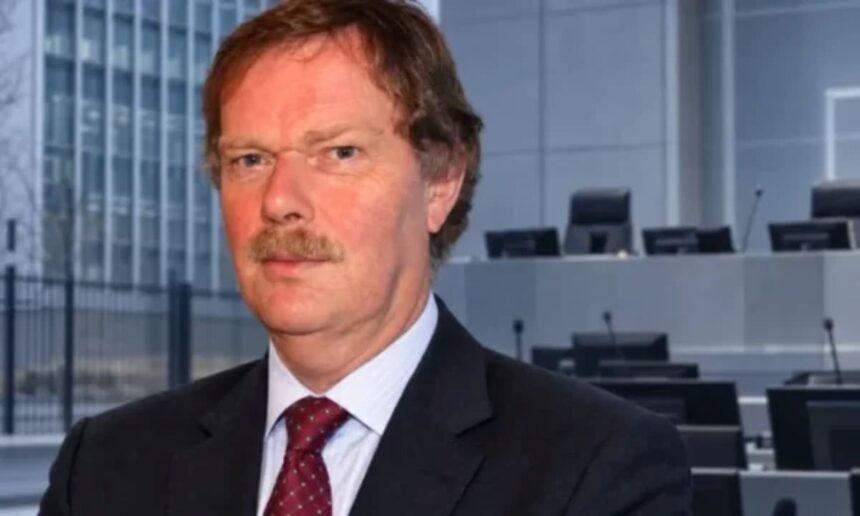
Former Dutch Ambassador to Kosovo Robert Bosch has strongly criticized the recent verdict against four former Kosovo Liberation Army (KLA) leaders, saying he was “completely shocked” by the decision and questioning the way the Kosovo Specialist Chambers handled the case.
Bosch, who served as the Netherlands’ ambassador to Kosovo when the Specialist Chambers were being established, made the remarks in an interview with Radio Dukagjini. He also accepted part of the responsibility for the creation of the court, saying Kosovo institutions had been pressured to establish it in the expectation that it would deliver justice.
“I cannot say more than that I am completely shocked. I did not expect this,” Bosch said, referring to testimony from senior international figures including former NATO commander Wesley Clark, former U.S. State Department official James Rubin and former U.S. Ambassador to Serbia Christopher Hill.
Bosch argued that testimony concerning the KLA’s lack of a centralized command structure should have been given greater weight when assessing the responsibility of former KLA leaders, particularly Hashim Thaçi.
He sharply criticized the judges and prosecutors, alleging that the court had disregarded testimony that he considered significant. Bosch further claimed that the proceedings had become unbalanced and questioned whether the court’s approach was influenced by a desire to satisfy Serbian expectations.
Those assertions reflect Bosch’s personal assessment of the proceedings and were not presented as findings of the Specialist Chambers.
Bosch also criticized the European Union’s response to the verdict, saying he disagreed with statements describing the court’s approach as fair and balanced.
He expressed concern about the appeals process, arguing that the defendants could remain in detention for a prolonged period while their cases are reviewed.
Bosch takes responsibility for role in establishing the court
Bosch said he had been directly involved in discussions surrounding the establishment of the Specialist Chambers, acting as an intermediary between Kosovo’s foreign and defense ministries.
He recalled that during briefings at the time, officials repeatedly described the KLA as having personnel “on the ground” but lacking a conventional centralized command structure.
Looking back, Bosch said he now considered the establishment of the court a mistake and acknowledged his own role in the process.
“I told Thaçi at the time: Don’t worry, you will be free very soon, you will be released for lack of evidence,” Bosch said. “The poor man put the noose around his own neck.”
He rejected the notion that Kosovo’s leaders had voluntarily chosen the consequences they later faced, arguing that they had been pressured by international actors to establish the court.
“I feel terrible about this,” Bosch said, adding that he had been acting on instructions he received from The Hague while serving as ambassador, although he said he had privately made clear that he disagreed with the policy.
Calls for greater international attention
Bosch also questioned the composition and legal framework of the Specialist Chambers, arguing that the institution was presented as a Kosovo court despite being based in The Hague and staffed by international judges and prosecutors.
He said he did not expect the appeals process to produce significant changes because, in his view, many of the same people would remain involved.
Bosch also called for greater political attention to the issue and suggested that U.S. President Donald Trump should become involved.
“I think that since President Trump intervenes in every issue, he should intervene here as well, because this has gone too far,” he said.
Concerns over the verdict’s impact on Kosovo’s image
Bosch said he was particularly concerned about how the verdict could affect Kosovo’s international image, arguing that media coverage could leave the public with the impression that former Kosovo leaders were personally responsible for serious crimes committed during the 1998–99 war.
He specifically disputed the idea that Thaçi was responsible for the crimes attributed to him, while criticizing international media for what he described as insufficient attention to statements by senior international figures who had expressed support for the former KLA leaders.
Bosch’s comments represent his personal assessment of the Specialist Chambers’ proceedings and verdict. The court’s judgments are based on its own assessment of the evidence and individual criminal responsibility established through the judicial process.