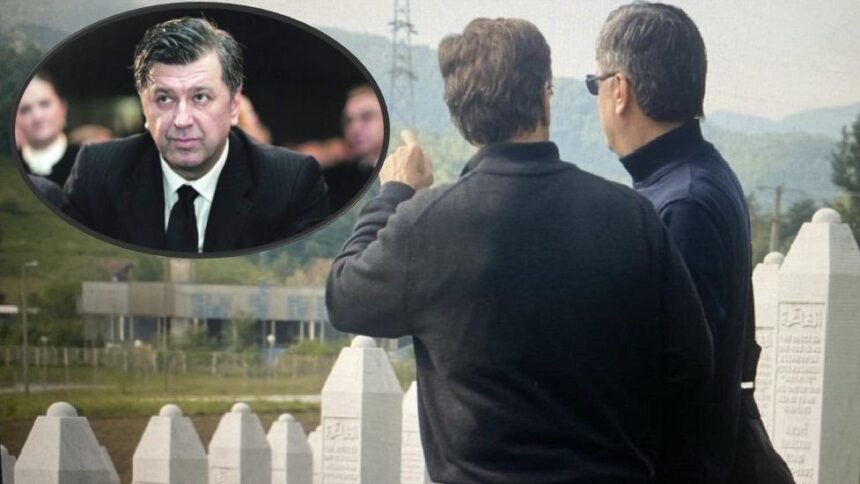
Amir Ahmić, Bosnia and Herzegovina’s former liaison officer with the International Criminal Tribunal for the former Yugoslavia (ICTY), has warned that the death of former Bosnian Serb military commander Ratko Mladić does not end the struggle to preserve the historical and judicial record of the crimes committed during the Bosnian war.
Ahmić, who spent 25 years closely following proceedings, evidence and judicial findings before the Hague tribunal, told Avaz that Mladić’s death leaves three issues unresolved: his personal failure to confront his crimes, society’s acceptance of legally established facts, and the political responsibility of those who continue to portray a convicted war criminal as a hero.
“The court established what was done, who participated, what the chain of command was, what the intentions were and what Mladić’s criminal responsibility was,” Ahmić said.
However, he stressed that a criminal court cannot determine every internal psychological motivation of a perpetrator.
“Mladić defended himself to the end by claiming that he was not guilty. Therefore, we did not receive from him an admission, remorse or his own explanation of why he accepted and implemented a policy that led to genocide and other crimes,” Ahmić said.
He described Mladić as a “coward” who not only denied responsibility and claimed to have respected the Geneva Conventions, but also repeatedly sought clemency from the Hague tribunal in an effort to secure his release.
“A coward who was not able to confront his crimes,” Ahmić said, adding that the former commander had repeatedly claimed that his life was nearing its end while asking for mercy.
“The court can impose a sentence, but it cannot force a conscience,” he said.
Legal justice was achieved, but not complete justice
Ahmić said Mladić’s conviction delivered important legal justice to the victims of the Srebrenica genocide, but could not by itself constitute complete justice.
Mladić was prosecuted, given the right to a defense and appeal, found guilty and ultimately sentenced to life imprisonment.
But a verdict cannot bring back those who were killed, restore the childhoods of survivors or erase the consequences of genocide, Ahmić argued.
“It does not return homes. It does not heal trauma easily. And most importantly, it does not guarantee that society will accept the truth established by the court,” he said.
According to Ahmić, the continuing glorification of Mladić, the restoration of murals honoring him and the denial or relativization of the genocide demonstrate that judicial truth and broader social acceptance of that truth remain separate issues.
“The verdict closed the criminal case, but it did not close history,” Ahmić said.
He argued that preserving the truth about the genocide may now be even more important following Mladić’s death, because the political and social battle over its interpretation is likely to continue.
“We must not allow a myth to be created”
Ahmić said facts are ultimately the easiest part of the historical record to preserve because they are documented in court judgments, evidence, testimony and archives.
Memory, he said, is more vulnerable, while accountability is the most vulnerable of all.
Future generations could know that Srebrenica happened and remember the date and number of victims, he warned, while losing the connection between the crime, its perpetrators, the ideology behind it, the political objectives and individual responsibility.
“If the connection between the crime, perpetrators, ideology, political goals and responsibility is lost, history becomes statistics,” Ahmić said.
He therefore stressed that preserving the facts must go hand in hand with preserving responsibility.
“The responsibility remains with us — to preserve what the court established and not allow responsibility to turn into a myth,” Ahmić said.