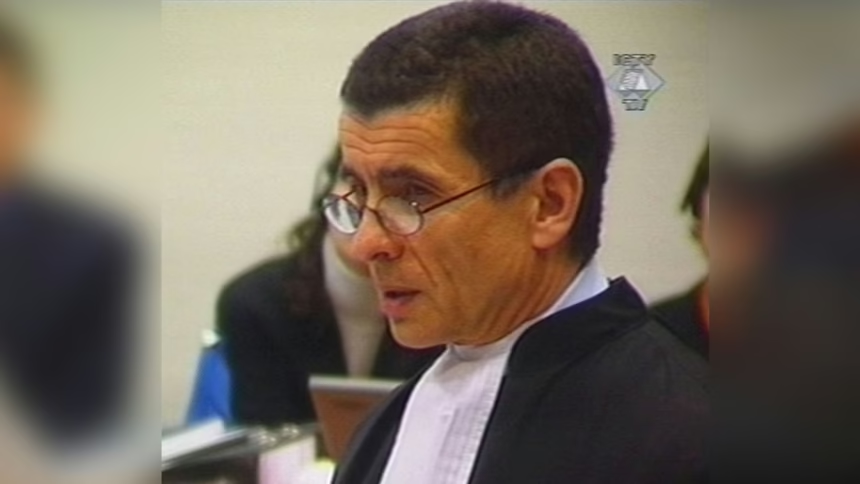
Former International Criminal Tribunal for the former Yugoslavia prosecutor Geoffrey Nice has said that a key question surrounding the Srebrenica genocide remains unanswered following the death of convicted Bosnian Serb military commander Ratko Mladić: how did Mladić know that he could enter Srebrenica and carry out the genocide in July 1995?
Speaking to Radio Free Europe following Mladić’s death, Nice said several explanations were possible, including that the Bosnian Serb commander had received intelligence, correctly assessed the situation, or obtained information from someone in the West.
“The question that Mladić perhaps could have answered, or perhaps already answered to someone else, is: How did he know he could do what he did?” Nice said.
He added that the possibility of fully answering the question has diminished because Mladić can no longer be questioned, but said the truth should not be lost.
Nice, who led the prosecution of former Serbian President Slobodan Milošević at The Hague, said he was not certain that the issue had ever been the subject of a final and unequivocal conclusion, despite what he described as substantial evidence pointing to at least part of the relevant background.
According to Nice, that evidence is publicly available in different places but has never been systematically connected and placed at the center of attention.
The “Quiet Agreement” Over Srebrenica
Nice pointed in particular to events in late May 1995, when French President Jacques Chirac and British Prime Minister John Major reportedly asked U.S. President Bill Clinton not to use air power to defend Srebrenica, which at the time had been designated a UN safe area where Bosniak civilians had sought refuge.
Nice said Clinton’s closest advisers accepted the proposal on May 28, describing it as a “quiet agreement” or secret understanding.
He argued that the decision was not communicated to the Dutch troops deployed in Srebrenica or to the Bosniak population there.
The question of what information reached Mladić and the Bosnian Serb leadership before the attack on Srebrenica therefore remains significant, Nice suggested, particularly in assessing how the perpetrators calculated the risks of launching the operation.
Mladić was convicted by the ICTY and later had his convictions upheld on appeal for genocide, crimes against humanity and war crimes committed during the war in Bosnia and Herzegovina, including the 1995 Srebrenica genocide.
Nice Warns of a Weaker International Order
Nice also expressed doubt that an international tribunal comparable to the ICTY would be established under today’s international conditions.
He argued that the international order has weakened significantly compared with the 1990s and said it had been deliberately undermined by several major political leaders, including Russian President Vladimir Putin, U.S. President Donald Trump and, to some extent, Chinese President Xi Jinping.
In his view, the prospects for international humanitarian law to positively influence global affairs have been significantly reduced because leaders of major powers are increasingly unwilling to be investigated, prosecuted or convicted by smaller states.
Mladić’s death, Nice suggested, therefore closes one of the remaining avenues for answers about the circumstances surrounding the Srebrenica genocide, while leaving unresolved questions about the intelligence, political calculations and international decisions that preceded the massacre.