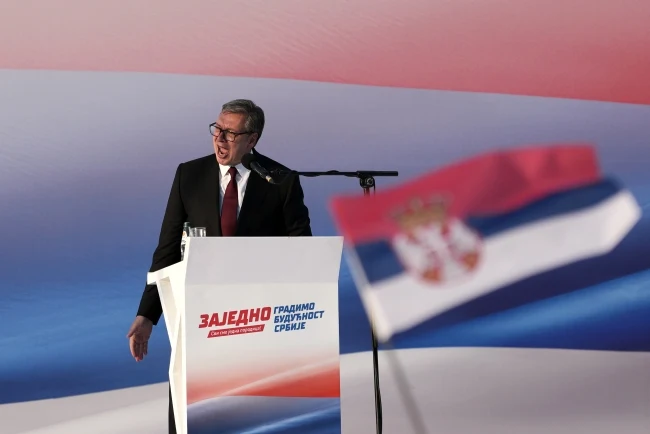
Serbian President Aleksandar Vučić is planning to resign from the presidency and return to power as prime minister following snap elections this autumn, deploying a strategic maneuver heavily inspired by Russian leader Vladimir Putin, according to a report by the Financial Times (FT).
The FT highlights that the 56-year-old man, who has effectively run Serbia in various institutional capacities for the last 13 years, is facing mounting domestic pressure. Rising student-led protests and public dissatisfaction have intensified over alleged authoritarian tendencies, systemic corruption, and sluggish economic development.
The Transatlantic & MAGA Connection
The report characterizes Vučić as one of the few remaining close allies of U.S. President Donald Trump in Central and Eastern Europe. The Serbian leader has increasingly adopted the rhetoric of the American MAGA movement, frequently targeting Brussels, independent media outlets, and foreign-backed elites, while championing conservative principles centered on family, Christianity, and opposition to gender politics.
This political alignment was mirrored in commercial ventures, notably a high-profile luxury real estate project backed by Trump’s son-in-law, Jared Kushner. The development was slated for the site of the former Yugoslav Ministry of Defense in Belgrade—a national monument bombed by NATO in 1999. However, the project was ultimately withdrawn following intense public backlash and investigations into alleged irregularities, including claims that cultural protection documents were forged to clear the site.
Testing the Political Waters
Political analysts suggest that Vučić’s announcements regarding resignation and early elections may be a tactical move to gauge the domestic political climate.
“This is not the first time he has thrown out this bait,” said Helena Ivanov, a researcher at the London-based Henry Jackson Society.
Ivanov noted that Vučić had floated the idea of summer elections and a premier bid months ago, concluding that he is explicitly targeting a “Putin scenario.” Analysts argue Vučić has already fundamentally altered the spirit of Serbia’s constitution—which designates the presidency as a largely ceremonial role—by continuing to dominate public life through the ruling Serbian Progressive Party (SNS).
“The key point is that he holds the power… in the party and in the country. This is not him yielding to student demands; it is simply keeping his base in campaign mode,” Ivanov added.
High-Risk vs. Low-Risk Strategies
The political landscape is shifting as the domestic student movement vows to field its own candidates in the upcoming parliamentary elections, positioning themselves as a credible challenger to the SNS machine.
According to Belgrade political insiders, a simultaneous presidential and parliamentary election would represent a high-risk, high-reward strategy. However, sources familiar with the administration note that “Vučić is not a gambler.” A more predictable, low-risk approach would involve securing the SNS parliamentary majority first, allowing Vučić to retain the presidency until at least 2027 before executing the transition.