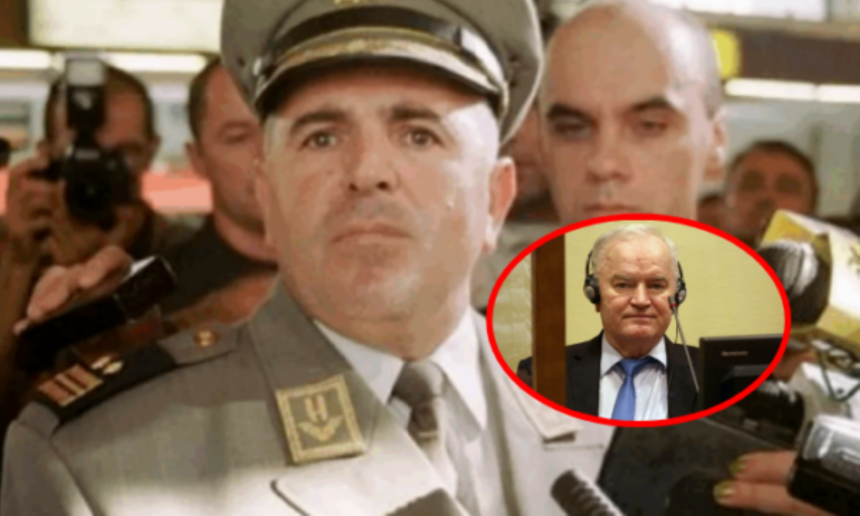
Croatian General Rahim Ademi has recalled the battles against Ratko Mladić during the 1991 war in Croatia, describing the later Bosnian Serb commander convicted of genocide and war crimes as a commander who showed “bravery” against civilians but repeatedly retreated when confronted by organized Croatian forces.
Ademi, an ethnic Albanian who served in the Yugoslav People’s Army before joining the Croatian Army, commanded Croatian forces defending Šibenik in September 1991, when units under Mladić’s command advanced toward the strategically important city.
Mladić had taken command of the JNA’s 9th Corps in Knin during the summer of 1991. His forces, together with Serbian paramilitary formations, conducted operations against Croatian-held areas in Dalmatia, including attacks around Šibenik, Zadar and Sinj.
The strategic objective was to reach the Adriatic coast. The advance came closest to achieving that goal during the September 1991 battle for Šibenik, when JNA forces reached the area around the city’s bridge.
They were stopped there by Croatian defenders under Ademi’s command.
Ademi later described the defense of Šibenik as one of Croatia’s most important early victories of the war.
“That was his defeat, while I, as a soldier, consider it the greatest victory of the Croatian Army and the first victory in the Homeland War, in the war in Šibenik,” Ademi recalled in an interview with Al Jazeera Balkans in 2017.
According to Ademi, the battle was particularly significant because the fall of Šibenik could have opened routes toward Split and further south, potentially threatening the defense of the entire Dalmatian region.
He said Croatian forces initially lacked heavy weapons but captured equipment from a JNA barracks in Rogoznica, allowing them to establish artillery positions and strengthen the defense.
Ademi also recalled preventing Mladić’s forces from reaching the Peruća Dam while he was commander of the 126th Brigade in Sinj.
“I was there as commander of the 126th Brigade in Sinj, and while I was commander, he never managed to get close to Peruća,” Ademi said, adding that the later mining of the dam occurred after he had left the brigade.
“He was no soldier”
Ademi said he never met Mladić personally.
“Thank God,” he said.
The two commanders, he recalled, effectively encountered each other through military operations and artillery sights.
Ademi was particularly dismissive of Mladić’s military reputation.
“I can say that he was no soldier at all. He never demonstrated his military fighting abilities. He showed ‘bravery’ only against innocent civilians, killing civilians and unarmed people,” Ademi said.
He pointed to the killings in Škabrnja and Srebrenica as examples of what he considered Mladić’s greatest crimes and argued that his conduct in battle differed fundamentally when he faced organized resistance.
According to Ademi, Mladić’s forces would use heavy weapons against civilian areas but retreat when confronted by determined Croatian military resistance.
“He was a commander there, the most responsible, and the only thing he knew was how to attack civilians,” Ademi said.
A confrontation recorded on camera
Croatian war cameraman and soldier Petar Malbaša also recalled an encounter with Mladić during negotiations on September 26, 1991.
Malbaša said Mladić arrived with three tanks and two armored personnel carriers and used the meeting to demonstrate his military power.
According to Malbaša, Mladić shouted an order to “kill everything that is not the army,” while the Croatian delegation was largely composed of civilians.
Malbaša said Mladić initially prevented him from filming and spent approximately half an hour insulting members of the Croatian delegation.
The cameraman also recalled Mladić claiming during the negotiations that he had personally mined the Maslenica Bridge and Peruća Dam.
“I personally mined the Maslenica Bridge and the Peruća Dam,” Malbaša recalled Mladić saying. He quoted the general as boasting that he carried out such actions effectively and that he was keeping Dalmatia under blockade.
The recollections of Ademi and Malbaša offer a picture of Mladić’s early military career in Croatia before he became the commander most closely associated with the Bosnian Serb Army and the crimes committed during the Bosnian war.
Mladić was later convicted by the International Criminal Tribunal for the former Yugoslavia of genocide at Srebrenica, crimes against humanity and war crimes and sentenced to life imprisonment.
His death has since reopened debate across the former Yugoslavia over his military legacy, with victims and their families remembering him primarily as one of the senior commanders responsible for some of the gravest crimes of the 1990s.