The Helsinki Committee for Human Rights in Serbia has issued a statement following the death of Ratko Mladic, expressing concern over the public reaction surrounding his death and attempts to portray the former Bosnian Serb military commander, who was convicted of war crimes, as a national hero.
According to the Committee, there is nothing troubling about the death of Ratko Mladic, a convicted war criminal. What is deeply troubling, however, is the reaction his death has provoked — particularly among certain segments of Serbia’s political, intellectual and social elites, including parts of the student movement.
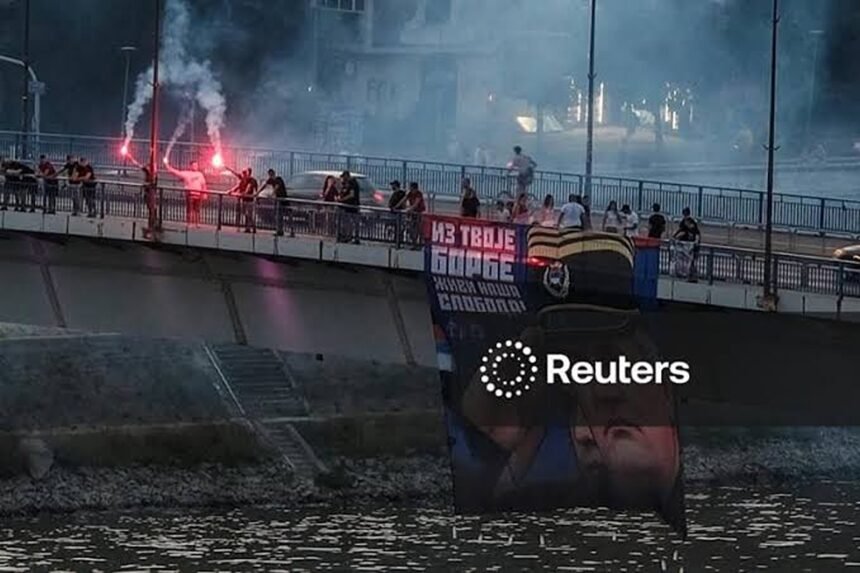
“Calls for a state funeral, flags being flown at half-mast, and the public glorification of Mladic show that his death is not being treated simply as the death of a convicted war criminal. Instead, some are using it as an opportunity to revive and reaffirm the myth of Mladic as a national hero,” the statement says.
The Helsinki Committee argues that his death has therefore exposed something much deeper: Serbia has never genuinely confronted the defeat of the policies that led to the wars of the 1990s, nor with their consequences.
“Rather than critically examining those policies, the responsibility behind them, and the enormous human and political costs they produced, a significant part of Serbian society continues to embrace a narrative in which the wars are portrayed as a historical injustice against Serbs, while those who waged them are presented as people who ‘fought for the freedom of the Serbian people.’”
According to the Committee, this ideology “did not disappear with Slobodan Milosevic, nor did it disappear with the judgments of the International Criminal Tribunal for the former Yugoslavia. It has survived both.”
The statement says it is particularly alarming that this narrative has found resonance among certain parts of a younger generation that sees itself as the “bearer of democratic change.”
According to the Committee, this demonstrates how deeply entrenched nationalist patterns of thinking remain and how incomplete Serbia’s process of confronting its past continues to be.
The statement also stresses that Serbia must acknowledge that the wars of the 1990s were not simply the result of external circumstances or a historical injustice, but were also the consequence of policies pursued by Belgrade aimed at changing borders and the political status of Serbs across the former Yugoslavia.
According to the Helsinki Committee, Serbia’s greatest challenge remains confronting the ideology that justified war, territorial expansion and violence in the name of the Serbian nation.
The most important question raised by Mladic’s death, the Committee argues, is not what kind of funeral he will receive, but what his glorification tells us about the society he leaves behind.
“A war criminal can die, while the ideology that turned him into a hero can survive. That is the real challenge Serbia continues to face,” the Committee concludes.
Ratko Mladic, the former commander of the Bosnian Serb Army, died on August 27 at the age of 84. He had been convicted by an international tribunal of genocide and crimes against humanity committed during the 1992–1995 war in Bosnia and Herzegovina.
In 2017, the International Criminal Tribunal for the former Yugoslavia (ICTY) in The Hague convicted Mladic on one count of genocide, five counts of crimes against humanity and four counts of war crimes, more than two decades after he was first indicted.
Known to his victims and others as the “Butcher of Bosnia,” Mladic was found responsible for crimes including the murder of more than 7,000 Bosniak men and boys in Srebrenica in 1995 — the largest atrocity committed in Europe since the end of the Second World War.