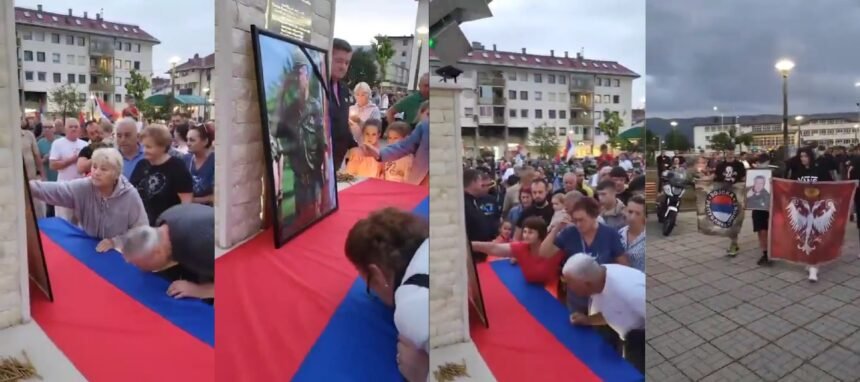
Thousands of Bosnian Serbs gathered on Sunday evening in Pale, Bosnia and Herzegovina, to pay tribute to Ratko Mladic, the former commander of the Bosnian Serb Army who was sentenced to life imprisonment for genocide, crimes against humanity and war crimes.
The gathering took place at the Olympic Park, where participants lit candles and flares, chanted Mladic’s name and sang songs honouring him. Some touched a large framed photograph of Mladic, while others kissed the Serbian flag.
Among the messages heard at the gathering, Mladic was hailed as a “Serbian hero.” Participants also sang “General, General, glory to your mother.”
The scenes have once again highlighted the persistence of nationalist narratives among parts of the Bosnian Serb community, where a man convicted of genocide and other grave crimes is still publicly celebrated rather than condemned.
Kissing the Serbian flag — echoes of Vucic at the UN
The images from Pale, particularly those showing participants kissing the Serbian flag, immediately recalled Serbian President Aleksandar Vucic’s own gesture following the adoption of the UN resolution on the Srebrenica genocide in May 2024.
On May 23, 2024, after the UN General Assembly adopted the resolution, Vucic kissed the Serbian flag and stood wrapped in it during the session. Serbia had strongly opposed the resolution.
The resolution designated July 11 as the International Day of Reflection and Commemoration of the 1995 Srebrenica Genocide and condemned both genocide denial and the glorification of individuals convicted by international courts of genocide, war crimes and crimes against humanity.
Tributes across Republika Srpska
The gathering in Pale was not an isolated event.
Similar tributes to Mladic have taken place in recent days in Zvornik, Visegrad, Foca, Novi Grad and other towns in Republika Srpska.
In Prijedor, a banner featuring Mladic’s photograph was displayed with the words “Glory to you, General.”
In Zvornik, footage published on social media showed participants chanting the slogan “Knife, wire, Srebrenica.”
A large banner bearing Mladic’s name was also displayed on an overpass along the road between Pale and Jahorina.
Pale and the legacy of the Bosnian Serb leadership
The choice of Pale is particularly significant.
Located near Sarajevo, Pale served from 1992 to 1995 as one of the principal political centres of the Bosnian Serb leadership. The Bosnian Serb administration led by Radovan Karadzic was based there during the war.
Mladic, meanwhile, commanded the Main Staff of the Army of Republika Srpska.
Mladic was convicted of genocide
In 2017, the Hague Tribunal sentenced Mladic to life imprisonment after finding him guilty of genocide, crimes against humanity and violations of the laws and customs of war. His conviction and life sentence were upheld on appeal in 2021.
He was convicted for genocide in Srebrenica, as well as persecution, extermination, murder, deportation and forcible transfer.
He was also found guilty of the campaign of shelling and sniper attacks against civilians in Sarajevo, which terrorised the city’s population, and of taking UN personnel hostage.
Mladic died on August 27 at the age of 84 while hospitalised in The Hague.
Glorification of war criminals is criminalised in Bosnia and Herzegovina
Bosnia and Herzegovina’s Criminal Code also makes the glorification of individuals finally convicted of genocide, crimes against humanity or war crimes punishable by law.
Despite this, public displays honouring Mladic continue to appear in parts of Republika Srpska.
The scenes in Pale therefore raise a difficult question for the Bosnian Serb political and social environment: how can reconciliation and lasting peace be achieved when a man convicted of genocide is still celebrated as a hero?
Mladic is dead. His conviction is final. But the public glorification of him demonstrates that the ideology surrounding his legacy has not disappeared.