
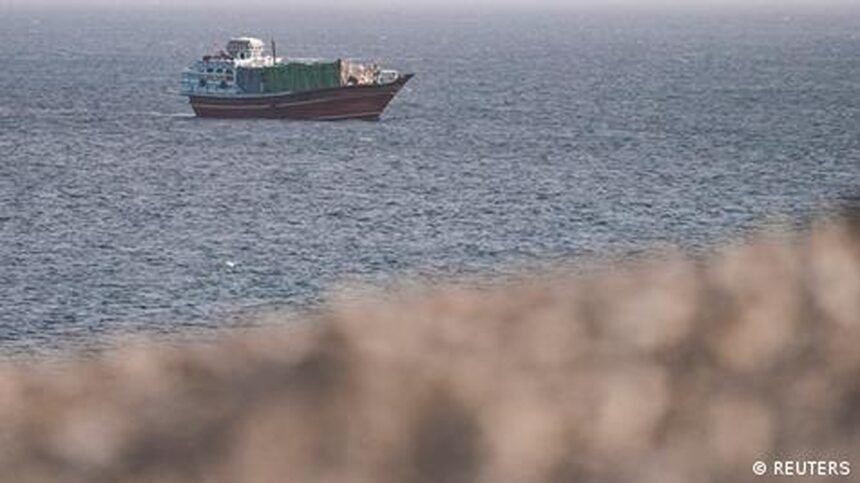
Oil and gas producers in the Gulf region are seeking alternatives to the Strait of Hormuz as maritime traffic once again comes under attack. The question now is whether Iran is also turning its attention to the pipelines built as alternatives to the strategic waterway.
Oil and gas exports from the Persian Gulf are facing renewed disruptions as tensions between the United States and Iran intensify. For both countries, control of the Strait of Hormuz remains of critical strategic importance.
In recent months, Iran has demonstrated that it can control—or at least significantly disrupt—the functioning of the Strait of Hormuz, according to Guntram Wolff, a senior fellow at the Bruegel think tank and professor of economics at the Free University of Brussels.
“Several months of bombing have not deprived Iran of its ability to control the Strait of Hormuz,” Wolff said, emphasizing that the United States still faces the challenge of gaining the upper hand.
This week, traffic through the strait nearly came to a halt once again after Iran attacked oil tankers and launched drones and missiles at military installations in Bahrain, Kuwait, and Jordan.
The United States responded with further strikes against Iran and reinstated its naval blockade of Iranian ports. It also revoked a sanctions waiver that had allowed Iran to openly sell its oil, depriving the country of a key source of revenue for its struggling economy.
Oil and Gas Flows Through Hormuz Before the War
Before the outbreak of the war on February 28, the Strait of Hormuz functioned as an international waterway free of transit fees and served as a corridor for approximately 20% of the world’s liquefied natural gas (LNG) shipments, according to the International Energy Agency.
At the same time, roughly 20% of global oil exports passed through the Persian Gulf via the Strait of Hormuz toward the Arabian Sea and beyond, with the vast majority destined for Asian markets.
In recent years, this has averaged around 20 million barrels of oil per day, according to the U.S. Energy Information Administration (EIA).
Traffic through the Strait of Hormuz fell to approximately 14.6 million barrels per day during the first quarter of the year and has declined significantly since the conflict escalated.
A preliminary ceasefire agreement between the United States and Iran, signed on June 17, briefly eased pressure on maritime shipping, but it is no longer in effect. In recent weeks, U.S. forces have struck hundreds of Iranian military targets.
Analysts warn that further attacks on Iran could trigger retaliatory strikes against oil and gas infrastructure across the Persian Gulf, including refineries, ports, and pipelines. Such developments would make the conflict far more costly for the entire region and could create oil supply shortages on global markets.
“The limited progress achieved following the June ceasefire has now effectively unraveled,” Greek maritime risk management company MARISKS warned after the latest escalation. “The potential for further escalation remains extremely high.”
The Growing Importance of Oil and Gas Pipelines
At the beginning of the conflict, reports claimed that Iran was demanding $2 million (around €1.7 million) from every vessel passing through the Strait of Hormuz. More recently, Iranian authorities have instructed ships to use a northern route through Iranian territorial waters.
At the same time, the U.S. Navy has been escorting vessels through a southern corridor near the coast of Oman, on the opposite side of the strait.
At present, Iran, Iraq, Kuwait, Qatar, and Bahrain depend on the Strait of Hormuz for exporting the majority of their oil.
Although maritime shipping remains the cheapest method of transporting oil, tankers have become central to the geopolitical struggle over control of the strait, prompting Gulf energy producers to accelerate efforts to find alternative export routes.
Some countries—including Saudi Arabia through its East-West Pipeline (Petroline) and the United Arab Emirates through the Abu Dhabi Crude Oil Pipeline—already have export routes that bypass the Strait of Hormuz. However, according to the International Energy Agency, these pipelines can transport a combined maximum of only 8.8 million barrels of oil per day.
New Routes, New Risks for Gulf Exporters
Because existing pipelines cannot replace the normal volumes that pass through Hormuz, expanding their capacity remains one of the few available options. However, such projects require years of construction and billions of dollars in investment.
Moreover, if these routes lead to the Red Sea, they could also become vulnerable as the conflict spreads beyond Hormuz.
Saudi Arabia’s East-West Pipeline links Abqaiq on the Gulf coast with the port of Yanbu on the Red Sea.
However, to reach the Arabian Sea and Asian markets, tankers departing from Yanbu must pass through the Bab el-Mandeb Strait—another critical maritime chokepoint—where Iran-backed Houthi rebels in Yemen have the capability to launch attacks.
Such a scenario could not only threaten these vessels but also open a second front in the conflict, forcing other ships bound for the Suez Canal to reroute around the southern tip of Africa.
Meanwhile, the United Arab Emirates, which can bypass both the Strait of Hormuz and the Red Sea, is investing even further in alternative infrastructure. According to several reports, the UAE plans to expand its existing export network and build a new port and container terminal on its eastern coast.
Additional pipelines in Iraq, Jordan, Kuwait, and Turkey are either operational or under development, but their capacity remains limited and would be insufficient to offset a major disruption in traffic through the Strait of Hormuz.
For Iran, It Appears to Be All or Nothing
Referring to Saudi Arabia’s East-West Pipeline and the Abu Dhabi Crude Oil Pipeline, MARISKS warned that the direct threat posed by Iran to alternative Gulf oil export infrastructure may represent “perhaps the most significant development” in the current crisis.
“Iran’s message is equally clear: either all regional energy producers can export, or no one will.”
Regardless of what happens next, Iran has demonstrated its willingness to raise the economic cost of any attack against it by threatening global energy supplies—either through blocking strategic maritime routes or by targeting oil and gas infrastructure in other Gulf countries as a form of retaliation.