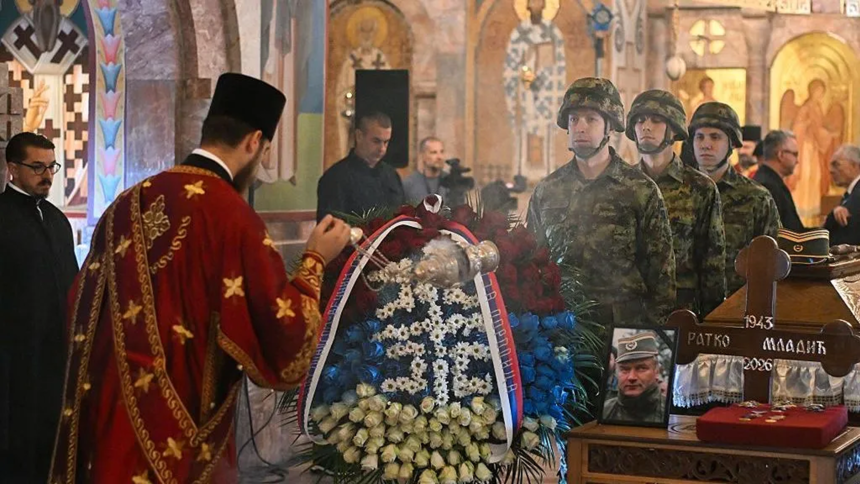
Thousands of people gathered in Belgrade today to pay their final respects to Ratko Mladić a man convicted of genocide, war crimes and crimes against humanity.
They came carrying Serbian flags. Some carried his portrait. Others wore symbols connected to the wars of the 1990s. Some applauded as his coffin arrived. Many came from different parts of Serbia and Republika Srpska to honor a man who spent his final years in prison after being sentenced to life imprisonment by The Hague tribunal.
And that is perhaps the most disturbing part of today’s spectacle.
Thousands of people did not gather to remember the victims. They gathered to honor the man convicted for the crimes.
Ratko Mladić was not an ordinary soldier. He was the commander of the Bosnian Serb Army and was convicted for his role in the Srebrenica genocide, the siege of Sarajevo and a campaign of crimes against civilians.
Yet in Belgrade today, he was presented by many as a hero.
His coffin was surrounded by military personnel. Serbian officials attended. Patriarch Porfirije led the religious ceremony. Military honors were given, while crowds applauded and chanted Mladić’s name.
Think about that.
A man convicted of genocide dies in prison — and thousands turn out to celebrate him.
Meanwhile, the families of those killed in Srebrenica still live with empty chairs at their dinner tables.
The families of Sarajevo’s victims still carry photographs of children who never grew up.
The survivors still remember.
And today, they were forced to watch the man responsible for their suffering being transformed into a national symbol.
This is not simply about how one family chooses to bury its dead.
This is about what thousands of people choose to celebrate.
It is about a society in which a convicted war criminal can become an object of admiration, where his portrait can be carried through the streets, where crowds can applaud his coffin, and where political and religious figures can stand beside him.
That is how historical revisionism works.
First, the crimes are minimized.
Then the victims disappear from the story.
Then the criminal becomes a “commander,” a “patriot,” a “hero.”
And eventually, thousands come to salute him.
But no crowd can change the verdict.
No flag can erase Srebrenica.
No military uniform can erase the victims.
No religious ceremony can erase the crimes documented and judged in The Hague.
Mladić died. His victims did not get that chance.
Their lives were taken from them.
Their families were left behind.
Their names deserve to be remembered far more than his.
So when you see thousands of people gathered around Mladić’s coffin, remember what they are standing beside — not a legend, not a martyr, not a hero, but a convicted war criminal.
And remember the people who never got to come home.
Srebrenica must not become a footnote.
Sarajevo must not become a footnote.
And the victims must never become a footnote.
Because the greatest danger is not that Ratko Mladić died.
It is that thousands are still willing to celebrate what he represented.