A renewed debate is unfolding within the European Union over whether to abandon unanimity in foreign policy decision-making in favor of qualified majority voting—a shift that could fundamentally reshape how the bloc responds to global crises.
The discussion was reignited by German Foreign Minister Johann Wadephul, who argued that the EU must act more decisively amid rising geopolitical tensions involving powers such as Russia, China, and the United States. His proposal reflects a long-standing concern: unanimity allows a single member state to block decisions supported by the rest, potentially paralyzing the EU during critical moments.
Countries like Hungary—under Prime Minister Viktor Orbán—have frequently used veto power as leverage, highlighting the structural limitations of the current system. Critics argue that even smaller states, such as Cyprus, can disproportionately influence decisions affecting the entire bloc.
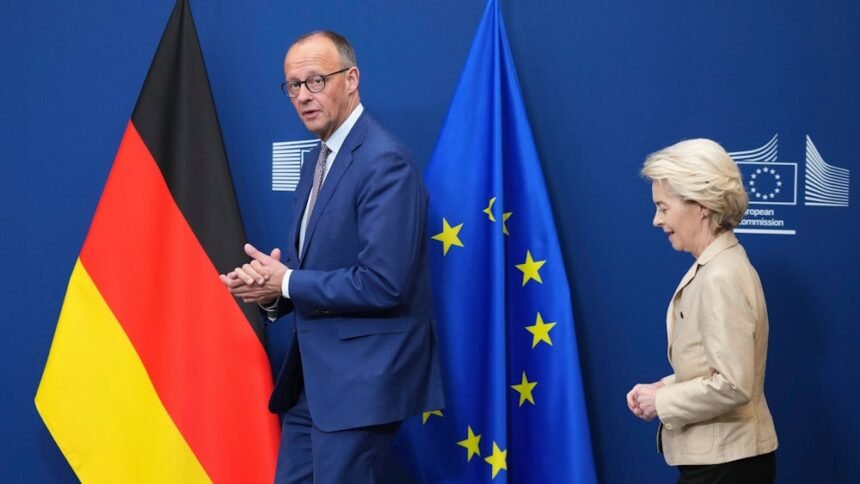
At the center of the debate stands Germany and its chancellor, Friedrich Merz. Berlin is expected to lead efforts toward reform, yet it faces a delicate balancing act. While some leaders, like Poland’s Foreign Minister Radosław Sikorski, have expressed greater concern over German inaction than dominance, others remain wary of concentrating too much power in the hands of larger states.
Smaller EU members—including the Baltic states, Austria, and Slovakia—are cautious about surrendering veto rights, viewing them as essential safeguards against marginalization.
Proponents argue that qualified majority voting would enhance the EU’s ability to act swiftly and cohesively, particularly in areas such as security and foreign policy. However, this would also grant larger states more influence—raising concerns about accountability and balance of power.
Germany’s evolving role is central to this transformation. Its increased support for Ukraine—from limited initial aid to substantial financial and military assistance—signals a shift toward a more assertive foreign policy. Still, questions remain about whether Berlin is ready to consistently exercise leadership and bear the associated costs.
Experts suggest that deeper integration—such as shared debt mechanisms, fiscal coordination, and defense industry consolidation—could help align German leadership with broader EU interests. At the same time, reliance on ad hoc “coalitions of the willing” to bypass vetoes, while effective in the short term, risks undermining EU institutions in the long run.
Ultimately, the debate over veto power reflects a broader question about the EU’s future: whether it can evolve into a more unified geopolitical actor or remain constrained by internal divisions. The answer will shape not only Europe’s global influence but also its internal cohesion in an increasingly uncertain world.